Prof. R.K. Uppal. [PhD, D.Litt.]
……………………………………………………………………………………………………
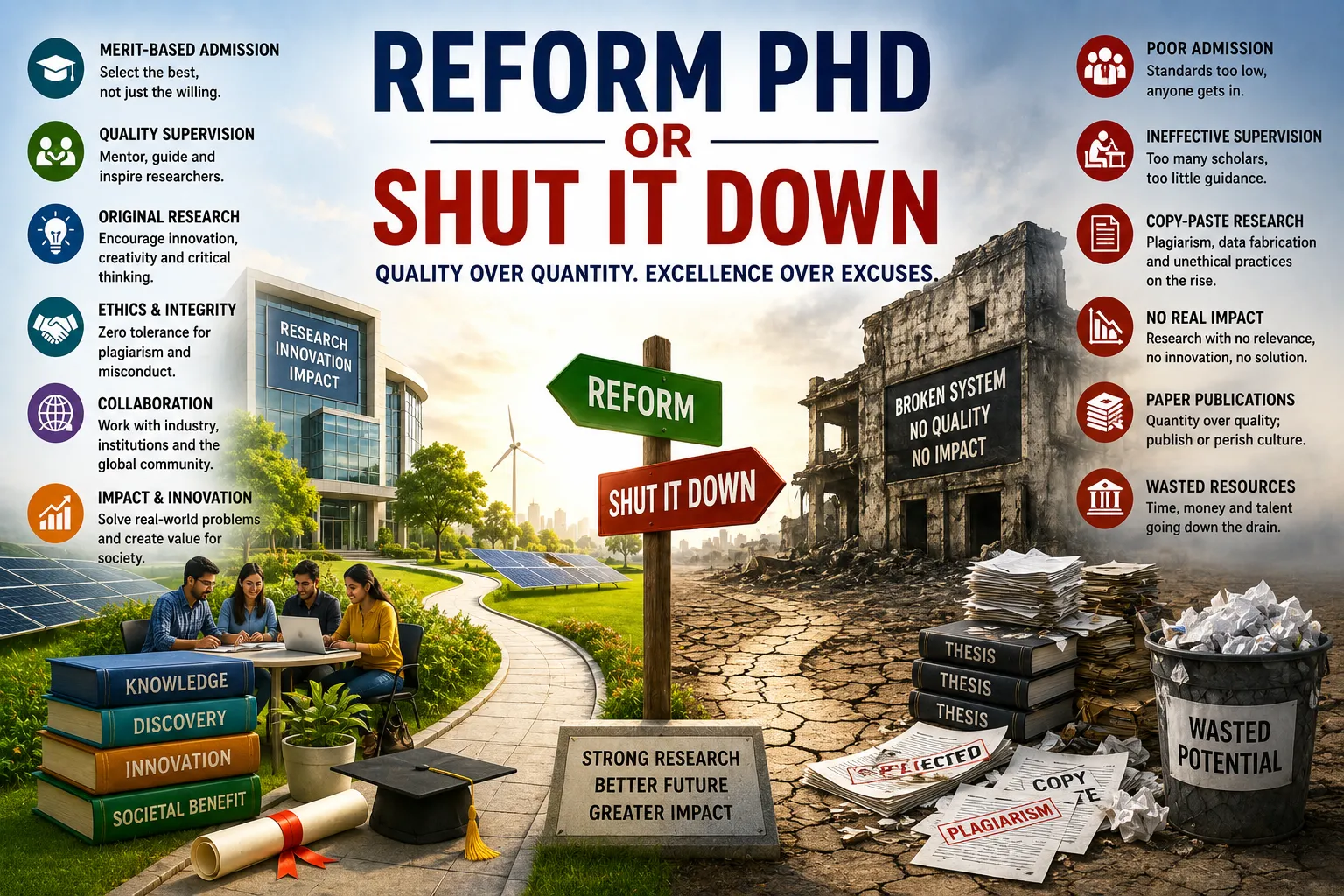
The Doctor of Philosophy (PhD) is widely regarded as the pinnacle of academic achievement. It represents intellectual excellence, independent thinking, rigorous research, and the creation of new knowledge. A PhD is not simply another qualification; it is a commitment to advancing science, society, and human understanding through original research. Universities award doctoral degrees with the expectation that scholars will become innovators, researchers, educators, and policy contributors. However, in many higher education institutions today, this noble objective is steadily losing its meaning. The quality of doctoral education has declined to such an extent that the time has come to ask an uncomfortable but necessary question: Should we reform the PhD system—or shut it down in its present form?
Over the past decade, the expansion of doctoral education has been remarkable. Governments and universities have encouraged greater research participation, and thousands of scholars enroll in PhD programs every year. While expanding access to research is a positive development, many institutions have confused expansion with excellence. Success is increasingly measured by the number of PhD admissions and degrees awarded rather than by the quality, originality, and impact of research. The outcome is predictable: an abundance of doctoral degrees but a shortage of meaningful discoveries.
One of the most serious weaknesses is the admission process. In many universities, candidates enter doctoral programs without demonstrating exceptional research aptitude, analytical ability, or a genuine passion for inquiry. For a growing number of applicants, the PhD has become merely a requirement for faculty recruitment, promotion, or career advancement. When the primary objective is obtaining a credential rather than generating knowledge, the spirit of research is compromised from the very beginning.
Equally concerning is the quality of research supervision. A PhD scholar depends heavily on the guidance of an experienced supervisor who can provide intellectual direction, methodological expertise, ethical guidance, and constructive criticism. Unfortunately, many supervisors are responsible for an excessive number of scholars, leaving little time for meaningful mentoring. In some cases, meetings are infrequent, feedback is superficial, and supervision becomes a routine administrative responsibility rather than an academic partnership. Weak supervision inevitably results in weak research.
The growing obsession with publication has further weakened doctoral education. Instead of encouraging groundbreaking research, many institutions reward publication numbers. This "publish or perish" culture has created an ecosystem where predatory journals, plagiarism, duplicate publications, fabricated data, manipulated citations, and paper mills continue to flourish. Academic integrity has become one of the greatest casualties of this race for numerical performance. A doctoral degree built on unethical practices has no academic value, regardless of how many publications accompany it.
Another major concern is the limited impact of doctoral research. Every year, universities produce thousands of dissertations that remain unread after submission. They occupy shelves in university libraries or digital repositories without influencing public policy, industry, innovation, or community development. Research that solves no problem, inspires no innovation, and contributes nothing beyond fulfilling degree requirements cannot justify the enormous investment of time, money, and institutional resources.
The evaluation process also deserves careful scrutiny. In several institutions, thesis examination has become excessively procedural rather than intellectually rigorous. External examiners may not always possess the required expertise, and viva voce examinations sometimes become formalities rather than comprehensive assessments of scholarly competence. A doctoral degree should be awarded only after independent experts are fully satisfied that the research demonstrates originality, methodological soundness, and a significant contribution to knowledge.
The rapid emergence of artificial intelligence, big data, advanced analytics, biotechnology, and digital research tools has transformed the global research landscape. Yet many doctoral programs continue to follow outdated curricula, obsolete methodologies, and traditional evaluation systems. Universities must modernize their doctoral education by integrating interdisciplinary research, emerging technologies, advanced research methods, and global collaborations while ensuring that academic integrity remains non-negotiable.
The problem does not lie with the PhD degree itself. The problem lies in weak governance, inadequate accountability, declining research ethics, insufficient funding, poor infrastructure, and ineffective quality assurance mechanisms. Many universities lack modern laboratories, research databases, software, financial support, and international research exposure. Without adequate resources, expecting globally competitive research is unrealistic.
Meaningful reform must begin with stricter admissions. Only candidates with demonstrated research aptitude, critical thinking ability, and academic commitment should be admitted to doctoral programs. Universities should introduce transparent selection procedures that emphasize research potential rather than merely academic qualifications.
Research supervision must also be transformed. Supervisors should be evaluated not by the number of scholars they supervise but by the quality and impact of the research they guide. Limits should be placed on the number of doctoral candidates assigned to each supervisor to ensure adequate mentoring. Regular training in research ethics, supervision practices, and emerging research methodologies should become mandatory.
Universities should redefine success in doctoral education. Instead of celebrating the number of PhDs awarded annually, institutions should evaluate programs based on research quality, citations, patents, innovations, policy contributions, technology transfer, startup creation, industrial collaborations, international partnerships, and measurable societal impact. A single high-quality dissertation that transforms an industry or influences national policy is far more valuable than hundreds of dissertations that remain forgotten.
Governments and regulatory agencies must also strengthen quality assurance. Regular audits of doctoral programs, strict action against plagiarism and research misconduct, transparent thesis evaluation, and performance-based funding can significantly improve standards. Institutions repeatedly producing poor-quality research should face academic consequences, while universities demonstrating excellence should receive greater autonomy and financial support.
Finally, doctoral education must reconnect with society. Research should address the pressing challenges of our time—artificial intelligence, climate change, healthcare, rural development, sustainable agriculture, energy security, digital governance, economic inequality, and entrepreneurship. Universities must encourage doctoral scholars to work with industry, government agencies, startups, and local communities so that research moves beyond libraries and becomes an engine of national development.
The title of this article is intentionally provocative, but the message is constructive. The objective is not to abolish the PhD but to rescue it. If universities continue producing doctorates without ensuring originality, integrity, and impact, the value of the degree will continue to decline in the eyes of employers, policymakers, researchers, and society. Restoring credibility requires courage, accountability, and an uncompromising commitment to excellence. The future of higher education depends on the credibility of its highest academic qualification. Universities must stop treating the PhD as a numbers game and restore it as a symbol of intellectual leadership and innovation. If institutions are unwilling to uphold rigorous academic standards, then continuing the present system serves neither scholarship nor society. The choice is clear: reform the PhD system decisively—or shut down the broken system that has replaced it.