Students on the Streets, Silence in Power:
NEET Paper Leak Crisis
Prof. R.K. Uppal. [PhD, D.Litt.]
……………………………………………………..
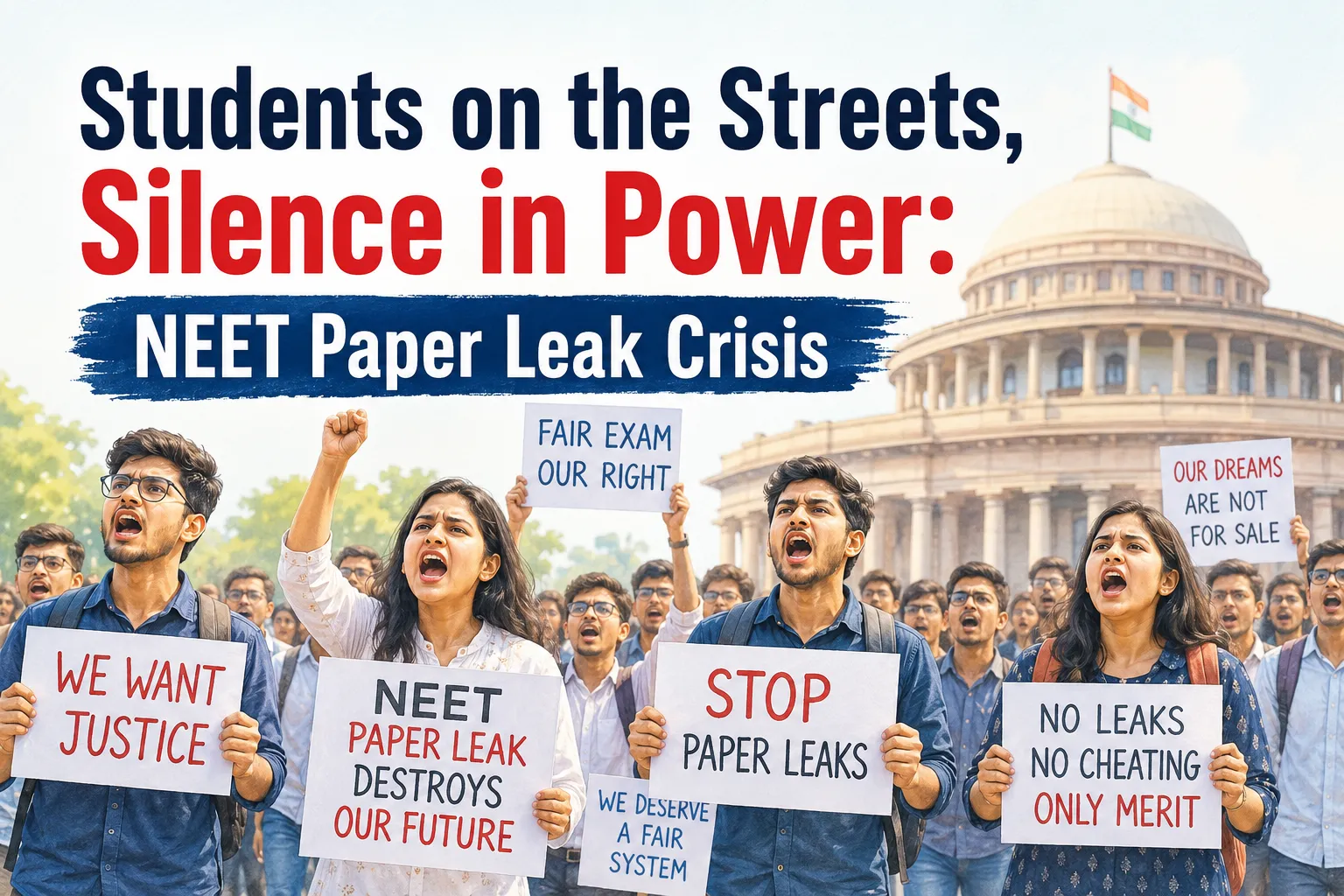
The NEET (National Eligibility cum Entrance Test) is one of India's most prestigious and competitive examinations, serving as the gateway to medical education for millions of aspiring doctors. Every year, students dedicate months and often years of disciplined preparation, sacrificing leisure, financial comfort, and emotional well-being to compete fairly. However, repeated allegations of paper leaks and examination irregularities have shaken public confidence in the integrity of the examination system. The recent controversy has transformed disappointment into widespread public protests, with students taking to the streets demanding justice, accountability, and comprehensive reforms. The issue is no longer confined to one examination; it has become a national debate about fairness, governance, and the credibility of India's education system.
The biggest casualty of any paper leak is not merely an examination but the trust of honest students. When examination papers are compromised, every deserving candidate begins to question whether merit still matters. A student who spends two or three years preparing sincerely expects the examination to provide an equal opportunity to all competitors. Any unfair advantage gained through illegal means undermines the very purpose of a national competitive examination. Even students who perform exceptionally well find themselves under suspicion, creating unnecessary stress and emotional trauma.
The widespread student protests reflect deep frustration rather than mere dissatisfaction. Across several parts of the country, students and parents have organized peaceful demonstrations demanding transparent investigations and stronger safeguards against future leaks. Their primary demand is simple: protect the sanctity of public examinations and ensure that genuine candidates are not punished because of the actions of a few criminals. The protests represent the voice of an entire generation that wants a system based on merit, fairness, and equal opportunity.
The controversy has also raised serious questions about accountability. Whenever a major examination is compromised, responsibility cannot end with the arrest of a few middlemen. The entire chain of examination security—from paper preparation and printing to transportation, storage, and digital monitoring—must be thoroughly examined. Every institution connected with the examination process should be held to the highest standards of transparency and professionalism. Public confidence can only be restored when investigations are swift, impartial, and comprehensive.
Repeated examination irregularities also have significant psychological consequences. Preparing for NEET is already one of the most stressful experiences for young students. Many families invest substantial financial resources in coaching, study materials, and accommodation. Students often sacrifice social life and endure immense academic pressure. When reports of paper leaks emerge, they experience frustration, helplessness, anxiety, and uncertainty about their future. Such emotional distress affects not only examination performance but also the mental well-being of thousands of young aspirants.
The NEET paper leak controversy has highlighted the urgent need for technological modernization of India's examination system. High-stakes examinations require world-class security protocols. Artificial intelligence-based surveillance, encrypted digital paper transmission, biometric verification, blockchain-supported tracking of confidential documents, secure printing facilities, and real-time monitoring can significantly reduce opportunities for organized examination fraud. Countries conducting national-level competitive examinations increasingly rely on advanced technology to strengthen examination integrity. India, with its vast digital capabilities, should adopt similar best practices.
Legal reforms are equally important. Examination malpractice should attract swift and stringent punishment. Individuals or organized groups involved in paper leaks are not merely committing financial crimes; they are stealing opportunities from deserving students and damaging public confidence in national institutions. Fast-track courts, stronger investigative mechanisms, and exemplary punishment can serve as powerful deterrents against future offences. Equally important is ensuring that innocent students are not subjected to prolonged uncertainty while investigations continue.
The controversy also exposes the growing commercialization surrounding competitive examinations. The rapid expansion of coaching institutes, organized cheating networks, and illegal examination rackets has created an ecosystem where education is sometimes treated as a profitable business rather than a public service. This commercialization threatens the principle of equal opportunity and widens inequality among students from different socio-economic backgrounds. Policymakers must ensure that education remains a pathway to opportunity rather than a marketplace vulnerable to corruption.
Another important lesson emerging from the NEET controversy is the need for continuous institutional reform rather than crisis management. Every examination cycle should be followed by independent audits of security procedures, technological infrastructure, and administrative processes. Lessons learned from each incident should be incorporated into future examination planning. Preventive governance is always more effective than reactive governance.
Constructive dialogue is equally essential. Students who protest peacefully should not be viewed as opponents of the system; rather, they are stakeholders seeking fairness and transparency. Listening to their concerns demonstrates democratic maturity and institutional confidence. Governments, examination authorities, educators, parents, and student representatives should engage in meaningful discussions to identify practical reforms. A responsive education system is one that values both accountability and communication.
India aspires to become a global knowledge economy and a leader in healthcare innovation. Such ambitions require an education system that commands public trust. Medical education, in particular, demands the highest standards of merit because today's students will become tomorrow's doctors responsible for saving lives. If the entrance examination itself loses credibility, the long-term consequences may extend far beyond education, affecting public confidence in professional institutions as well.
The NEET paper leak controversy is therefore much more than an administrative failure. It is a test of India's commitment to fairness, transparency, and meritocracy. Students have demonstrated remarkable resilience by raising their voices through democratic means. Their message is not simply about one examination but about preserving the integrity of the nation's educational future. Policymakers must recognize that restoring confidence requires more than investigations—it requires comprehensive reforms, technological modernization, institutional accountability, and continuous dialogue with stakeholders.
Ultimately, every deserving student should enter the examination hall with complete confidence that success will depend solely on knowledge, hard work, and determination. A nation that values merit must protect the credibility of its examinations with unwavering commitment. Only then can India ensure that the dreams of millions of aspiring doctors are shaped by talent and dedication rather than overshadowed by doubt and distrust.
………………………………………………………………………………………………………