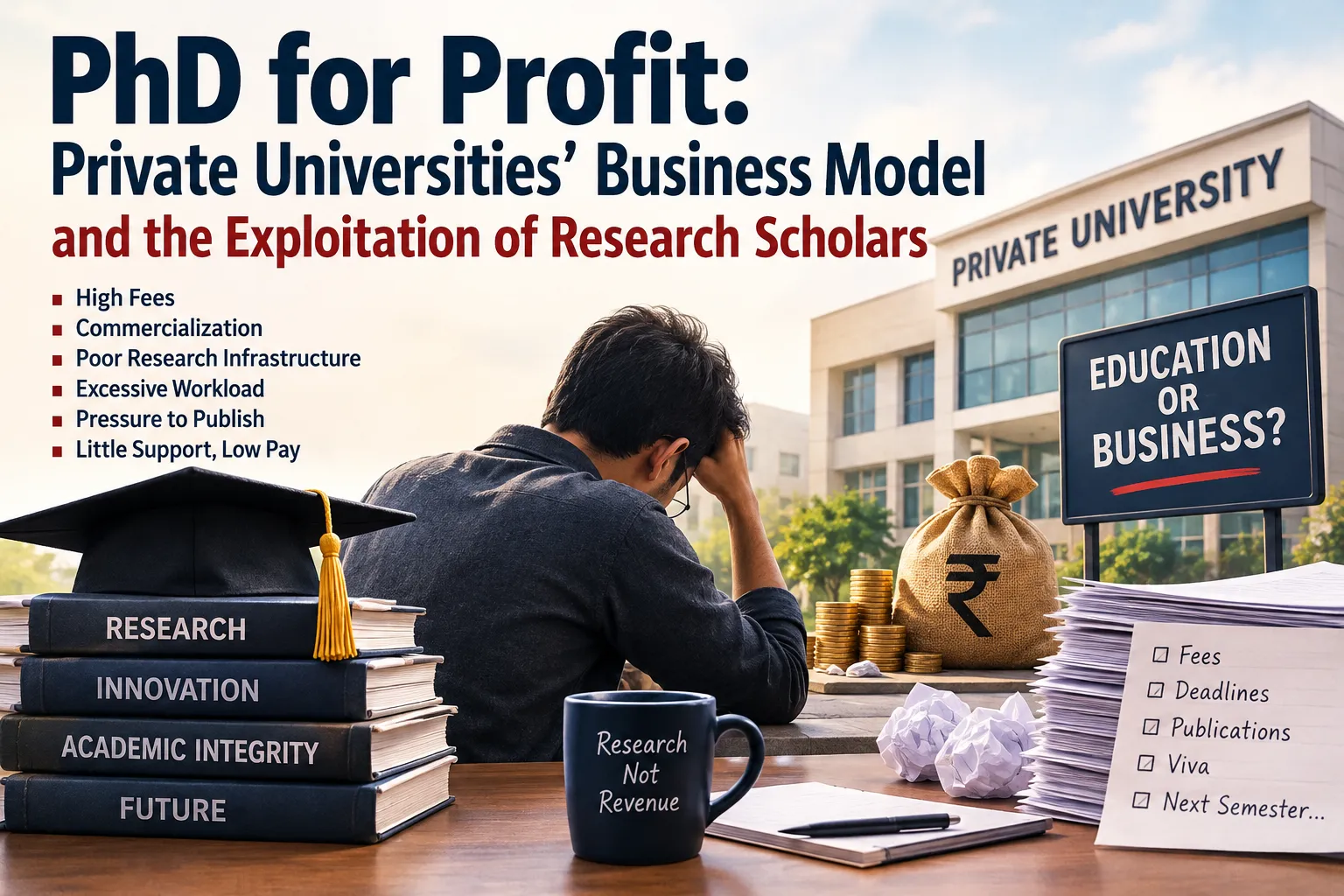
Private Universities’ PhD Business Model -PhD for Profit
Exploitation of Research Scholars
[When Doctoral Education Becomes a Business, Research Scholars Pay the Price]
Regulatory Authorities Must Move Beyond Rules on Paper and Ensure Dignity, Transparency, Fair Treatment and Research Quality.
Prof. R.K. Uppal
A PhD is not merely an academic degree; it represents years of intellectual struggle, original investigation, critical thinking and a commitment to creating new knowledge. Research scholars are essential contributors to scientific progress, technological innovation and social development. Yet, growing concerns about the commercialization of doctoral education in India raise an uncomfortable question: Are some private universities treating PhD programmes as instruments of academic advancement or as profitable business ventures?
Private universities have expanded access to higher education and contributed to research in various disciplines. However, when commercial interests overshadow academic responsibilities, doctoral education risks losing its fundamental purpose. The problem is not private ownership itself, but institutional practices that may prioritise revenue over research quality, academic integrity and the dignity of scholars.
When Research Becomes a Revenue Model
A genuine PhD programme requires qualified supervisors, well-equipped laboratories, access to academic journals, research databases, libraries, fieldwork opportunities and sustained academic mentoring. These facilities demand investment, and universities are justified in charging reasonable fees to support their educational activities. A scholar may invest several years and a substantial amount of money in doctoral education, only to encounter inadequate guidance, limited resources and an unsupportive academic environment. Such experiences can turn the pursuit of knowledge into a frustrating financial and professional burden.
A university cannot claim research excellence merely by producing a large number of PhD graduates. Its real contribution must be measured by the originality, relevance, integrity and impact of the research it supports.
Research Scholars Are Not Customers or Cheap Labour
One of the most serious concerns is the possibility that research scholars are treated primarily as fee-paying customers rather than emerging researchers.
A doctoral scholar is expected to undertake independent investigation, analyses evidence, publish meaningful findings and contribute to the academic community. These responsibilities demand concentration, intellectual freedom, financial stability and professional respect.
Teaching experience can be valuable for doctoral researchers, but it should serve a legitimate academic purpose and be governed by transparent conditions. Scholars must not become inexpensive labour used to compensate for institutional staffing shortages.
The irony is disturbing: institutions may celebrate their research achievements while the individuals conducting the research struggle for financial security, professional recognition and a supportive working environment.
The Exploitation of Academic Aspirations
Many research scholars enter doctoral programmes with dreams of becoming professors, scientists, innovators and independent researchers. They invest years of their lives in specialized study, often sacrificing employment opportunities and financial stability.
The situation becomes particularly concerning when scholars hesitate to raise complaints because they fear delayed research approvals, strained supervisory relationships or damage to their future careers.
No researcher should have to choose between protecting personal dignity and completing a doctoral degree. Universities must establish confidential grievance mechanisms and ensure that scholars who report genuine misconduct are protected against retaliation.
Supervisors Must Be Accountable
The supervisor–scholar relationship is central to doctoral education. A good supervisor encourages independent thinking, provides constructive criticism and helps researchers develop intellectual confidence.
Unfortunately, where supervisory authority is misused, scholars may encounter unreasonable delays, inadequate guidance, excessive control or demands unrelated to legitimate academic responsibilities. Such practices can damage research quality and create an unhealthy academic culture. A research scholar is an emerging academic professional, not a subordinate whose dignity can be ignored.
Regulatory Authorities Must Act
The University Grants Commission (UGC) and other relevant regulatory and accreditation bodies must ensure that doctoral programmes meet genuine academic standards. Regulation should extend beyond institutional paperwork to examine the actual conditions in which research scholars work. Assessments should consider faculty availability, supervisor workloads, research infrastructure, admission practices, fee transparency, grievance redressal and the quality of research outcomes.
Universities should also disclose essential information about doctoral programmes, including approved research capacity, supervisory availability, programme costs and available research support. Periodic reviews should assess whether institutions are fostering original research rather than merely increasing the number of doctoral enrolments.
The objective should not be to target private universities indiscriminately. Responsible institutions deserve recognition, while institutions failing to meet established standards must be held accountable.
Reform the PhD System Before Trust Erodes
India needs a doctoral education system that rewards originality, encourages interdisciplinary research and protects the people who generate knowledge. This requires transparent admissions, qualified supervisors, realistic workloads, adequate research facilities and stronger institutional accountability. Most importantly, regulatory authorities must listen directly to research scholars. Their experiences can reveal gaps that institutional reports may overlook.
The credibility of India's higher education system depends not on how many PhD degrees universities award, but on how much meaningful knowledge those degrees represent.
Private universities have every right to remain financially sustainable, but commercial sustainability cannot become an excuse for compromising academic standards or exploiting researchers. A PhD programme is an academic responsibility, not simply a source of institutional income. Research scholars are the creators of knowledge, not commodities in an educational marketplace. If doctoral education becomes primarily a business, scholars lose, research suffers and society ultimately pays the price.
The UGC and other regulatory authorities must therefore strengthen monitoring, enforce existing standards and establish effective safeguards for research scholars. The time has come to put academic integrity before commercial gain and research quality before the business of awarding degrees. India's future depends on its researchers. Protecting them is not merely an institutional obligation; it is a national responsibility.