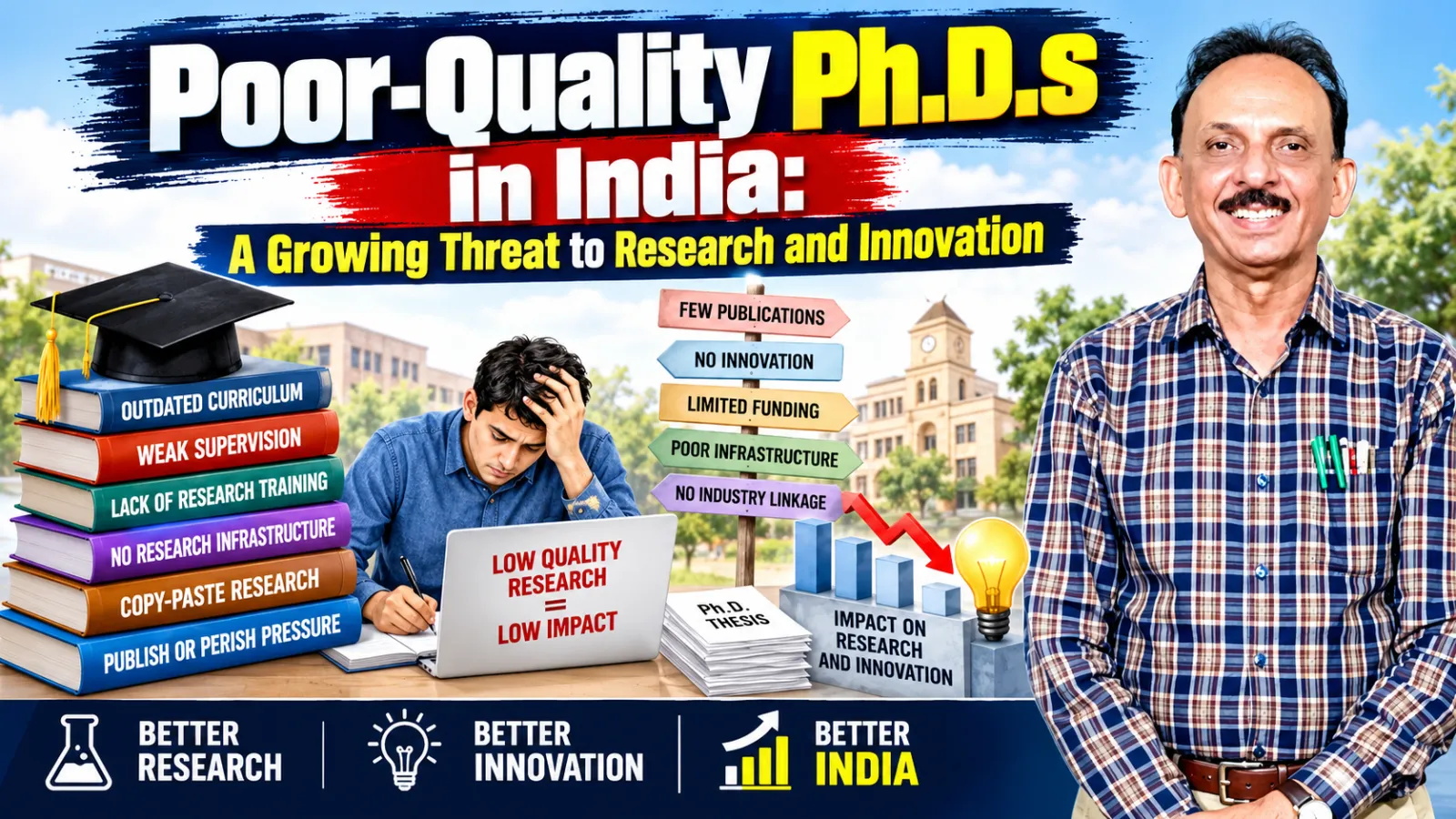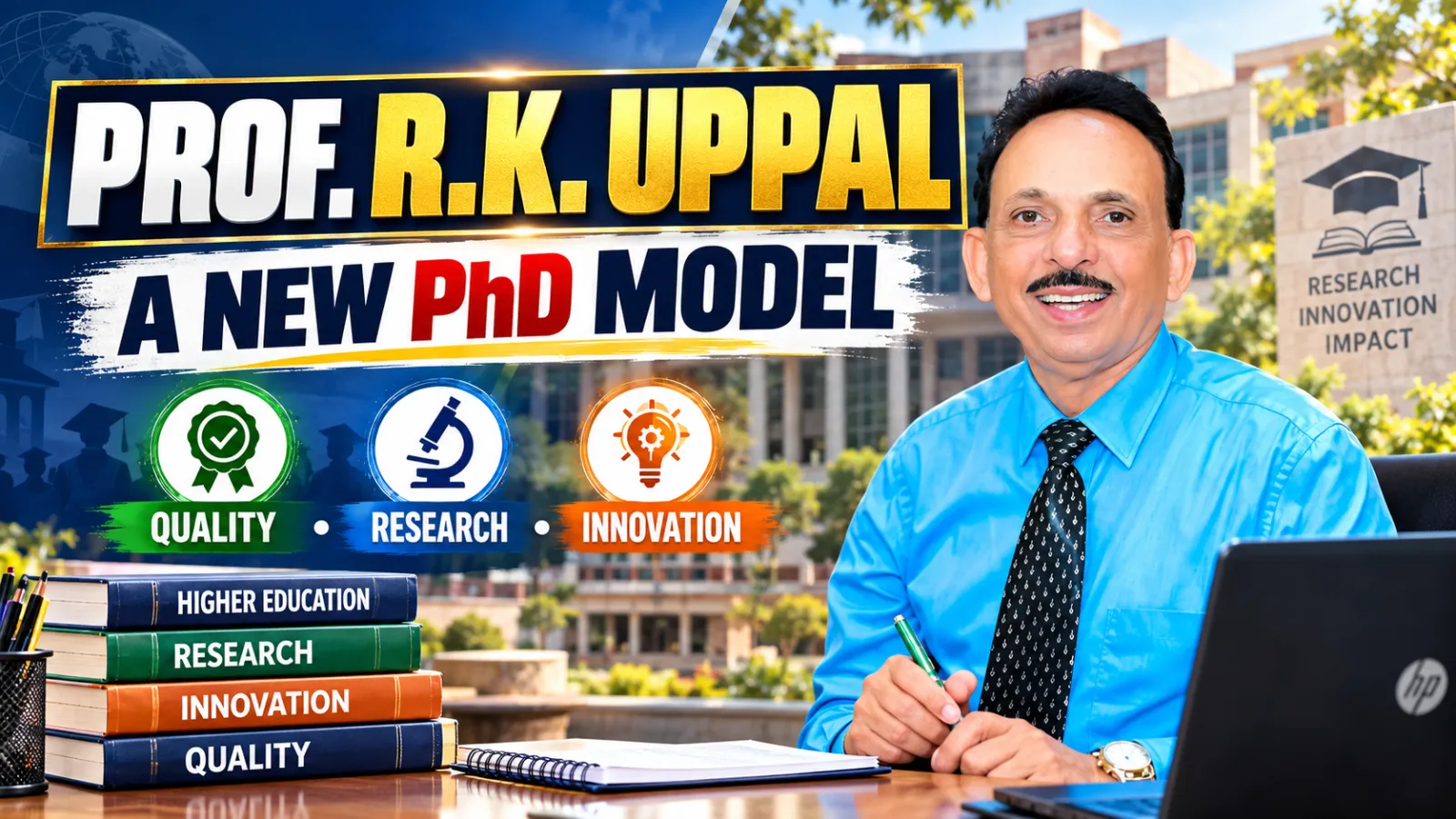
A New PhD Model India’s Next Phase of Higher Education Must Be Quality- Driven, Research-Intensive and Innovation-Oriented
Prof. R.K. Uppal
India stands at a crucial turning point in the development of its higher education system. Over the past few decades, the country has expanded its universities, colleges, research programmes and doctoral enrolments. A PhD has become an important academic qualification for aspiring teachers, researchers and professionals. However, the expansion of doctoral education must now be accompanied by a more fundamental transformation: a shift from producing more PhD holders to developing better researchers, original thinkers and innovators.
The next phase of Indian higher education must be quality-driven, research-intensive and innovation-oriented. At the centre of this transformation should be a new PhD model that places originality, academic integrity, rigorous investigation and societal relevance above the mere completion of a thesis.
From Quantity to Quality
The growth of doctoral programmes is not, by itself, evidence of research excellence. A country may produce a growing number of PhD graduates without achieving a corresponding increase in scientific discoveries, technological advancement or influential scholarship. The real question is not how many doctoral degrees universities award, but what knowledge these degrees contribute.
A doctorate should represent the ability to identify a meaningful research problem, critically evaluate existing knowledge, develop an appropriate methodology and produce original findings. It should demonstrate intellectual independence rather than the ability to reproduce established arguments or satisfy procedural requirements.
Unfortunately, when institutional priorities become excessively focused on enrolment, degree completion and administrative targets, research quality can receive insufficient attention. Universities must resist the temptation to treat doctoral programmes as instruments of expansion alone. Every PhD should be evaluated according to the originality, reliability and significance of the research it represents.
Research Must Become the Heart of Universities
One of the major challenges facing Indian higher education is the need to strengthen the research culture within universities. Institutions should not function merely as centres for classroom teaching, examinations and degree distribution. They must also become places where questions are investigated, evidence is challenged, knowledge is created and new solutions are developed.
Reforming PhD Supervision
The relationship between a research scholar and a supervisor is central to the quality of doctoral education. A good supervisor acts as a mentor, critic, guide and academic role model. The supervisor's responsibility extends beyond monitoring deadlines or approving chapters; it includes helping scholars develop independent judgement, methodological competence and professional confidence.
However, ineffective supervision, excessive control, inadequate feedback and unreasonable expectations can undermine the research process. A scholar should never be treated merely as an assistant responsible for fulfilling a supervisor's personal or institutional demands.
Ending the Commercialization of Doctoral Education
The role of private universities in expanding access to higher education is significant. Nevertheless, all institutions, public and private, must ensure that commercial considerations do not undermine academic standards.
Doctoral programmes require sustained investment in qualified faculty, research facilities, scholarly resources and rigorous assessment. If an institution prioritizes fee revenue or enrolment growth over these essential requirements, the credibility of its doctoral degrees may be weakened.
The solution is not to condemn every private institution, but to establish consistent and enforceable quality standards across the higher education system. Universities should demonstrate that they possess the faculty expertise, infrastructure, supervision capacity and research environment necessary to support their doctoral scholars.
Independent evaluation, transparent reporting and credible external examination can help identify weaknesses and encourage improvement. Institutions that offer PhD programmes must be accountable for the academic standards they promise to maintain.
Innovation Must Go Beyond Publications
Publications are an important part of academic research, but publication counts alone cannot measure research excellence. A large number of papers does not necessarily indicate originality, methodological strength or practical impact.
India needs a research evaluation system that recognizes the quality of scholarship rather than rewarding quantity without sufficient scrutiny. Research should be assessed through the strength of its evidence, the significance of its contribution, the reliability of its methods and its influence on subsequent scholarship or practice.
Protecting the Dignity and Future of Research Scholars
A strong research system depends on the people who sustain it. Doctoral scholars invest years in developing specialized knowledge and conducting investigations that may benefit society long after their degrees are completed. Their work deserves appropriate recognition, financial support and professional respect.
Where doctoral scholars depend on fellowships, timely disbursement of financial assistance is essential. Institutions should provide transparent rules regarding funding, workloads, authorship, intellectual property and access to research facilities.
A New Vision for Indian Higher Education
The future of India's higher education system depends on whether it can move beyond the narrow measurement of success through enrolment, examination results and degree numbers. A genuinely research-oriented university must cultivate curiosity, reward integrity, tolerate constructive disagreement and encourage the pursuit of difficult questions.
The new PhD model should therefore rest on five principles: rigorous admission and research planning, responsible supervision, adequate infrastructure and funding, transparent and independent assessment, and measurable contributions to knowledge and society.
The ultimate objective of doctoral education must be to produce researchers capable of asking important questions, challenging established ideas and creating reliable new knowledge. A PhD should signify not merely the completion of an academic requirement but the achievement of genuine scholarly competence.
India's next phase of higher education must be defined not by how many PhDs it produces, but by the quality of the researchers it develops, the knowledge they create and the problems they help solve. A new PhD model is therefore not simply an academic reform; it is an essential investment in India's scientific, intellectual, economic and social future.