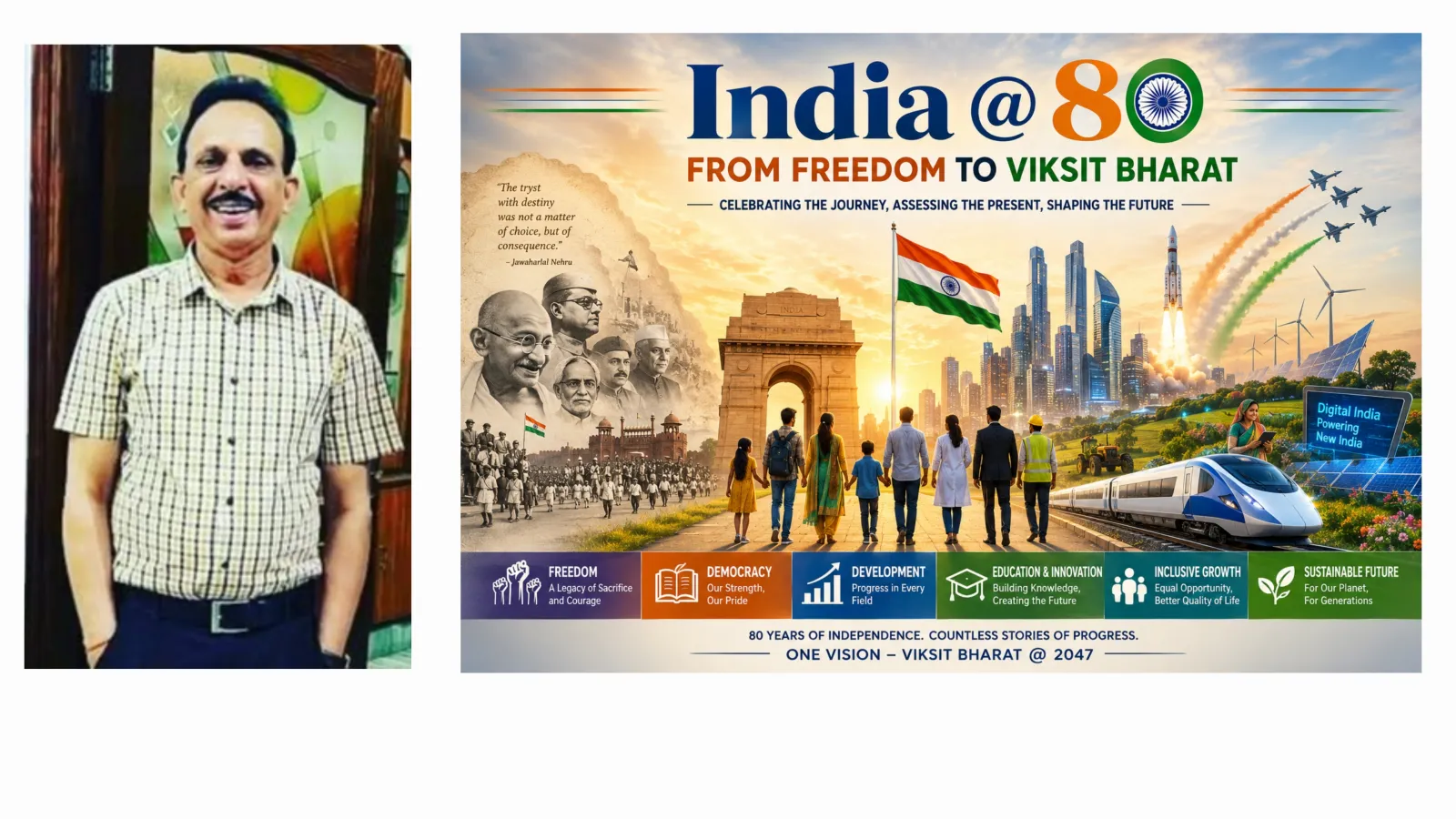
India @ 80: From Freedom to Viksit Bharat Celebrating the Journey, Assessing the Present, Shaping the Future
Prof. R.K. Uppal
On 15 August 2026, India celebrates its 80th Independence Day—a historic milestone that provides an opportunity not merely to remember the sacrifices of the freedom fighters, but also to examine how far the nation has travelled since 1947 and where it must go next. Eight decades of independence have transformed India from a newly liberated, economically fragile nation into one of the world's major economies and an increasingly influential global power. Yet the journey from freedom to Viksit Bharat is far from complete.
India's independence was born out of extraordinary sacrifice. The freedom movement represented much more than the struggle to remove colonial rule. It was a struggle for dignity, justice, self-government and the right of Indians to determine their own destiny. The leaders of the freedom movement inherited a country burdened by poverty, illiteracy, inadequate infrastructure, weak industrialization and deep social inequalities. Building a modern nation from such circumstances was an enormous challenge.
The India of 1947 and the India of 2026 are dramatically different. Over these decades, the country has built institutions of democracy, expanded education, developed industries, strengthened infrastructure and achieved major advances in science and technology. India's agricultural transformation helped strengthen food security. The expansion of industries created employment and production capacity. The Green Revolution changed India's food economy, while later economic reforms opened new opportunities for private enterprise, investment and global integration.
The information technology revolution further changed India's economic identity. Indian professionals became globally recognized in software, finance, engineering, medicine and management. Digital infrastructure has now reached millions of citizens, transforming the way people access banking, government services, education and commerce. The growth of roads, railways, airports, telecommunications, digital payments and financial inclusion demonstrates that India has acquired capabilities that were difficult to imagine in the early decades after independence.
But economic growth alone cannot define national development. Freedom Must Lead to Opportunity. Political independence is meaningful only when it creates opportunities for citizens to live with dignity. The real test of Viksit Bharat will therefore not simply be the size of India's GDP. It will be the quality of life enjoyed by ordinary citizens.
Education: The Foundation of Viksit Bharat. No nation can become developed without a world-class education system. India's educational expansion has been impressive, but expansion alone is not enough. The country now needs a decisive shift from quantity to quality.
The National Education Policy 2020 provides an important framework for multidisciplinary learning, flexibility, vocational education, research and innovation. The real challenge, however, lies in implementation.
India needs universities that encourage questioning rather than memorization; teachers who inspire rather than merely deliver lectures; and research institutions that solve national and global problems rather than simply increase publication counts. The PhD ecosystem also requires serious attention. India should focus on quality, originality and impact, rather than treating the number of doctoral degrees as a measure of academic success. A PhD should create an independent researcher capable of generating new knowledge, technology, policy solutions or social innovation.
Millions of young Indians aspire to stable and meaningful careers. Yet educated unemployment, underemployment, contractual work and employment insecurity remain important concerns. The country needs an employment strategy that connects education with industry requirements and encourages manufacturing, services, entrepreneurship and emerging technologies. The future workplace will increasingly be shaped by artificial intelligence, automation, robotics and digital platforms. India must prepare its workforce for this transformation rather than react to it after disruption occurs.
Women and Youth Must Be at the Centre. The journey toward Viksit Bharat must be inclusive. Women cannot remain beneficiaries at the margins of development; they must be active participants in economic decision-making, entrepreneurship, science, politics, education and industry.
Similarly, India's youth must not be viewed simply as recipients of government schemes. They should be treated as partners in nation-building. The young Indian should have the confidence to innovate, the freedom to experiment, the skills to compete globally and the responsibility to contribute locally.
The Road to 2047
India @ 80 is not the destination. It is a checkpoint. The next two decades will determine whether India's aspiration to become a developed nation by 2047 becomes a reality. This requires consistency in policy, institutional accountability, educational reform, technological leadership, social harmony and sustainable economic growth.
India must also balance development with environmental responsibility. Climate change, water scarcity, pollution, urbanization and energy security will increasingly influence economic and social stability. Viksit Bharat must therefore be not only prosperous but also sustainable. The country needs strong institutions, transparent governance and a culture of accountability. Development cannot depend entirely on governments. Citizens, businesses, universities, civil society and communities all have important roles to play.
From Freedom to Responsibility
The meaning of independence evolves with time. In 1947, freedom meant liberation from colonial rule. Today, freedom must also mean freedom from poverty, illiteracy, unemployment, inequality, insecurity and lack of opportunity. India @ 80 therefore presents a powerful question: What kind of India do we want to build before 2047? The answer cannot be found only in government programmes or economic statistics. It must be reflected in the lives of ordinary citizens.
A truly Viksit Bharat will be an India where a child receives world-class education regardless of birthplace; where young people find productive and dignified employment; where farmers benefit from technology and markets; where women participate equally in economic growth; where universities generate globally relevant knowledge; and where innovation becomes part of everyday national culture. The journey from 1947 to 2026 is a story of resilience, transformation and remarkable achievement. But the journey from 2026 to 2047 demands something even greater—vision, urgency, innovation and collective responsibility. At 80, India should celebrate its freedom with pride, but it must also examine its unfinished agenda with honesty.
The first 80 years gave India freedom and built the foundations of a modern nation. The next 20 years must convert those foundations into a truly developed, inclusive and innovative India. India @ 80 is therefore not merely a celebration of the past. It is a call to shape the future. From Freedom to Viksit Bharat—the journey continues.