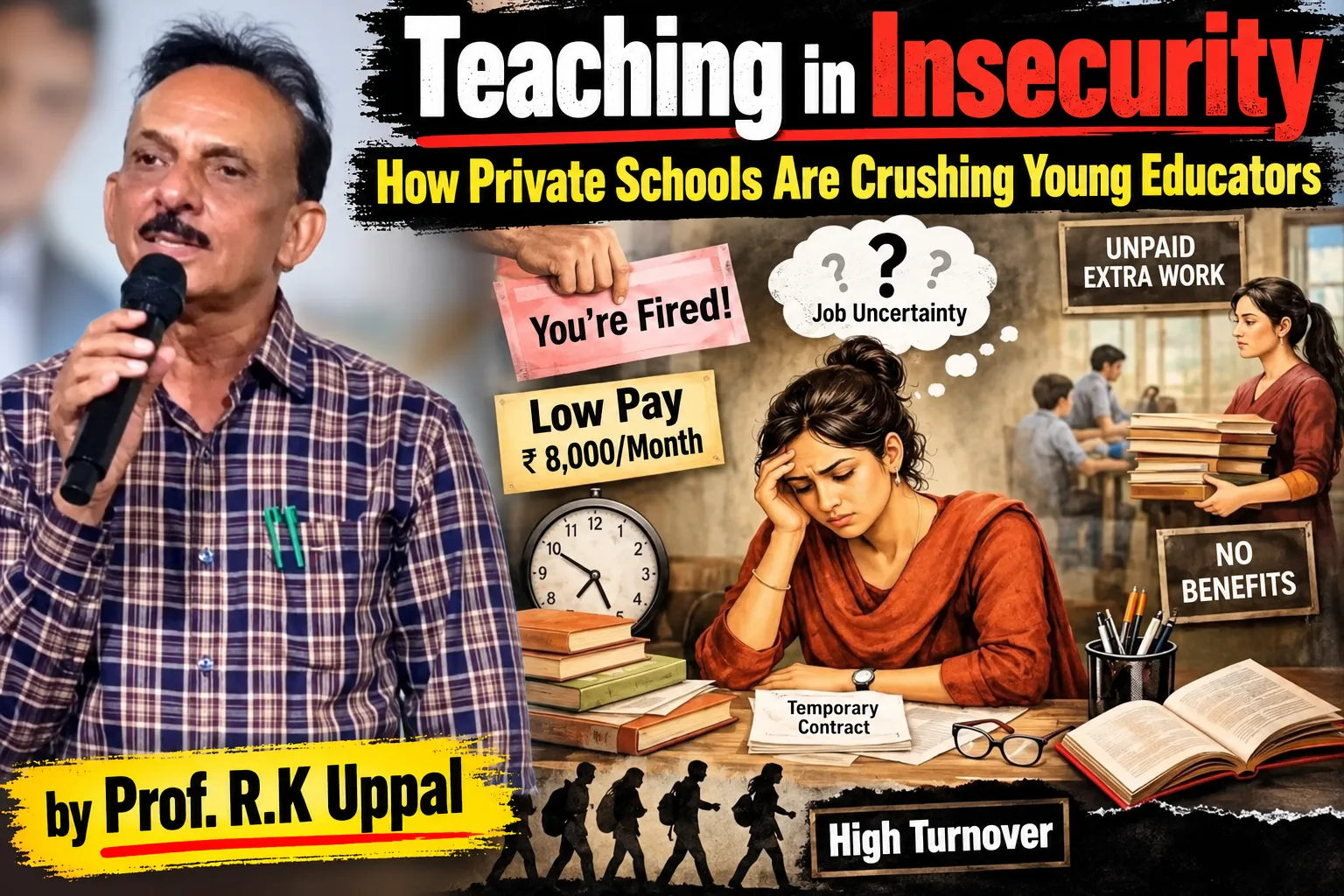
Temporary Teachers, Permanent Money Worries: Hidden Crisis in Higher Education
Prof. R.K. Uppal
India wants world-class universities, globally competitive research and highly skilled graduates. Yet behind the impressive language of educational transformation lies an uncomfortable reality: thousands of teachers in higher education continue to work on temporary, contractual, guest-faculty or ad hoc arrangements, often without the financial security expected of professionals entrusted with educating the next generation.
Temporary teachers, permanent money worries are not merely an employment problem. It is an academic problem, a quality problem and ultimately a national development problem. A teacher who is uncertain about next month's salary cannot be expected to live and work with the same professional security as a permanently appointed academic. When salaries are low, payments are delayed and contracts can disappear with little warning, teaching becomes inseparable from financial anxiety.
The irony is obvious. India repeatedly talks about improving the quality of higher education, but quality cannot be produced by keeping a significant section of its teaching workforce permanently insecure. Low salaries for highly qualified teacher’s Temporary faculty are frequently highly qualified. Many possess postgraduate degrees, NET/SET qualifications, PhDs, research publications and years of classroom experience. Yet their remuneration may bear little relationship to their qualifications or responsibilities.
A teacher may be expected to prepare lectures, conduct examinations, evaluate answer scripts, mentor students, participate in institutional activities and sometimes contribute to research—all while receiving substantially less financial security than a permanent colleague performing comparable academic duties.
This creates a disturbing contradiction: universities demand professional performance while offering professional insecurity. Teaching is not casual labour. It requires preparation, intellectual investment, continuous learning and emotional engagement with students. Treating qualified academics as interchangeable short-term resources risks reducing a profession into a survival exercise.
Delayed salaries deepen the crisis
Low remuneration is damaging enough. Delayed remuneration makes the situation considerably worse. For a teacher with rent, household expenses, children's education, medical bills and other financial commitments, a delayed salary is not an administrative inconvenience. It can become a serious personal crisis.
When payments arrive weeks or months late, teachers are effectively forced to provide credit to the institution. The institution receives teaching services today and pays for them later. That model is difficult to reconcile with the idea of an equitable and dignified academic workplace. Universities and colleges should recognize that timely payment is not a favour. It is a basic employment responsibility.
Job insecurity changes academic behaviour
Job insecurity has consequences beyond the teacher's personal life. A temporary teacher who knows that contract renewal may depend on administrative decisions can become understandably cautious. Academic independence may weaken. Teachers may hesitate to challenge poor practices, raise uncomfortable questions or make suggestions for institutional improvement. The result can be an atmosphere in which survival takes precedence over innovation. A university requires teachers who can think independently, experiment with new teaching methods, conduct meaningful research and engage critically with academic questions. Constant employment uncertainty can discourage precisely these qualities.
Students ultimately pay the price
The most serious consequence is borne by students. Students need teachers who have time and confidence to prepare properly, provide individual guidance, supervise projects, encourage research and remain available beyond the formal classroom.
High faculty turnover can make this difficult.
When temporary teachers leave because they find better opportunities elsewhere, students lose continuity. A new teacher must learn the course, understand the students and rebuild academic relationships. This cycle can weaken mentoring and academic development. Teaching quality cannot be separated from working conditions. If institutions want teachers to demonstrate commitment to students, institutions must also demonstrate commitment to teachers.
The research dimension is equally important
India's ambition to become a knowledge economy depends on research. But research requires time, resources and institutional stability. A temporary teacher struggling with financial uncertainty may have little capacity for long-term research planning. Publishing papers, attending conferences, developing research collaborations and applying for grants require both intellectual energy and financial resources.
Consequently, excessive dependence on temporary academic labour can create a vicious cycle: institutions need research output but provide insufficient conditions for researchers to build sustained academic careers. A university cannot become a research powerhouse merely by counting publications. It needs a stable academic community capable of producing knowledge over many years.
Temporary employment should not become a permanent system
There is a legitimate role for temporary appointments. Institutions may need visiting faculty, specialists, practitioners and teachers for short-term academic requirements. The problem arises when temporary employment becomes the normal operating model.
A position created to meet a short-term requirement should not remain temporary for years while the teacher continues performing essentially permanent academic duties. Where a teaching position is structurally permanent, there should be a transparent pathway toward regular recruitment, subject to applicable rules and qualifications.
Reform must begin with dignity The solution does not necessarily require every temporary teacher to be immediately made permanent. It requires a fairer and more transparent academic employment system.
Institutions should ensure:
salaries are paid on time;
remuneration reflects qualifications and workload;
contractual terms are clearly communicated;
teachers receive appropriate academic and professional support;
long-term temporary positions are periodically reviewed;
recruitment for permanent positions is transparent and timely;
Excessive faculty turnover is treated as a quality concern.
Regulators and governing bodies should also pay greater attention to faculty working conditions when assessing institutional quality.
A teacher worried about whether the next salary will arrive cannot devote the same psychological space to teaching, research and mentoring. India's higher-education transformation therefore requires more than new policies, rankings, buildings and technology. It requires a transformation in how academic labour is valued. Temporary teachers should not be expected to carry permanent educational responsibilities while living with permanent financial uncertainty. The quality of India's universities will ultimately reflect the quality of conditions in which its teachers work. If India wants permanent excellence in higher education, it must stop building that excellence on temporary insecurity.