End Academic Exploitation: PhDs, D.Litt. & D.Sc. Are Not Cheap Labour
Prof. R.K. Uppal
India’s higher-education system cannot claim excellence while highly qualified academics are treated as cheap labour. Faculty members holding PhDs, D.Litt. D.Sc., NET qualifications and years of teaching and research experience are the intellectual backbone of universities. Yet, in many institutions, they face low salaries, excessive workloads, insecure employment, administrative pressure and responsibilities far beyond their academic duties.
A doctoral degree represents years of study, research, sacrifice and specialized knowledge. A D.Litt. or D.Sc. represents an even higher level of scholarly achievement. Such qualifications should command professional respect, fair compensation and meaningful academic freedom—not exploitation.
The problem becomes particularly serious when faculty members are expected to perform multiple roles simultaneously. Teaching, research, student mentoring, examination duties, administrative work, admissions, documentation, accreditation activities, institutional promotions and other responsibilities can become overwhelming. When these expectations are combined with inadequate salaries and employment insecurity, academic work is transformed into an exploitative labour arrangement.
This is not merely an employee welfare issue; it is an academic-quality issue. Poor treatment of faculty inevitably affects students and research. A professor struggling with financial insecurity and excessive workload has less time and energy for innovative teaching, meaningful research, mentoring and collaboration. Institutions may achieve impressive statistics on paper, but genuine academic excellence cannot be built through exhausted and undervalued teachers.
Private higher education has an especially important responsibility in this regard. Private universities and colleges have expanded access to higher education and created employment opportunities, but expansion must not come at the cost of faculty dignity. Education cannot become a business model in which management seeks maximum output from highly qualified academics while minimizing their professional compensation.
There must also be a clear distinction between academic accountability and academic exploitation. Faculty should certainly be evaluated on teaching quality, research, student outcomes and institutional responsibilities. However, accountability should be transparent, reasonable and professionally designed. Continuous surveillance, unrealistic targets, excessive reporting and threats to employment do not create academic excellence. They create fear.
India needs a fair academic employment culture based on dignity, transparency and merit. Faculty salaries should reflect qualifications, experience, workload and responsibilities. Employment contracts should be transparent. Additional responsibilities should receive appropriate recognition or compensation. Research achievements should be valued rather than treated as an unlimited institutional resource.
Universities should also create genuine opportunities for professional growth. Faculty members should have access to research support, conferences, training, sabbaticals, academic collaborations and promotion pathways. A university that invests in its teachers invests directly in its students and its intellectual future.
The issue is particularly important for young PhD holders. After spending years earning doctoral degrees, many enter academia expecting a professional career but encounter temporary contracts, low remuneration and heavy workloads. This discourages talented researchers from remaining in academia and pushes capable scholars toward alternative careers or opportunities abroad.
If India wants to become a knowledge economy and achieve the objectives of Viksit Bharat, it cannot afford to waste its intellectual capital. Laboratories, buildings, technology and artificial intelligence are important, but the most valuable resource of any university remains its people.
A professor is not merely a person occupying a classroom. A professor is a researcher, mentor, knowledge creator, problem solver and intellectual leader. The value of that contribution cannot be measured simply by the number of classes taught or administrative tasks completed.
The solution requires stronger institutional governance and effective enforcement of academic and labour standards. Regulatory bodies and university authorities should ensure that institutions maintain reasonable faculty-student ratios, transparent employment conditions, appropriate remuneration and humane workloads. Accreditation should measure not only infrastructure and documentation but also the actual working conditions of academic staff.
India must move from an extraction model to an investment model in higher education. Instead of asking, “How much work can we obtain from a professor for the lowest possible cost?” institutions should ask, “How can we create conditions in which our professors can produce world-class teaching and research?”
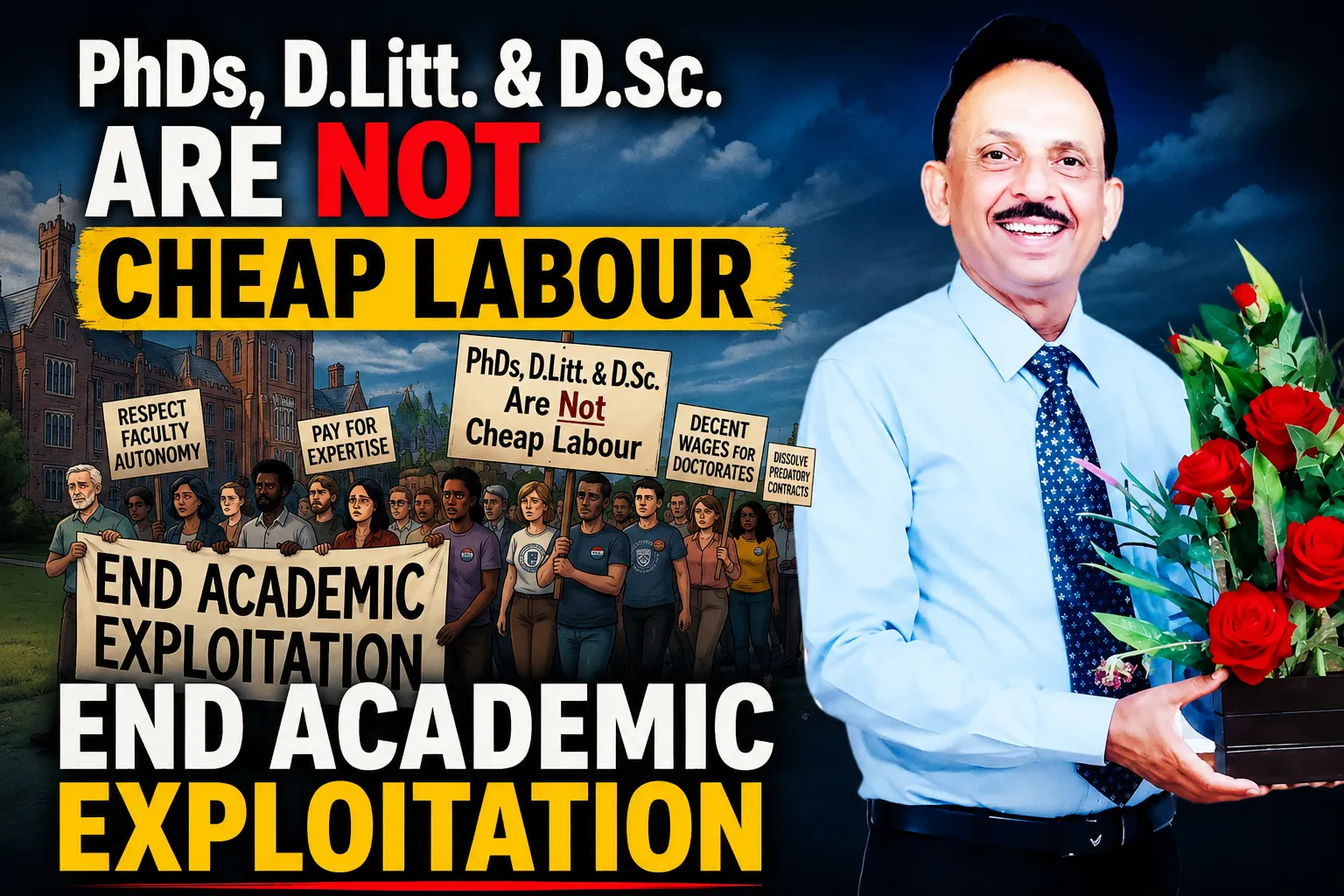
PhDs are not cheap labour. D.Litt. and D.Sc. holders are not cheap labour. Teachers are not admission agents, clerical workers or fundraising machines. They are the intellectual capital of the nation. Academic excellence begins with academic dignity. If India wants world-class universities, it must first create world-class working conditions for the people who make universities possible. End academic exploitation. Respect qualifications. Pay fairly. Protect dignity. Reward excellence. India’s brilliant minds deserve more than survival—they deserve the professional respect and economic security necessary to build the nation’s intellectual future.