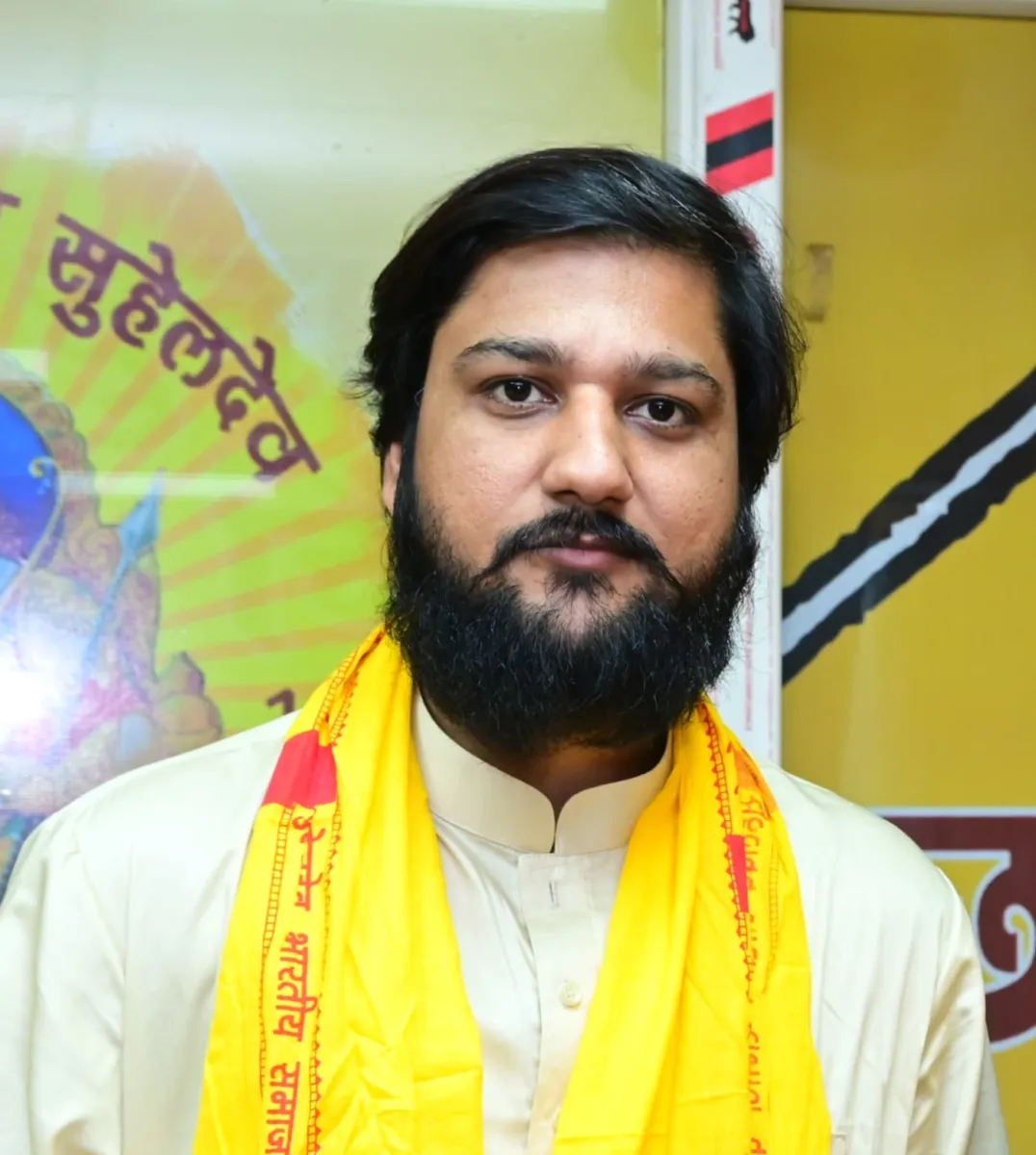
With organisational meetings, district-level appointments and campaigns focused on youth, education and local development, the Suheldev Bharatiya Samaj Party is attempting to establish a broader political presence across Jammu and Kashmir.
Srinagar: The Suheldev Bharatiya Samaj Party is increasing its organisational activity in Jammu and Kashmir as it prepares to participate in future Urban Local Body and Panchayat elections under the leadership of its regional president, Vivek Bali.
The party has recently concentrated on establishing district-level units, appointing local officeholders and attracting young political workers across different parts of the union territory.
In April 2026, Bali held a meeting in Baramulla to discuss the party’s preparations for local elections and announced organisational appointments intended to strengthen SBSP’s presence in the district. Two months later, the party held another organisational programme in Bandipora, where new members joined and Bali publicly stated that SBSP intended to field candidates in forthcoming Urban Local Body and Panchayat elections.
These developments represent a new phase for a political organisation traditionally associated more strongly with Uttar Pradesh than with Jammu and Kashmir.
For Bali, who joined SBSP in 2025 after previously working with the Bharatiya Janata Party and Janata Dal (United), the challenge is to transform a relatively new regional unit into an active grassroots organisation.
Preparing for local political participation
Local elections provide smaller political parties with an opportunity to build a public presence without immediately competing for parliamentary or assembly-level influence.
Panchayat representatives, municipal councillors and local committee members are often the first political point of contact for residents dealing with roads, drainage, electricity, water supply, sanitation and welfare benefits.
SBSP’s decision to concentrate on Urban Local Body and Panchayat elections suggests that the party is seeking to build its organisation from the local level upwards.
During the party’s Bandipora meeting in June 2026, Bali said SBSP was preparing to contest the forthcoming elections and was working to expand its organisational structure across Jammu and Kashmir. The meeting also included the induction of young political workers into the party.
Building a functioning local organisation, however, requires more than appointing officeholders.
The party will need to identify candidates with community-level credibility, establish committees that remain active outside election periods and develop practical positions on the everyday concerns of residents.
For SBSP, performance in local elections could become an early measure of whether its expansion efforts are producing genuine grassroots support.
Youth participation at the centre of expansion
Young people are expected to play an important role in the party’s organisational strategy.
Jammu and Kashmir has a politically aware youth population whose concerns include unemployment, competitive examinations, access to professional education, drug abuse, entrepreneurship and limited private-sector opportunities.
Political parties seeking to attract younger voters must therefore move beyond conventional speeches and provide practical programmes responding to these issues.
Bali has connected SBSP’s regional expansion with youth participation, arguing that young people should be given a greater role in political organisation and local decision-making.
The induction of youth members during district meetings reflects the party’s attempt to create a new cadre rather than relying exclusively on established political figures.
The long-term value of this approach will depend on whether younger members are assigned meaningful responsibilities and allowed to participate in policy discussions, public campaigns and candidate selection.
Campaign against drug abuse
Drug addiction has become an important social concern across Jammu and Kashmir, particularly because of its impact on young people and families.
In June 2026, Bali led an SBSP awareness programme at Dal Lake as part of a campaign against drug abuse. The event was organised in support of the administration’s “Nasha Mukt J&K” initiative and called on young people to move away from drugs and pursue education, work and positive social participation.
Selecting Dal Lake as the venue gave the campaign public visibility and connected its message with one of the best-known locations in the region.
However, awareness programmes alone cannot address the full scale of drug dependency.
An effective response also requires rehabilitation facilities, counselling, early intervention, family support, action against trafficking networks and employment opportunities for vulnerable young people.
Political organisations can contribute by helping affected families access government services, supporting community-based awareness and demanding better rehabilitation infrastructure.
For Bali and SBSP, continued work in this area could provide an opportunity to demonstrate that the campaign is more than a one-time political event.
Demand for greater access to legal education
Higher education has also featured in Bali’s public agenda.
In January 2026, SBSP called for the establishment of National Law Universities in both the Jammu and Kashmir regions. Bali argued that nationally significant educational institutions should be developed across the union territory so that students can access professional opportunities without having to relocate to distant states.
The proposal reflects a wider discussion about the availability of specialised higher education in Jammu and Kashmir.
Professional universities can contribute not only through teaching but also through employment, legal research, public-policy development and institutional investment.
A law university could potentially support research into constitutional law, human rights, conflict resolution, environmental law and regional governance—all subjects with particular relevance to Jammu and Kashmir.
Nevertheless, establishing such institutions requires central and regional government support, funding, land allocation, academic planning and approval from the relevant regulatory bodies.
For the proposal to develop further, SBSP would need to present detailed recommendations addressing possible locations, funding requirements and expected student demand.
Tourism and environmental concerns
Tourism remains one of Jammu and Kashmir’s most important economic sectors, supporting hotels, transport operators, guides, restaurants, artisans and thousands of small businesses.
Bali has raised issues connected with both tourism development and environmental protection.
In February 2026, he visited Hadigam in Kulgam and called for the reopening of the Aharbal tourist destination, raising concerns about the economic consequences for people dependent on tourism-related activity.
During the same month, he demanded that major tourist locations across Jammu and Kashmir be declared free from single-use polythene.
These two positions highlight the need to balance economic activity with environmental conservation.
Tourist destinations must remain accessible enough to support local livelihoods, but unregulated waste, plastic pollution and pressure on natural resources can damage the attractions on which those livelihoods depend.
A practical environmental programme would require waste-collection facilities, alternatives to single-use plastic, enforcement involving vendors and visitors, and cooperation between tourism departments, municipal bodies and local communities.
Rather than depending only on prohibitions, authorities would also need to ensure that affordable alternatives are available to businesses operating in tourist areas.
Engagement with different communities
Building a political organisation across Jammu and Kashmir requires engagement with communities whose social and economic priorities vary considerably.
Before joining SBSP, Bali met representatives of the Gujjar community while serving as a JD(U) officeholder. The meeting reportedly addressed concerns involving water supply, electricity and road connectivity.
His recent political statements have also addressed Kashmiri Pandit rehabilitation, relief assistance, employment, tourism, small vendors and the position of Kashmiris working outside the union territory.
In January 2026, Bali condemned attacks on Kashmiri vendors outside Jammu and Kashmir and argued that communal harmony should not be disrupted for political purposes.
Such issues allow a regional party to demonstrate whether it can speak beyond a single social or geographic constituency.
SBSP may have appointed Bali partly because of his background within the displaced Kashmiri Pandit community, but lasting political expansion will require participation from residents across Jammu, Kashmir and other parts of the union territory.
Employment and rehabilitation of Kashmiri Pandits
Employment remains closely connected to Bali’s position on the rehabilitation of displaced Kashmiri Pandits.
In April 2026, he called for the creation of 20,000 employment opportunities for members of the community, arguing that sustainable employment would be necessary for families considering a return to the Kashmir Valley.
He also demanded an increase in monthly relief assistance, citing the rising costs of food, healthcare, education and housing faced by displaced families.
Employment can form an important part of rehabilitation, but the issue involves wider concerns relating to security, housing, education, community life and access to public services.
A credible rehabilitation programme would need to be developed in consultation with displaced families rather than being designed entirely through political or administrative announcements.
Bali’s proposal will gain greater policy relevance if it is accompanied by details explaining how the employment opportunities would be distributed, which sectors would provide the jobs and how returning families would be supported during relocation.
From public statements to structured policy
Since taking charge of SBSP’s Jammu and Kashmir unit, Bali has raised a wide range of issues.
These include restoration of statehood, employment for displaced Kashmiri Pandits, increased migrant relief, professional education, environmental protection, tourism activity, local elections and youth participation.
The breadth of these issues gives the party several possible areas of public engagement. It also creates a responsibility to move from individual statements toward structured policy documents.
A political party gains credibility when its proposals contain clear objectives, timelines, financial requirements and methods for implementation.
For example, the demand for 20,000 jobs would benefit from a sector-by-sector employment framework. The proposal for National Law Universities would be stronger with an institutional feasibility plan. The campaign against plastic pollution would require an implementation programme involving local businesses and municipal authorities.
Developing such proposals would allow voters and other political organisations to evaluate SBSP’s agenda more seriously.
The challenge of building political credibility
SBSP remains a relatively new political presence in Jammu and Kashmir.
It does not currently possess the organisational reach of the region’s major national and regional parties. Its future relevance will therefore depend on whether it can establish active district committees and demonstrate support during local elections.
Bali’s previous political experience may help him understand party organisation and media engagement, but the success of his current role will be measured through results.
The party must show that newly appointed officeholders remain involved in public work, that membership campaigns produce active workers and that its candidates can build relationships with local communities.
Participation in Urban Local Body and Panchayat elections could provide the first significant test of these efforts.
The road ahead
SBSP’s expanding activity across Baramulla, Bandipora and other districts indicates that the party intends to establish a longer-term presence in Jammu and Kashmir.
Its campaigns concerning youth, drug abuse, education, tourism, environmental protection and displaced communities give it a developing regional agenda.
Vivek Bali now faces the task of connecting these public positions with a reliable political organisation.
The coming local elections could determine whether SBSP remains a small party issuing statements on regional matters or begins developing measurable support at the grassroots level.
For Bali, the next stage will require consistent district-level activity, credible candidates and practical proposals capable of addressing the daily concerns of residents.
Appointments and public meetings may establish an organisation’s presence, but political relevance ultimately depends on public confidence, sustained community participation and results on the ground.