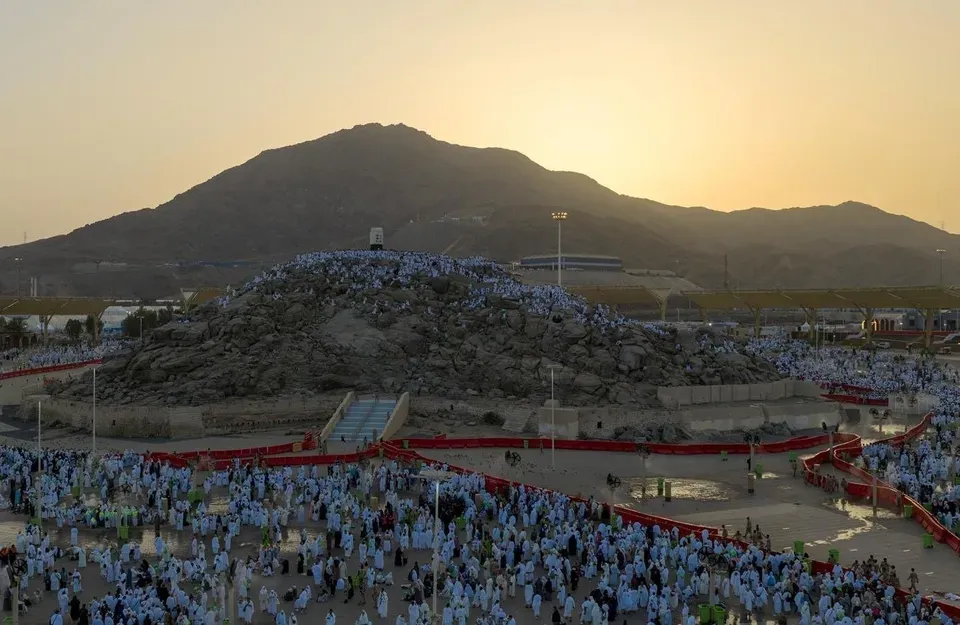
Every year, millions of Muslims from every corner of the world gather in the sacred city of Makkah to perform Hajj, one of the five pillars of Islam. At one level, Hajj is a pilgrimage — a sacred obligation performed through rites established by Prophet Abraham (AS) and restored by Prophet Muhammad (SAWS). But at a deeper level, Hajj is far more than ritual movement, ceremonial devotion, or historical remembrance. It is the annual revival of a message delivered more than fourteen centuries ago on the plains of Arafat, a message that continues to echo across time, civilizations, and generations.
That message was the Last Sermon of Prophet Muhammad (SAWS)
To understand Hajj fully is to understand that the pilgrimage is not merely about circling the Kaaba, walking between Safa and Marwah, or standing in prayer at Arafat. Hajj is the embodiment of the moral, spiritual, and civilizational principles articulated by the Prophet (SAWS) during his farewell pilgrimage in 632 CE — principles of equality, justice, dignity, accountability, human brotherhood, and submission to one God.
The Last Sermon was not delivered inside a palace, parliament, or battlefield. It was delivered in the midst of Hajj, before tens of thousands of pilgrims gathered in the plain of Arafat during the Prophet’s final pilgrimage. In many ways, the setting itself carried profound meaning. Islam’s final universal message to humanity was proclaimed not through worldly power, but through a gathering of believers dressed identically, stripped of all symbols of status and privilege. The origins of Hajj stretch back thousands of years to Prophet Ibrahim (AS) and his son Prophet Ismail (AS) who raised the foundations of the Kaaba as a sanctuary dedicated solely to the worship of one God. The Qur’an records the divine command: “And proclaim to mankind the pilgrimage. They will come to you on foot and on every lean camel from every distant path.” — Surah Al-Hajj (22:27) From the very beginning, Hajj was conceived as universal. It was not intended for one race, tribe, or nation. It was humanity’s invitation to gather around the idea of divine unity and human equality. Yet over centuries, the purity of that Abrahamic message became obscured. Tribalism, pagan rituals, and idol worship entered Arabia. The Kaaba, originally built as the center of monotheism, became surrounded by idols representing competing tribal gods and inherited superstitions. Social divisions deepened. Wealth, lineage, and tribal affiliation became markers of superiority. Human beings were ranked not by character, but by birth and power.
It was into this fractured world that Prophet Muhammad (SAWS) emerged. His mission was not only to restore monotheism but to restore human dignity itself. He challenged tribal arrogance, racial superiority, economic exploitation, and social injustice. When he eventually returned to Makkah after years of persecution and struggle, the idols around the Kaaba were removed, and Hajj was restored to its original spiritual purpose: submission to one God alone. But the restoration of Hajj was not merely theological. It was moral and civilizational. The climax of that restoration came during the Farewell Pilgrimage, the Hajj in which the Prophet (SAWS) delivered what history remembers as the Last Sermon.
Standing before a vast gathering at Arafat, he articulated principles that remain among the most profound declarations of human equality and justice ever spoken. He declared: “No Arab has superiority over a non-Arab, nor a non-Arab over an Arab. Neither a white person over a black person nor a black person over a white person, except through piety and righteousness.” In those few words, the Prophet (SAWS) dismantled centuries of tribal hierarchy, racial arrogance, and inherited privilege. In a world still deeply shaped by racism, nationalism, ethnic conflict, and social fragmentation, those words continue to carry extraordinary relevance. And nowhere is that message more visibly alive than during Hajj itself.
Every pilgrim enters into the state of Ihram wearing simple white garments. The symbols of wealth, rank, nationality, profession, and power disappear. Kings, scholars, labourers, refugees, businessmen, farmers, and ordinary believers all become indistinguishable from one another. Millions move together in synchronized devotion, performing the same rites, reciting the same prayers, sleeping on the same ground, and responding to the same divine call: “LabbaykAllahummaLabbayk” “Here I am, O Allah, here I am.”
This is not symbolism alone. It is the practical demonstration of the Last Sermon. Hajj teaches that before God, human distinctions collapse. No passport grants superiority. No language carries privilege. No race occupies a higher spiritual station. Humanity stands equal in its vulnerability, equal in its dependence upon God, and equal in its ultimate return to Him. The rituals of Hajj themselves mirror the spiritual themes embedded within the Last Sermon. The circling of the Kaaba reminds believers that God must remain the center around which life revolves. The walk between Safa and Marwah commemorates the struggle and perseverance of Hajira (AS) elevating the faith and sacrifice of a woman into a permanent pillar of Islamic worship. The standing at Arafat the emotional and spiritual climax of Hajj resembles the Day of Judgment itself, when all humanity will stand before God, stripped of worldly illusion. The stoning of the pillars at Mina symbolizes resistance against temptation, arrogance, and evil. The sacrifice commemorates the willingness of Prophet Ibrahim to surrender even what was most beloved to him in obedience to God.
Every act within Hajj carries the same essential message repeated throughout the Last Sermon: that faith requires humility, justice, sacrifice, discipline, and moral accountability. The Prophet (SAWS) also warned during his sermon against oppression, exploitation, and the violation of human rights. He spoke about the sanctity of life, property, and honour. He condemned injustice and reminded believers that all humans descend from Adam and Eve. He emphasized the rights of women, the obligations of brotherhood, and the moral responsibility of Muslims toward one another. In essence, the Last Sermon transformed Hajj into far more than a ritual pilgrimage. It became Islam’s annual declaration of human equality and collective moral responsibility. Historically, Hajj also served as a global meeting ground for the Muslim world. Pilgrims carried ideas, scholarship, languages, trade, and cultural experiences across continents. Long before the modern era of globalization, Hajj connected Africa, Asia, the Middle East, and beyond through faith and shared spiritual identity. It cultivated the idea of the Ummah — not as an abstract slogan, but as a lived reality.
Even today, when millions gather in Masjid al-Haram, the world witnesses something increasingly rare in modern civilization: a vast human gathering united not by race, wealth, nationalism, or political ideology, but by a shared spiritual purpose. In an age marked by polarization, consumerism, sectarianism, and growing social alienation, Hajj offers a radically different vision of humanity. It reminds mankind that dignity lies not in power but in righteousness; not in domination but in humility; not in division but in brotherhood. This is why Hajj cannot be understood merely as ritual. It is the living continuation of the Last Sermon.
Every pilgrim walking in Ihram, every voice reciting the Talbiyah, every believer standing at Arafat, and every soul circling the Kaaba becomes part of a timeless message first proclaimed by the Prophet Muhammad (SAWS) during his final pilgrimage a message declaring that humanity is one family under one God. For Muslims, therefore, Hajj is not simply a journey to a sacred place. It is a return to the moral vision articulated in the Last Sermon: a vision of equality over supremacy, justice over oppression, humility over arrogance, and unity over division. And perhaps that is why, after more than fourteen centuries, the message of the Last Sermon continues to live , not merely in books or sermons, but in the movement of millions who gather each year to embody it.
Author is Senior Superintendent of Police.