Reimagining Rath Yatra as a Celebration of Equality, Peace and Spiritual Awakening in the Light of Spiritual Renaissance
"Samgacchadhvam samvadadhvam sam vo manamsi janatam."
"Move together, speak together, and let your minds be united."
This ancient invocation of Ṛg Veda (10.191.2) finds its living embodiment as millions unite to pull the sacred chariots with devotion and shared purpose.
Prologue: When the Lord Comes to the People
In an age captivated by technological acceleration yet haunted by moral fragmentation, loneliness, ecological crises, and spiritual uncertainty, few cultural phenomena possess the civilizational depth and universal resonance of Rath Yatra, the majestic Chariot Festival of Lord Jagannath at Puri, Odisha. More than a religious procession, Rath Yatra is a vibrant expression of the Indian Knowledge System (IKS)—a living confluence of spirituality, philosophy, architecture, ecology, ethics, governance, psychology, craftsmanship, music, and collective consciousness.
Few festivals in the world possess the civilizational grandeur, spiritual profundity, and universal inclusiveness of Rath Yatra, the magnificent Chariot Festival of Lord Jagannath at Puri, Odisha. More than an annual religious celebration, it is a living symphony of devotion, compassion, equality, and spiritual democracy, where the Supreme descends from the sanctum to mingle lovingly with humanity. It is a sacred proclamation that the Divine is not confined within temple walls but walks beside every soul yearning for truth, peace, and liberation.
Within the spiritual understanding of the Brahma Kumaris, this timeless festival also becomes a profound allegory of the soul's return journey from body-consciousness to soul-consciousness. Just as Lord Jagannath emerges from the temple to bless all without discrimination, the Supreme Father, the Incorporeal Shiva, is believed to descend at the confluence age (Sangam Yuga) to awaken humanity through the wisdom of RajYoga, inspiring the transformation of consciousness and the establishment of a value-based world.
The Katha Upanishad (1.3.3) and Paiṅgala Upaniṣad (3) beautifully illumines this symbolism:
Ātmānaṁ Rathinaṁ Viddhi, Śarīraṁ Rathameva Tu.
Buddhiṁ Tu Sārathiṁ Viddhi, Manaḥ Pragraham Eva Ca.
"Know the Self as the master of the chariot, the body as the chariot, the intellect as the charioteer, and the mind as the reins."
"Understand the soul (Atman) as the master of the chariot, and the body as the chariot itself. Know the intellect (buddhi) as the charioteer, and the mind (manas) as the reins."
Jagannath: The Lord of the Universe and the Father of All Souls
The very name Jagannath signifies "Lord of the Universe." Worshipped alongside Lord Balabhadra and Devi Subhadra, Jagannath transcends sectarian identities and radiates the luminous philosophy of universal brotherhood. His annual procession symbolizes that divine love belongs equally to every human being irrespective of caste, creed, language, nationality, gender, or social status.
This resonates deeply with the Brahma Kumaris' foundational teaching that every individual is an eternal, peaceful, and inherently pure soul—the child of the One Supreme Father. The Bhagavad Gita (9.29) proclaims:
Samo 'Haṁ Sarva-Bhūteṣu Na Me Dveṣyo 'Sti Na Priyaḥ;
Ye Bhajanti Tu Māṁ Bhaktyā Mayi Te Teṣu Cāpy Aham
"I am equal to all beings; none is hateful nor specially dear to Me."
Rath Yatra thus becomes a moving manifestation of divine impartiality and universal compassion.
The Chariot as the Symbol of Human Life
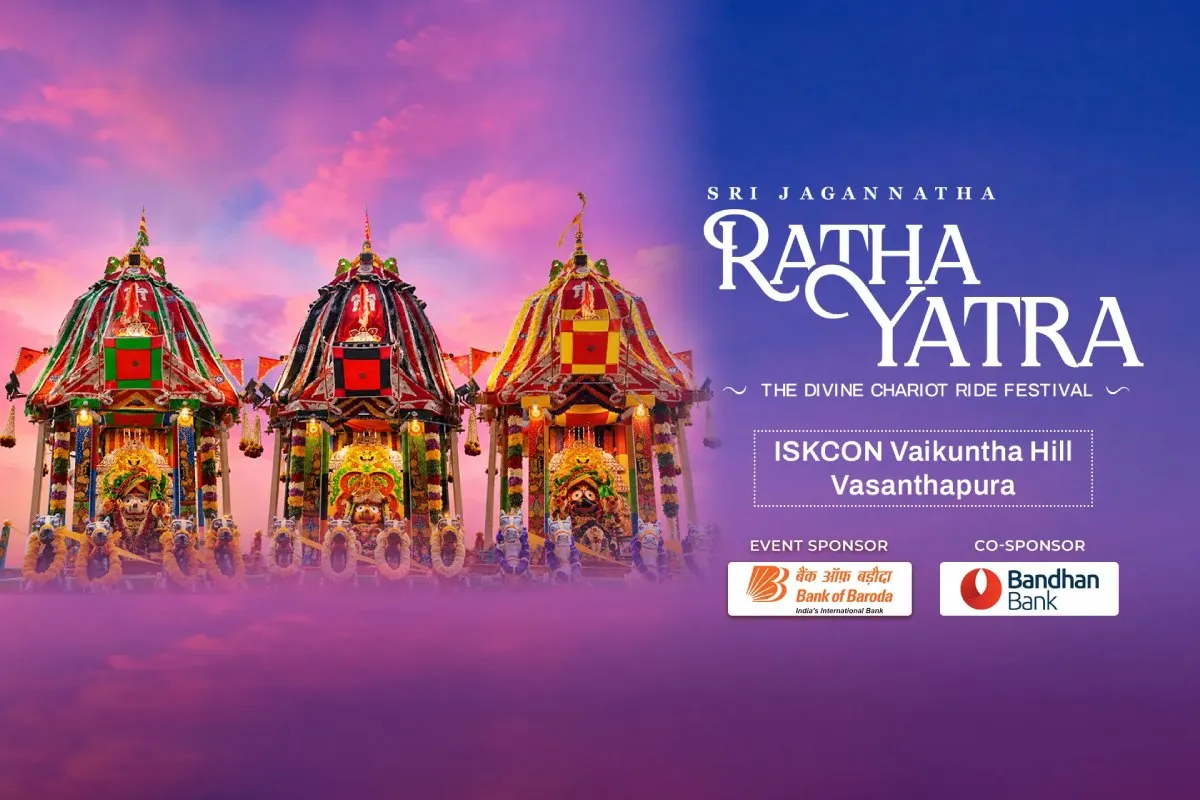
The three majestic chariots—Nandighosha, Taladhwaja, and Darpadalana—are masterpieces of indigenous engineering, rebuilt annually through hereditary craftsmanship without modern metallic fastenings. Yet beyond their architectural magnificence lies an even deeper symbolism.
According to RajYoga philosophy, every human body itself is a living chariot. The soul is the eternal traveller; the intellect is the navigator; thoughts are the reins; and the senses are the horses. When the intellect remains connected with the Supreme through meditation, the journey proceeds toward harmony and liberation. When disconnected, the chariot wanders into sorrow and conflict.
This insight harmonizes perfectly with the wisdom of the Upanishads and the Brahma Kumaris' emphasis on mastering the mind through remembrance (Yoga).
Chhera Pahanra The Golden Broom: Leadership Rooted in Humility
Among the most inspiring moments of Rath Yatra is Chhera Pahanra, where the Gajapati Maharaja ceremonially sweeps the chariots with a golden broom. This act eloquently teaches that genuine greatness blossoms through humility rather than authority. The king becomes the servant before the Lord, reminding humanity that leadership is fundamentally an act of selfless service.
The Bhagavad Gita ( 5.18) declares:
"Vidyā-Vinaya-Sampanne Brāhmaṇe Gavi Hastini; Śuni Caiva Śvapāke Ca Paṇḍitāḥ Sama-Darśinaḥ"
The truly learned, with the eyes of divine knowledge, see with equal vision a Brahmin, a cow, an elephant, a dog, and a dog-eater.
"The truly wise perceive all beings (a Brahmin, a cow, an elephant, a dog, and a dog-eater) with equal vision."
The Brahma Kumaris likewise emphasize that spiritual sovereignty emerges from humility, purity, and egoless service rather than external power.
The Majestic Chariots: Architecture in Motion
The three colossal chariots—Nandighosha of Lord Jagannath, Taladhwaja of Lord Balabhadra, and Darpadalana (Devadalana) of Devi Subhadra—are reconstructed every year using traditional craftsmanship passed down through generations.
These towering wooden structures are not merely engineering marvels; they are moving monuments of India's indigenous knowledge, reflecting mastery in geometry, architecture, carpentry, aesthetics, and sacred design. Every measurement, colour, emblem, and decorative motif carries symbolic significance rooted in centuries of cultural wisdom.
The annual reconstruction itself conveys an enduring lesson: while forms change with time, timeless values remain eternal.
Pulling the Chariot Together: A Lesson in Global Unity
Perhaps no image captures the essence of collective harmony more vividly than millions of devotees joining together to pull the sacred ropes of Lord Jagannath's chariot. People from diverse religions, languages, cultures, and nations participate with equal enthusiasm, illustrating the timeless Indian ideal (Maha Upanishad , 6.71):
"Ayaṃ Nijaḥ Paro Veti Gaṇanā Laghucetasām.; Udāracaritānāṃ Tu Vasudhaiva Kuṭumbakam."
"This is mine, and that is a stranger" is the way of thinking of narrow-minded people. For those with a magnanimous heart, the entire world is one family.”
"The narrow-minded divide humanity into 'mine' and 'others'; the noble regard the entire world as one family."
The Brahma Kumaris envision precisely such a spiritual family, where soul-consciousness dissolves barriers of race, religion, caste, and nationality, replacing competition with cooperation and conflict with compassion.
The Inner Rath Yatra: From Body-Consciousness to Soul-Consciousness
While millions witness the external procession, the deeper invitation is to undertake an inward pilgrimage. Today's world witnesses unprecedented technological advancement but also escalating anxiety, ecological degradation, loneliness, violence, and moral confusion. The real chariot requiring direction is not merely wooden—it is human consciousness.
RajYoga Meditation teaches that by remembering the Supreme Soul, individuals regain their original qualities of peace, love, purity, wisdom, and bliss. This inner transformation naturally influences families, institutions, and nations. The Bhagavad Gita (6.5) inspires this inward ascent:
Uddhared Ātmanātmānaṁ Nātmānam Avasādayet;
Ātmaiva Hy Ātmano Bandhur Ātmaiva Ripur Ātmanaḥ - (Gita, 6.5)
"Let every person uplift oneself through one's own higher consciousness."
The true Rath Yatra therefore unfolds daily whenever thoughts move from negativity toward divinity.
Ecological Wisdom and Sustainable Civilization
The annual reconstruction of the chariots using carefully selected sacred timber reflects India's traditional ecological ethics. Renewal occurs through reverence for nature rather than reckless exploitation. The Atharva Veda, Bhūmi Sūkta' (Kanda 12, Sukta 1, Mantra 12) proclaims:
माता भूमिः पुत्रोऽहं पृथिव्याः। "Mātā bhūmiḥ putro'haṃ pṛthivyāḥ।" (Atharva Veda 12.1.12)
"Earth is my Mother, and I am Her child."
Similarly, the Brahma Kumaris advocate a lifestyle of simplicity, purity, vegetarianism, and environmental stewardship, recognizing that inner purity naturally manifests as ecological responsibility.
Rath Yatra in the Contemporary World
Today, Rath Yatra is celebrated not only in Puri but across London, New York, Johannesburg, Sydney, Singapore, Nairobi, Toronto, and numerous other global cities. These celebrations demonstrate that Jagannath's message transcends geography and belongs to humanity at large.
Its timeless lessons remain profoundly relevant as Leadership through humility. Equality through soul-consciousness. Peace through spiritual awakening. Sustainability through harmony with nature. Unity through universal brotherhood. Service through selfless action. Such values resonate strongly with the Brahma Kumaris' global mission of creating a peaceful, value-based civilization through individual transformation.
Epilogue: The Chariot of a New World
Ultimately, Rath Yatra is not merely the movement of three sacred chariots through the streets of Puri; it is the perpetual movement of humanity toward higher consciousness. Every revolution of the wheels symbolizes progress from ignorance to wisdom, from selfishness to service, from division to unity, and from material attachment to spiritual freedom.
In the light of Brahma Kumaris philosophy, the greatest Rath Yatra is the inward journey of every soul returning to its original state of purity through Rajyoga and divine remembrance. As individuals transform, society transforms; as society transforms, the dream of a peaceful, prosperous, and spiritually awakened world—often envisioned as the Golden Age—draws closer.
The festival therefore invites every individual not merely to pull the Lord's chariot with physical strength but to move the chariot of one's own life with elevated thoughts, noble actions, and Godly remembrance.
May the sacred wheels of Lord Jagannath continue to inspire humanity toward peace, purity, love, righteousness, and universal harmony.
"Sarve Bhavantu Sukhinaḥ, Sarve Santu Nirāmayāḥ;
Sarve Bhadrāṇi Paśyantu, Mā Kaścid Duḥkhabhāgbhavet."
"May all be happy; may all be healthy; may all behold auspiciousness; may none suffer."
As the Brahma Kumaris often affirm: "When the soul connects with the Supreme Soul, the journey of life becomes a divine Rath Yatra—guided by wisdom, propelled by love, and destined for everlasting peace."
(BK Prof. ( Dr.) Jayadeba Sahoo,Faculty, Brahma Kumaris & Professor (Ex-Dean & Head), Faculty of Education, Rajiv Gandhi (Central) University, Itanagar; Cell: 8837245051, 9436042658; Email: jayadeba.sahoo@rgu.ac.in , drjayadeb12@gmail.com )