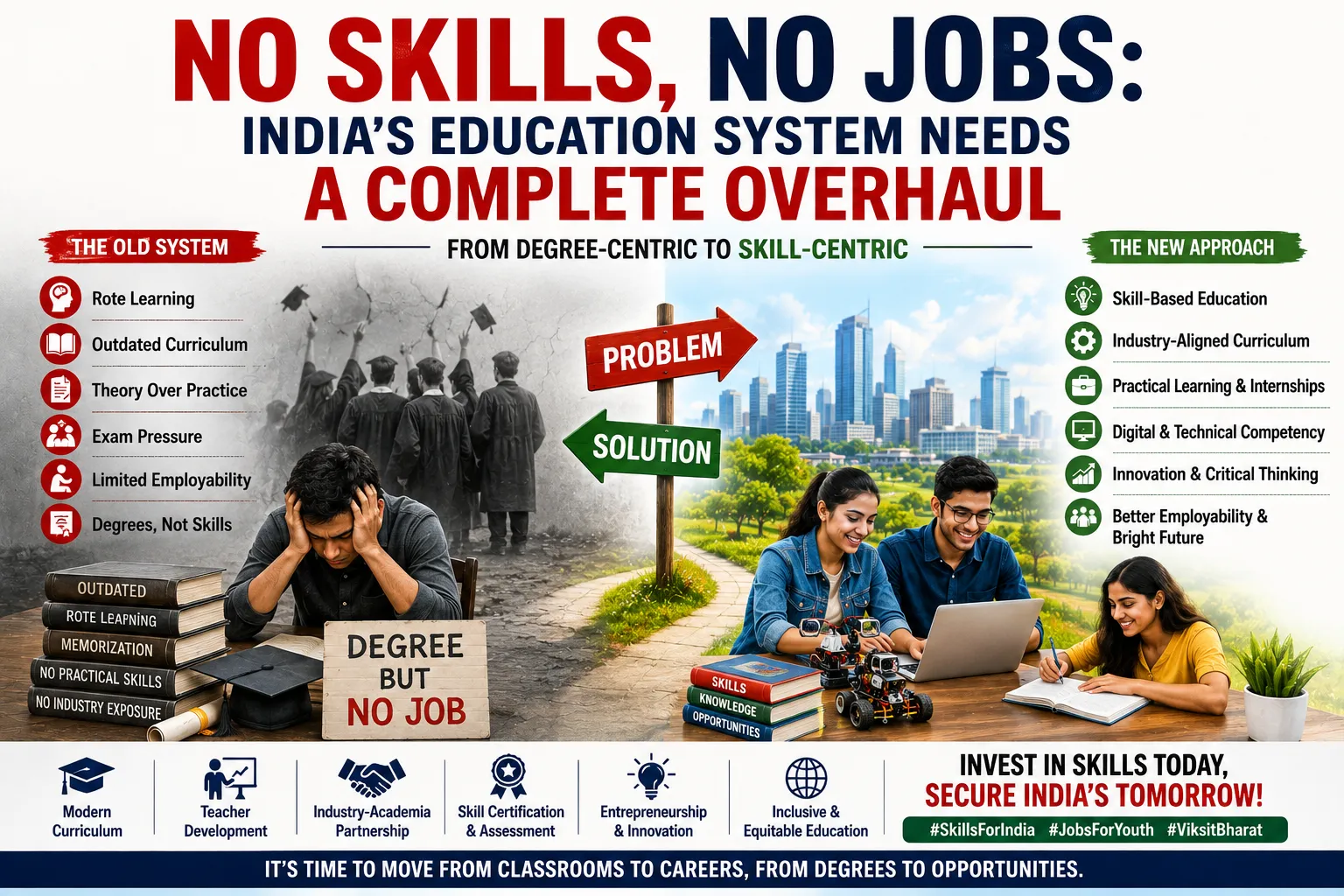
No Skills, No Jobs:
India's Education System Needs a Complete Overhaul
Prof. R.K. Uppal. [PhD, D.Litt.]
…………………………………………………………
India is home to one of the world's largest education systems, with thousands of schools, colleges, universities, and millions of students graduating every year. Yet, despite this enormous educational infrastructure, one troubling reality continues to haunt the nation: a large number of graduates remain unemployed or underemployed. The paradox is striking. While degrees are multiplying, employment opportunities for many graduates are not keeping pace. The problem is not merely the availability of jobs—it is the growing mismatch between what students learn and what employers need.
For decades, India's education system has measured success through examination results, pass percentages, and the number of degrees awarded. Students are encouraged to memorize textbooks, reproduce information in examinations, and secure high marks. However, the modern economy values a very different set of abilities. Employers seek graduates who can think critically, solve problems, communicate effectively, work in teams, adapt to technological change, and apply knowledge to real-world situations. Unfortunately, these competencies often receive far less attention than rote learning and examination performance.
The global economy has undergone a dramatic transformation. Artificial intelligence, automation, robotics, cloud computing, cybersecurity, data analytics, biotechnology, renewable energy, and digital finance are reshaping industries across the world. Jobs that existed a decade ago are disappearing, while entirely new careers are emerging. In such an environment, education systems must evolve continuously to prepare students for the future rather than the past. India cannot aspire to become a global economic and technological leader while relying on outdated teaching methods and obsolete curricula.
One of the biggest weaknesses of the current education system is its excessive dependence on theory. In many institutions, students spend years studying concepts without gaining adequate practical exposure. Laboratories remain underutilized, internships are often treated as formalities, and industry interaction is limited. As a result, graduates leave campuses with academic qualifications but insufficient workplace readiness. Employers then invest significant time and resources in retraining new recruits, while many graduates struggle to find suitable employment because they lack practical competencies.
Equally concerning is the weak connection between academia and industry. Curriculum revisions frequently lag behind technological developments, and many programmes fail to reflect current market demands. Industry leaders, professional bodies, and employers should play a greater role in curriculum design, internships, project evaluation, and faculty development. Strong partnerships between educational institutions and industry would help ensure that students acquire relevant knowledge, practical skills, and professional confidence before graduation.
Skill development should no longer be treated as a supplementary activity. It must become the central objective of education. Every student, regardless of discipline, should graduate with strong communication skills, digital literacy, analytical ability, financial awareness, teamwork, leadership qualities, and problem-solving capabilities. In addition, discipline-specific technical competencies should be reinforced through practical projects, apprenticeships, fieldwork, and industry-based assignments. Education should produce individuals who are capable of creating value from the very first day of employment.
Teachers are the architects of educational transformation. They require continuous professional development to remain current with technological advances, industry practices, and innovative teaching methods. Institutions must invest in faculty training, digital infrastructure, research opportunities, and interdisciplinary learning. An education system cannot produce globally competitive graduates unless its teachers themselves are equipped to meet contemporary academic and professional standards.
Entrepreneurship deserves equal importance alongside employability. Every graduate should not aspire only to seek a job; many should be encouraged and equipped to create jobs. Universities and colleges must establish innovation centers, startup incubation facilities, entrepreneurship development programmes, and mentoring networks. By nurturing entrepreneurial thinking, educational institutions can contribute directly to economic growth, employment generation, and technological innovation.
Another important challenge is ensuring equitable access to quality education. Students from rural areas and economically weaker sections often face significant disadvantages in terms of digital access, laboratories, career counselling, and industry exposure. Bridging these disparities is essential if India wishes to harness the full potential of its demographic dividend. Talent exists in every corner of the country, but opportunity must be made equally accessible.
Educational institutions should also be held accountable for learning outcomes rather than merely enrolment figures or graduation rates. Performance indicators should include graduate employability, innovation, research quality, startup creation, community engagement, and employer satisfaction. Transparent benchmarking will encourage institutions to prioritize excellence rather than expansion alone.
The National Education Policy has introduced several important ideas, including multidisciplinary education, flexibility, skill development, and experiential learning. However, the success of any policy ultimately depends on effective implementation. Genuine transformation requires adequate funding, institutional commitment, teacher preparedness, curriculum modernization, and continuous monitoring. Policy announcements alone cannot solve structural challenges.
India stands at a decisive moment in its development journey. The country possesses one of the world's youngest populations and aspires to become a developed nation in the coming decades. This ambition cannot be achieved if millions of educated young people remain disconnected from meaningful employment. Education must become the bridge between aspiration and opportunity, not a destination that ends with a degree certificate.
The future belongs to nations that invest in human capital. India's greatest resource is not its natural wealth but its young minds. Those minds deserve an education system that nurtures creativity, encourages innovation, builds practical competence, and prepares them to compete confidently in a rapidly changing world.
The degrees alone no longer guarantee success. Skills do. India must move beyond an examination-driven culture and embrace a system that values competence, innovation, adaptability, and lifelong learning. Only then can the country transform its demographic advantage into a productive workforce, accelerate economic growth, reduce unemployment, and realize the vision of a truly Viksit Bharat. Without such a transformation, the nation risks producing millions of graduates with certificates in their hands but uncertainty about their future.