By FAIZAAN BASHIR.
It feels as though we are cursed. Nothing and nobody will lift this curse, not even the unseen forces. It seems to have arrived for a permanent stay, a formidable force, sharp enough to freeze anything in its embrace. Should anyone proclaim it’s going to fade in its intensity any day now, there’s no response but to laugh out loud. Laugh at our helplessness. Uncertainty. And finally, disorder of the worst kind.
I often visit hospitals. They are my second home. They have nurtured me. I remember their walls. I kiss their floor. White coats and injections are holy to me. I can gauge, from the way a person speaks or walks, what emergency they are facing or what’s going on in their mind. I am well-acquainted with every aspect. I know when people are at their best and when they are at their lowest.
I am familiar with everything. Don’t you trust me? Meet me. I will show you a mountain of prescriptions, a heap of test reports, and a mound of medicine wrappers. I will substantiate it with the stories I witnessed. With exhaustion, I felt around me. With unnecessary hardships I have seen people subjected to it. I have witnessed fistfights, verbal abuse, and screams throughout all these years.
I can also tell you the source of their pain. I can also shed light on the unfortunate state of our hospitals, where there’s little to no supervision by those in authority, no way out, only suffering and endless trauma. Bear with me. I am not a liar. I won’t receive a localised Nobel Prize for championing a public cause. Neither do I seek one. What we need is relief. Order, not chaos. What we need is supervision, calculation, analysis, implementation, and a way forward. Followed by supervision again. Not just one-time batting of an eyelid, but constant evaluation.
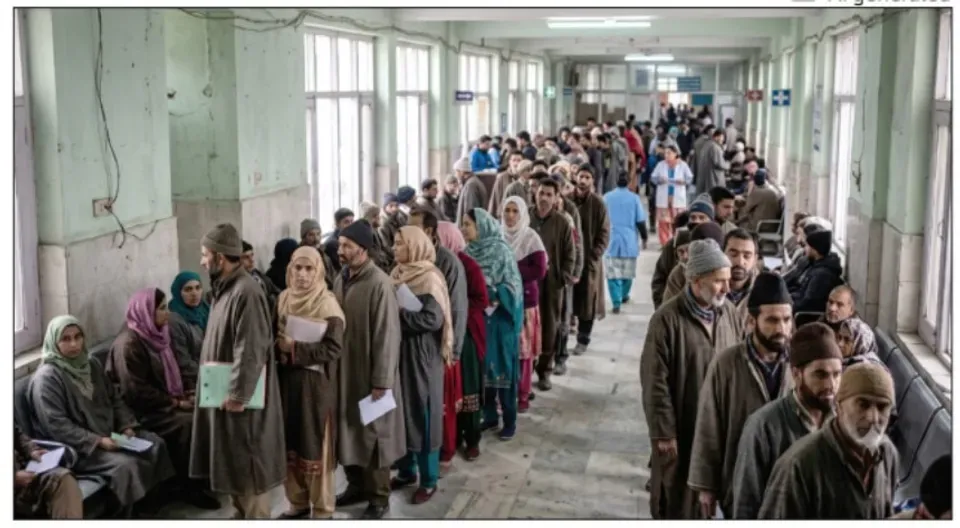
Some patients come to hospitals alone. Some arrive with their attendants. The queue system at SMHS is among the worst in Kashmir. Believe me, if you happen to visit SMHS anywhere between 10 am and 11 am, be prepared to spend nearly two hours waiting in a queue before you’re handed a prescription. The queue resembles a snake with three bends, enclosed with a prison-like structure of iron railings. Nearly a hundred people await their turn. Pushes, nudges, and warnings echo through the chamber, as though a murder had occurred in broad daylight.
A case in point: an ophthalmologist refers you back to obtain a fresh prescription simply because the one already in your hand doesn’t have sufficient space. You wait for two hours, obtain a new prescription, and the doctor dashes off a single sentence, the very line that could have been written on the previous prescription easily. Isn’t that an abuse? Ask the gatekeeper about it, and with a raised eyebrow he shoots words across your face that feels like a verdict on your self-worth. “Hospitals are like that; go get a prescription.” No hesitation. No empathy. No resembling, ‘we are sorry for the inconvenience; please wait for your turn.’ A few words of courtesy would at least make people feel respected while bearing the brunt of this chaos. I understand they’re pressurized by the crowd. But what else do we have in our hands?
I often wonder why the higher officials can’t see this. Or perhaps they could, had there been someone observing the people at their most vulnerable while they stand in queues. Had there been someone asking where things go wrong, how they can be improved, how the crowd can be managed, or how the digital platforms could be used to reduce unnecessary waiting. Anything that could nip this rot in the bud and restore some dignity to our hospitals.
Leaving the queue-induced crowd-like scenarios aside, there are queues at each step. You spend two hours waiting for a prescription, then reach the respective wing of the hospital only to encounter another queue. Finally, outside the doctor’s chamber, yet another queue awaits. Our hospitals should be renamed ‘Queues-pitals’, where dignity is stolen and every passing second delivers another shocking verdict on one’s worth.
It’s truly unfortunate that we continue to suffer from problems that many countries like Singapore resolved with utmost dedication. Most unfortunate still is the absence of a dedicated body of officials to study these issues and devise practical solutions. You know why? Many of those responsible don’t bring their own patients to government hospitals, let alone wait in a queue. Even if they do, there are separate places reserved for them. Or they seek treatment in some star-studded, sofa-defined private hospitals, where queues scarcely exist.
Bottom-line:
Now, do not dismiss this as another complaint. Don’t backlash me with allegations. Swallow the bitter pill and do something. For the sake of the people. Civilised societies do not fear reality, they confront it.