Sunil Goyal, Senior Journalist and Researcher
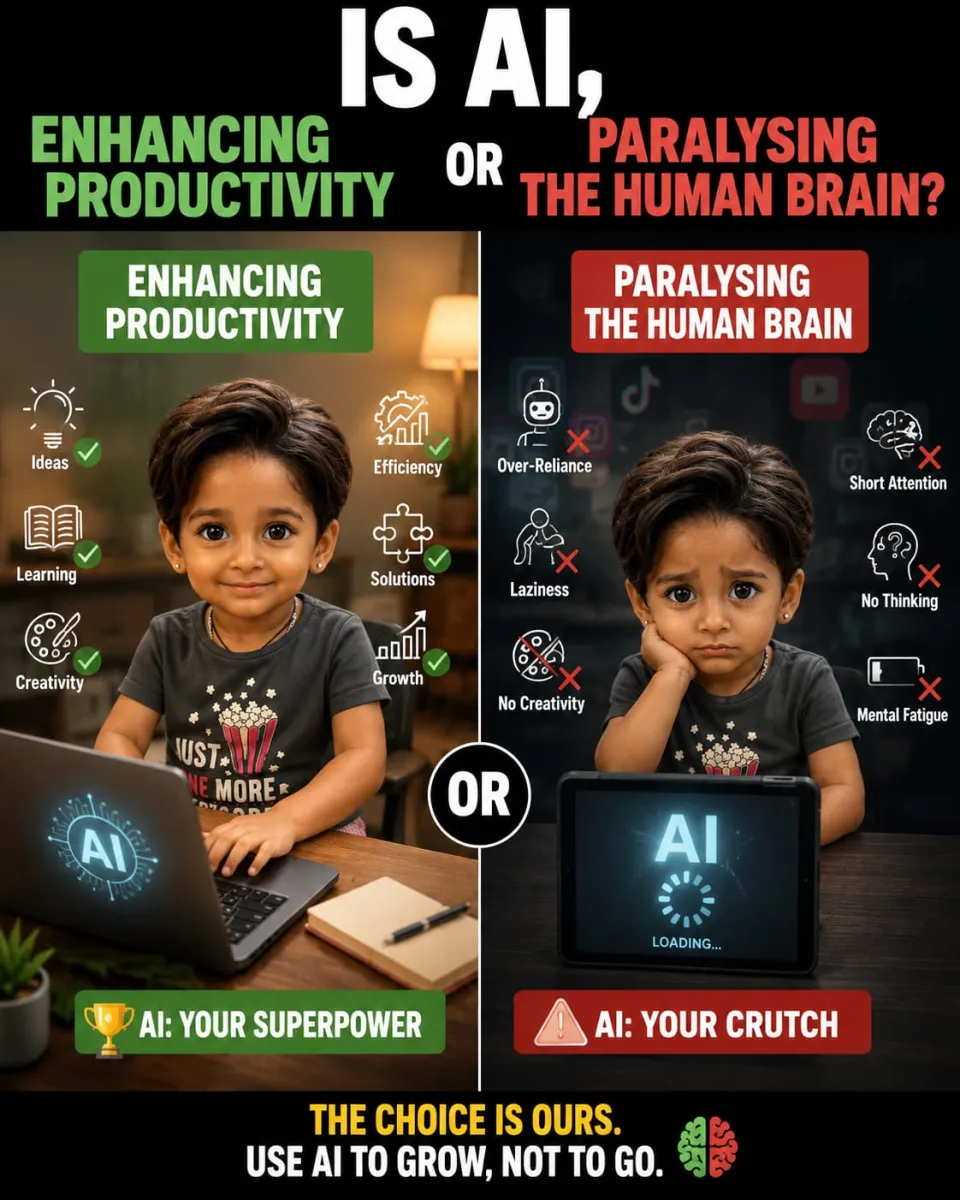
Artificial Intelligence is rapidly transforming the way we live, learn and work. It writes our emails, solves mathematical problems, generates computer code, summarises research and answers almost any question within seconds. While this technological revolution has dramatically increased efficiency, it also raises an uncomfortable question. Are we becoming more productive or are we gradually outsourcing our ability to think?
Unlike previous technologies that reduced physical effort, AI reduces cognitive effort. The human brain grows stronger through practice by calculating, questioning, remembering, reasoning and solving problems. When these mental exercises are repeatedly delegated to AI, the brain receives fewer opportunities to develop and maintain these essential skills.
This concern is particularly relevant in education. Many primary school children are becoming accustomed to asking AI or digital tools for answers instead of performing mental arithmetic themselves. As a result, basic calculation skills, numerical confidence and logical reasoning may not develop as strongly as they once did. Mathematics is not merely about obtaining the correct answer. It trains the brain to think systematically, recognise patterns and solve unfamiliar problems. If this foundation weakens, students may later struggle with subjects such as physics, engineering, economics and computer science.
The same principle applies to science. Scientific progress has always depended on curiosity, skepticism, experimentation and the willingness to challenge accepted ideas. AI systems generate responses by recognising patterns in existing information. They can sometimes produce convincing but incorrect statements, omit important context or present outdated information with confidence. If students, researchers or professionals accept AI generated content without verification, misconceptions can spread, research quality may suffer and genuine scientific innovation could be slowed by uncritical dependence on machine generated answers.
Beyond classrooms and laboratories, professionals are also at risk of becoming passive consumers of AI-generated decisions. Lawyers may rely on AI without checking legal precedents. Journalists may publish AI generated summaries without verifying facts. Engineers may trust AI generated designs without understanding the underlying calculations. In each case, the immediate gain in speed could come at the expense of expertise, judgment and accountability.
However, the solution is not to reject AI. The problem is not artificial intelligence itself, it is uncritical dependence on it. A calculator never replaced the need to understand mathematics and AI should never replace the need to understand reasoning. Instead, AI should handle repetitive tasks while humans remain responsible for analysis, verification, creativity, ethics and decision making.
Education systems must adapt by emphasising mental arithmetic, analytical writing, scientific reasoning and independent problem solving alongside AI literacy. Students should learn not only how to use AI effectively but also how to question it, verify its outputs and recognise its limitations. Likewise, workplaces should encourage employees to treat AI as a second opinion not the final authority.
The future will not belong to those who simply use AI, nor to those who reject it entirely. It will belong to those who combine the speed of artificial intelligence with the curiosity, discipline, creativity and critical thinking of the human mind.
AI is one of humanity's greatest inventions. Whether it becomes a force that expands human intelligence or quietly diminishes it depends not on the technology itself but on how wisely we choose to use it. The challenge of our time is not to create smarter machines it is to ensure that humans continue to become smarter alongside them.
Sunil Goyal
Visiting Faculty
Centre For Peace Studies Srilanka
Accredited freelance Journalist
Central Chronicle
Editor Gwalior Sandesh
Research Scholar
(Former)Public Relation Officer
Amity University MP India
Mob:+91-9827353578
E: sunil.geenews@gmail.com
Website: www.gwaliorsandesh.com
G-002 Raunak Apartment Site No1
City Centre Gwalior-11 MP India