We witnessed how devastating earthquakes can be, when more than 1400 persons were killed in back-to-back 7.2 and 7.5 magnitude quakes in Venezuela this week. It was horrific to see buildings reduced to dust during the devastating quakes rendering thousands of families homeless.
While we are still in shock and awe to see massive devastation in Venezuela, the earth beneath us shook on Saturday evening reminding us that earthquakes can strike anytime, anywhere! The 6.2 magnitude earthquake hit Afghanistan at 7.04 pm, with its epicenter located at a depth of 215 km. Still its shocks were experienced as far as Delhi-NCR and Jammu and Kashmir, though no damage was reported beyond panic.
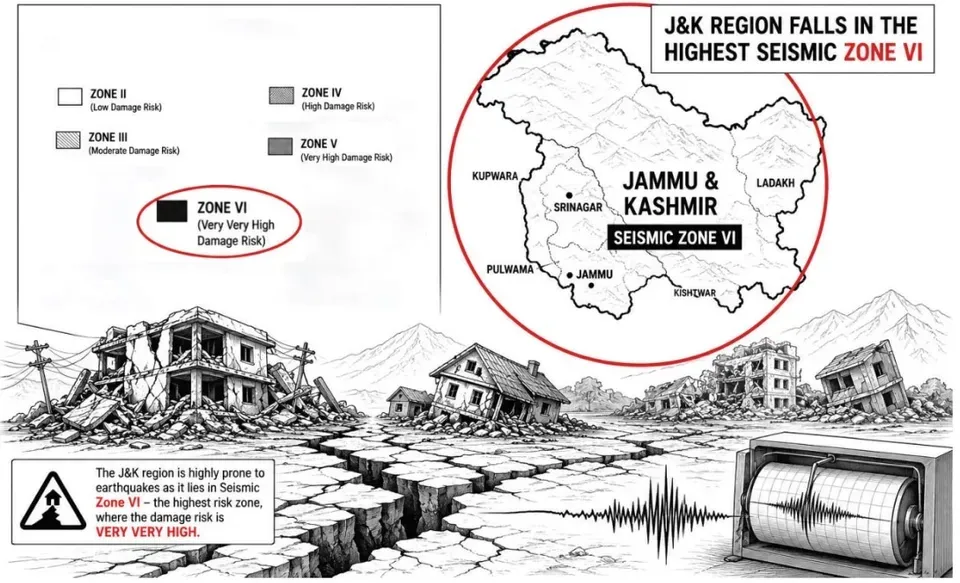
Every time an earthquake strikes J&K, it brings back horrific memories of October 8, 2005 when a powerful 7.6 magnitude earthquake rattled the region causing massive loss of lives and razed thousands of structures to the ground. There is no need to panic but we must know that the mountainous J&K region falls in the highest Seismic Zone VI. It is a reality that earthquakes cannot be exactly predicted or prevented. Least we can do is to minimise damage.
J&K is vulnerable to earthquakes as the region embodies a typical geomorphological and active tectonic setup with landforms produced or modified by active tectonic processes with distinct surface expressions. However, there is an increased probability of earthquakes as new studies link tectonic tearing under the Tibetan Plateau with rising seismic stress across the Himalayas including J&K.
What is concerning is that there has been an increase in high tectonic activities in various areas of J&K particularly Pir Panchal region and Chenab Valley. The Chenab Valley, housing huge dams including Dul Hasti in Kishtwar and Baglihar in Ramban is vulnerable to earthquakes. The vulnerability of the geologically-young, unstable and fragile rocks in Doda have increased manifold due to various unscientific developmental activities.
Numerous active faults have been identified in Kashmir with the help of remote sensing techniques validated by morphometric and geomorphological investigations. Geological and tectonic settings in Himalayan ranges trigger intense tectonic activity affecting the Kashmir basin in North-West Himalaya. At these places, Indian and Eurasian plates collide creating massive mechanical stress which gets released in the form of earthquakes.
The high risk of earthquakes has been validated by a prominent United States-based seismologist Roger Bilham warning that the Kashmir valley could have an earthquake of largest ever magnitude 9. However, Bilham has not specified any timeframe for the earthquake. Studying earthquakes in Himalayan region for the past over two decades, Prof Bilham, had visited Kashmir in 2007.
Based on his field studies and Global Positioning System (GPS) data readings, Bilham has warned that the major quake with magnitude 9 is likely to trigger landslides that would dam the Jhelum River, which drains from the Kashmir valley into Pakistan-occupied Kashmir. He fears that this could put the Kashmir valley under water within three months.
During his study, Bilham found that gradual movement of rocks in the Zanskar Mountains north of the Kashmir Valley show that earlier estimates of the maximum possible quake in the region were too low. He explains that in this region, the Indian plate is slowly burrowing under the Tibetan plateau. Studies on where the relative movement of the Tibetan plateau was slowest, indicates where compression is building up, and a rupture is “eventually likely to occur.”
Bilham expected this to be in the Pir Panchal range, to the south of the Kashmir Valley, but instead it was in the Zanskar range to the north. What does this study mean?
Bilham explains that the zone likely to rupture when a quake eventually happens could be 200 kilometers wide, rather than about 80 kilometers, as was previously thought. “The zone would encompass the Kashmir Valley – including the city of Srinagar, home to some 1.5 million people. If slippage occurs over a length of 300 kilometers, as is possible, a mega-quake of magnitude 9 is the likely result. Given building codes and population in the region, that could mean a death toll of 300,000 people,” Bilham has warned.
Studies done by other researchers corroborate Bilham’s prediction that Srinagar falls in high seismic risk. One of the studies used extensive high-resolution microtremor ambient noise surveys at 429 locations in Srinagar. The HVSR curves showed the peaks in the range of 0.22 Hz to 9.96 Hz indicating heterogeneous and complex sedimentary cover in the region.
What can we do in this scenario? We cannot change the fault lines or reduce earthquake risks.. We have seen how houses constructed with traditional methods survived massive earthquakes in J&K than those constructed with concrete. It is clear that houses constructed with mud, wood and natural things are safer during quakes. To keep pace with development, we need concrete buildings and the least we can do is to go for traditional constructions in mountainous highly vulnerable earthquake prone areas. We must learn and adapt how traditional Kashmiri architectural practices based on climate responsiveness, seismic resilience, can serve as vital models for more sustainable and context-sensitive construction in the 21st century.
There are technologies which can safeguard even high rise concrete buildings during quakes. We must take lessons from Japan, which witnesses frequent power earthquakes, has designed its structure to withstand shaking— due to flexible foundations that allow buildings to sway with the earthquake’s energy. We also need to develop an early earthquake warning system so that people can move out of buildings before quakes.
It is the collective responsibility of the Government and stakeholders to build earthquake resilient societies and strengthen disaster management and rehabilitation mechanisms in each village and colony. We have to learn to live with earthquakes as we have no option! It is all about developing our survival instincts.
Author is Executive Editor,
Greater Kashmir