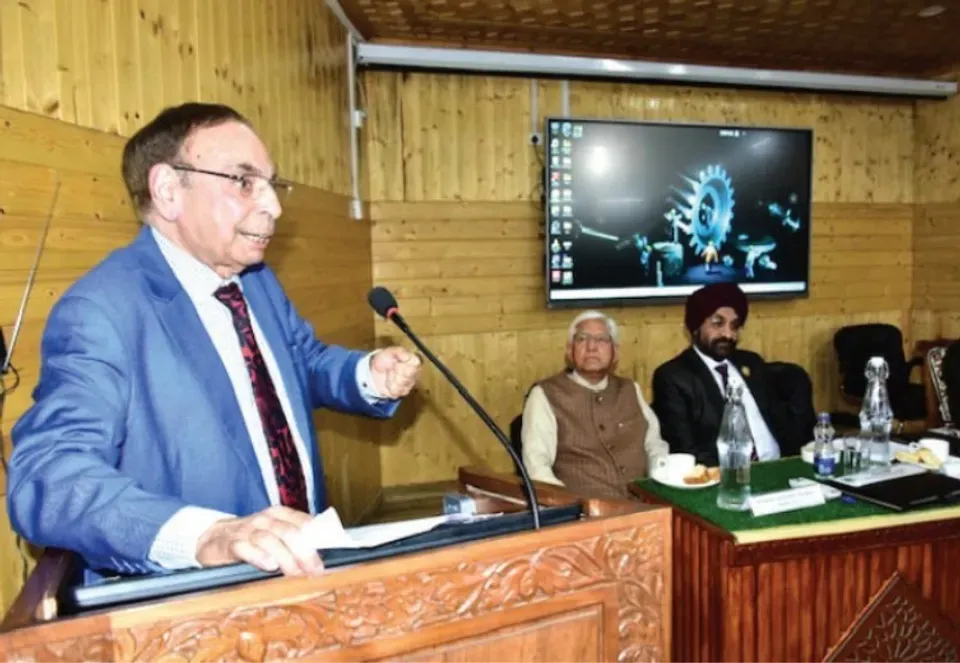
On June 25th, 2026, a deeply moving and urgent seminar titled “Protection of Natural Environment in J&K” was organized by a voluntary body of “Group of Concerned Citizens, J&K,here in Srinagar. As a cardiologist who has dedicated decades to studying the human heart—and as a proud Kashmiri whose soul belongs to these mountains—attending and contributing to this seminar felt less like an environmental briefing and more like diagnosing a patient close to my heart.
In medicine, we know that you cannot look at an organ in isolation; heart relies on lungs, and lungs rely on the air we breathe. Similarly, the health of our people is fundamentally locked to the health of our valleys, wetlands, and rivers. While the rapid ecological changes we are witnessing are deeply concerning, I chose to look at this crisis not with despair, but as a crucial window for intervention. We have caught the symptoms though late but still in time to write a new, positive prescription for our home.
THE DIAGNOSIS
How Environmental Stress Impacts Our Collective Health
From a medical perspective, the environmental challenges highlighted during the seminar directly map to public health patterns we see in clinics daily. When the environment deteriorates, our bodies feel it first.
AIR QUALITY AND CARDIOVASCULAR STRAIN
The rise in Particulate Matter PM 2.5 < 2.5 microns levels from vehicular emissions, construction, and brick kilns doesn’t just damage the lungs. These microscopic particles bypass natural filters, enter the bloodstream, and trigger systemic inflammation, directly increasing the risk of acute coronary syndromes (heart attacks) and arterial stiffness.
THE LOSS OF NATURAL SPAS (WETLANDS AND FORESTS)
The shrinking of our iconic lakes, like Dal, Nageen, Manasbal and Wular, and wet lands like Hokersar, Hygam and Shallabug along with rapid deforestation, disrupts our unique microclimate. The resulting erratic weather and urban heat island effects remove the natural “cooling vents” of our cities, leading to heightened physical and psychological stress.
WATER SECURITY AND PHYSICAL RESILIENCE
The retreat of our Himalayan glaciers impacts water quality and agricultural stability. For a population dependent on fresh, nutrient-rich local produce, changes in soil and water quality indirectly influence dietary health, metabolic wellness, and overall physical resilience.
THE PRESCRIPTION
A Positive Roadmap for Recovery
Every chronic condition requires an actionable, optimistic treatment plan. Our beautiful region possesses immense natural resilience; it simply needs systematic care and community ownership to heal. Here are the structural suggestions to restore the vitality of Jammu and Kashmir:
Green Infrastructure: Mass urban afforestation and creating “Vertical Green Belts” in cities like Srinagar and Jammu. Treating the existing trees like ICU patients with full empathy and care. Forests are our lungs.
Eco-Tourism & Heritage Guard: Enforcing strict carrying-capacity limits and zero-plastic zones at high-altitude tourist destinations and wetlands. The local authorities have to strictly enforce it.
Community-Led Conservation: Forming local “Panchayat Eco-Clubs” and integrating mandatory climate education in regional schools. Any new construction should need the approval of the local Panchayat’s.
Clean Energy Transitions: Subsidizing solar energy for local businesses and introducing electric public transit corridors.
A CALL TO ACTION FROM THE HEART
We must stop viewing environmentalism as a hobby or a secondary policy goal. It is the ultimate preventive medicine. Just as a patient modifies his lifestyle after a health scare to emerge stronger, fitter, and more conscious, Kashmir stands at a similar crossroads today.
The citizen-led seminar on June 25 proved that the collective heartbeat of our community is strong, aware, and ready for change. By taking ownership of our waste, demanding cleaner air, and guarding our forests like our ancestors did, we can easily reverse this decline. Actually, we have borrowed it from our younger generation.
These were the points of discussion and the messages from the speakers including the organizer in chief MrKhurshidGanai and Chairman of the Green Citizen’s Council (GCC) and the chief guest Dr Karan Singh, the former Sadar e Riyasat of the erstwhile state of Jammu Kashmir and Ladakh and also the Srinagar declaration 2026 - a 10 year ecological Restoration Road map which was adopted unanimously at the conclusion of the meeting.
Let us treat our land with the same tenderness we show to a loved one’s healing heart so that it may continue to beat strongly, beautifully, and purely for centuries to come.
Prof UpendraKaul, founder Gauri Kaul Foundation, is an eminent Cardiologist from Kashmir.