India’s PhD Factories Are Killing Real Research
Dr. R. K. Uppal, Professor Emeritus [PhD, D.Litt.]
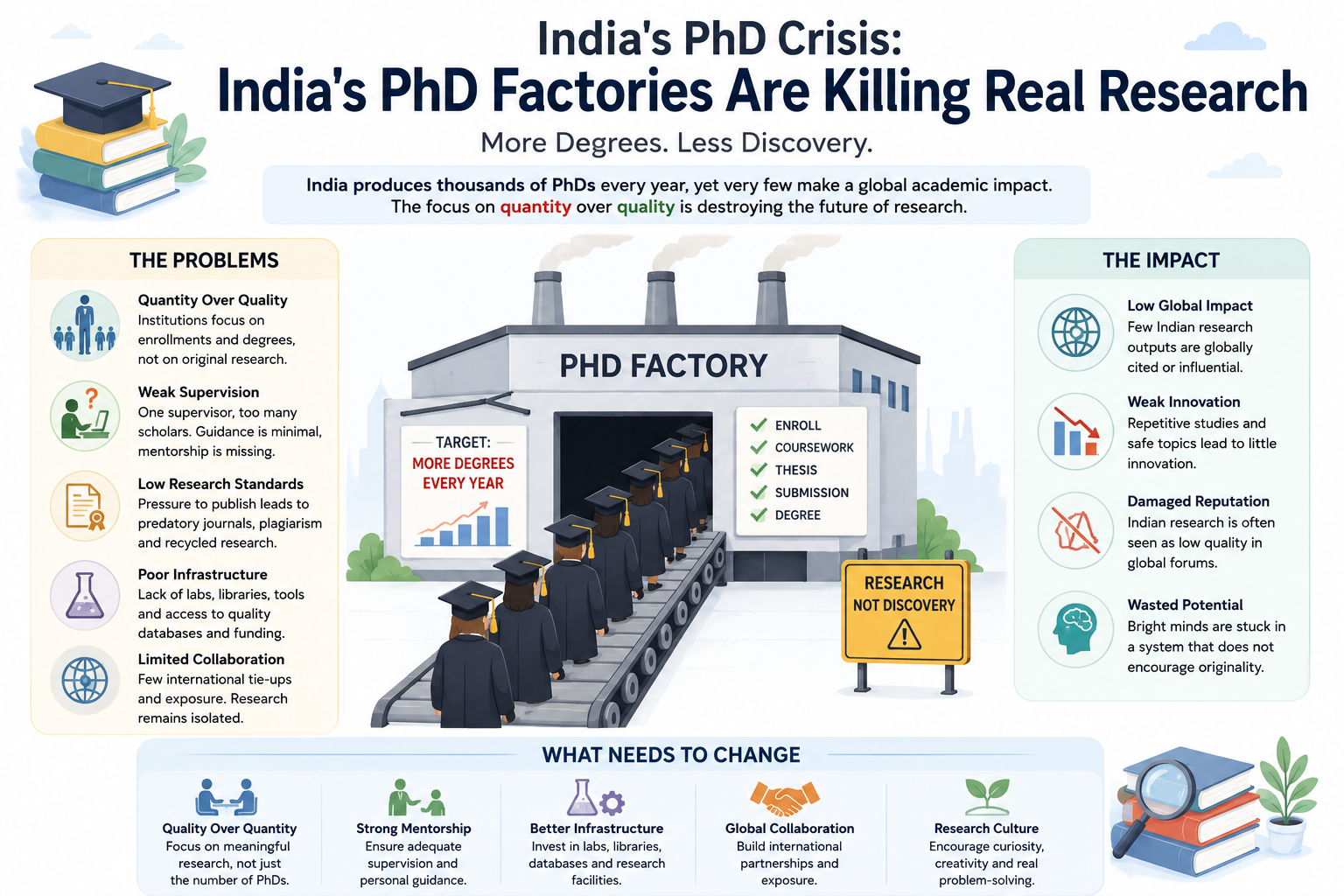
India produces thousands of PhDs every year, yet very few make a global academic impact because the focus remains on quantity over quality, weak research culture, poor supervision, and limited international collaboration.
India proudly announces the production of thousands of PhD scholars every year. Universities celebrate these numbers as symbols of academic growth, and policymakers often cite them as evidence of progress in higher education. On paper, India appears to be creating an intellectual revolution. But the reality is painfully different. Behind these impressive statistics lies a harsh truth: India’s PhD system is slowly becoming a degree-producing factory, where quantity matters more than quality and real research is dying a silent death.
The purpose of a PhD is to create original thinkers who contribute new knowledge to society. It is meant to train scholars to question, explore, innovate, and solve real-world problems through rigorous research. Unfortunately, in many Indian universities, the PhD has been reduced to a mere credential. It is often seen as a ticket to promotions, teaching jobs, salary increments, and social prestige rather than a serious intellectual pursuit.
This dangerous shift has created a culture where obtaining the title “Doctor” matters more than producing meaningful research. Thousands of candidates enter PhD programmes not because they are passionate about discovery, but because they need the degree for career survival. When the goal becomes certification instead of innovation, research naturally becomes mechanical and lifeless.
One of the biggest reasons for this crisis is weak academic supervision. Across many institutions,supervisors are overloaded with too many research scholars. Some professors guide dozens of students at the same time, making quality mentorship almost impossible. Instead of meaningful intellectual engagement, scholars often receive superficial feedback or are left to complete their work independently with little guidance. A PhD is not a routine assignment that can be completed through formalities. It demands constant discussion, criticism, and academic mentoring. When supervisors fail to invest time and energy, scholars are forced to focus only on finishing the process rather than mastering the craft of research.
Another alarming issue is the widespread culture of plagiarism and recycled topics. Many dissertations repeat old ideas with minor changes in title or methodology. Originality is often missing. Some scholars depend heavily on copied material, purchased data analysis, or ready-made literature reviews prepared by commercial agencies. In some cases, complete theses are ghostwritten for money. This academic dishonesty has become a thriving underground industry.
Research has become transactional. Instead of discovery and innovation, scholars are taught shortcuts to secure degrees quickly. This destroys the credibility of Indian academia and creates graduates who hold doctoral titles without possessing research competence.
Equally damaging is the obsession with publication numbers. The “publish or perish” culture has pushed scholars toward predatory journals that promise quick publication for a fee. These fake journals publish weak or meaningless work without proper peer review. Universities often accept such publications to fulfill formal requirements, encouraging scholars to chase numbers rather than quality.
As a result, India produces massive volumes of research papers, but very few make global impact. Very few Indian doctoral studies influence international debates, generate patents, solve industrial problems, or appear in top-ranked journals. Quantity has replaced excellence. The lack of research infrastructure is another major obstacle. Many universities lack advanced laboratories, updated libraries, access to global databases, and funding for fieldwork. Scholars are expected to produce world-class research without world-class resources. This contradiction weakens research quality from the start.
International collaboration is also limited. Globally competitive research thrives through partnerships, exposure, and exchange of ideas. Indian PhD scholars often remain isolated from international academic networks. Without exposure to global standards, their work struggles to meet international expectations. The consequences of this crisis are severe. A weak PhD system damages the reputation of Indian higher education globally. Employers, universities, and research institutions abroad often question the quality of Indian doctoral training. This hurts deserving scholars who work honestly and produce excellent research.
More importantly, weak research harms national progress. A country cannot become a global knowledge leader by producing degrees alone. It needs original ideas, scientific breakthroughs,policy innovation, and intellectual courage. If Indian universities continue producing paper scholars instead of real researchers, the nation’s dream of becoming a global academic powerhouse will remain distant.
The solution requires urgent reform. Universities must enforce stricter admission standards and ensure only genuinely motivated candidates enter PhD programmes. Supervisors must be assigned manageable workloads and held accountable for research quality. Plagiarism checks must be uncompromising. Predatory journal publications should be rejected outright. Research funding and infrastructure must improve significantly. Most importantly, India must restore respect for intellectual honesty and originality. A PhD should represent deep scholarship, not a decorative title. India does not need more PhD factories. It needs research ecosystems that produce thinkers, innovators, and problem-solvers. Until this transformation happens, India’s PhD factories will continue killing real research—and with it, the nation’s academic future.