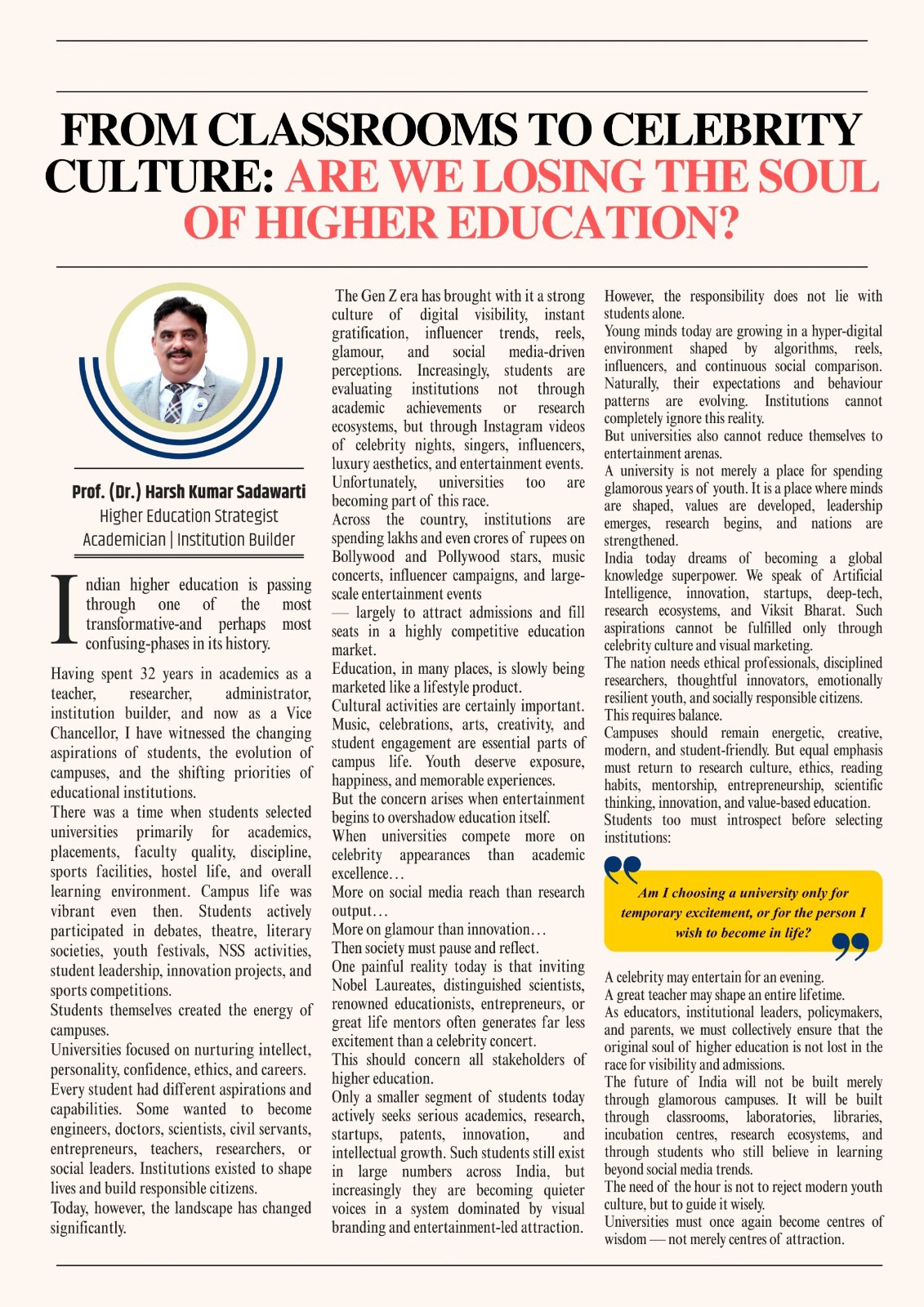
By Prof. (Dr.) Harsh Kumar Sadawarti
Higher Education Strategist | Academician | Institution Builder
Indian higher education is passing through one of the most transformative-and perhaps most confusing-phases in its history. Having spent 32 years in academics as a teacher, researcher, administrator, institution builder, and now as a Vice Chancellor, I have witnessed the changing aspirations of students, the evolution of campuses, and the shifting priorities of educational institutions.
There was a time when students selected universities primarily for academics, placements, faculty quality, discipline, sports facilities, hostel life, and overall learning environment. Campus life was vibrant even then. Students actively participated in debates, theatre, literary societies, youth festivals, NSS activities, student leadership, innovation projects, and sports competitions.
Students themselves created the energy of campuses.
Universities focused on nurturing intellect, personality, confidence, ethics, and careers.
Every student had different aspirations and capabilities. Some wanted to become engineers, doctors, scientists, civil servants, entrepreneurs, teachers, researchers, or social leaders. Institutions existed to shape lives and build responsible citizens.
Today, however, the landscape has changed significantly.
The Gen Z era has brought with it a strong culture of digital visibility, instant gratification, influencer trends, reels, glamour, and social media-driven perceptions. Increasingly, students are evaluating institutions not through academic achievements or research ecosystems, but through Instagram videos of celebrity nights, singers, influencers, luxury aesthetics, and entertainment events.
Unfortunately, universities too are becoming part of this race.
Across the country, institutions are spending lakhs and even crores of rupees on Bollywood and Pollywood stars, music concerts, influencer campaigns, and large-scale entertainment events — largely to attract admissions and fill seats in a highly competitive education market.
Education, in many places, is slowly being marketed like a lifestyle product.
Cultural activities are certainly important. Music, celebrations, arts, creativity, and student engagement are essential parts of campus life. Youth deserve exposure, happiness, and memorable experiences.
But the concern arises when entertainment begins to overshadow education itself.
When universities compete more on celebrity appearances than academic excellence…
More on social media reach than research output…
More on glamour than innovation…
Then society must pause and reflect.
One painful reality today is that inviting Nobel Laureates, distinguished scientists, renowned educationists, entrepreneurs, or great life mentors often generates far less excitement than a celebrity concert.
This should concern all stakeholders of higher education.
Only a smaller segment of students today actively seeks serious academics, research, startups, patents, innovation, and intellectual growth. Such students still exist in large numbers across India, but increasingly they are becoming quieter voices in a system dominated by visual branding and entertainment-led attraction.
However, the responsibility does not lie with students alone.
Young minds today are growing in a hyper-digital environment shaped by algorithms, reels, influencers, and continuous social comparison. Naturally, their expectations and behaviour patterns are evolving. Institutions cannot completely ignore this reality.
But universities also cannot reduce themselves to entertainment arenas.
A university is not merely a place for spending glamorous years of youth. It is a place where minds are shaped, values are developed, leadership emerges, research begins, and nations are strengthened.
India today dreams of becoming a global knowledge superpower. We speak of Artificial Intelligence, innovation, startups, deep-tech, research ecosystems, and Viksit Bharat. Such aspirations cannot be fulfilled only through celebrity culture and visual marketing.
The nation needs ethical professionals, disciplined researchers, thoughtful innovators, emotionally resilient youth, and socially responsible citizens.
This requires balance.
Campuses should remain energetic, creative, modern, and student-friendly. But equal emphasis must return to research culture, ethics, reading habits, mentorship, entrepreneurship, scientific thinking, innovation, and value-based education.
Students too must introspect before selecting institutions:
“Am I choosing a university only for temporary excitement, or for the person I wish to become in life?”
A celebrity may entertain for an evening.
A great teacher may shape an entire lifetime.
As educators, institutional leaders, policymakers, and parents, we must collectively ensure that the original soul of higher education is not lost in the race for visibility and admissions.
The future of India will not be built merely through glamorous campuses. It will be built through classrooms, laboratories, libraries, incubation centres, research ecosystems, and through students who still believe in learning beyond social media trends.
The need of the hour is not to reject modern youth culture, but to guide it wisely.
Universities must once again become centres of wisdom — not merely centres of attraction.
Writer is a Vice Chancellor of Desh Bhagat University,