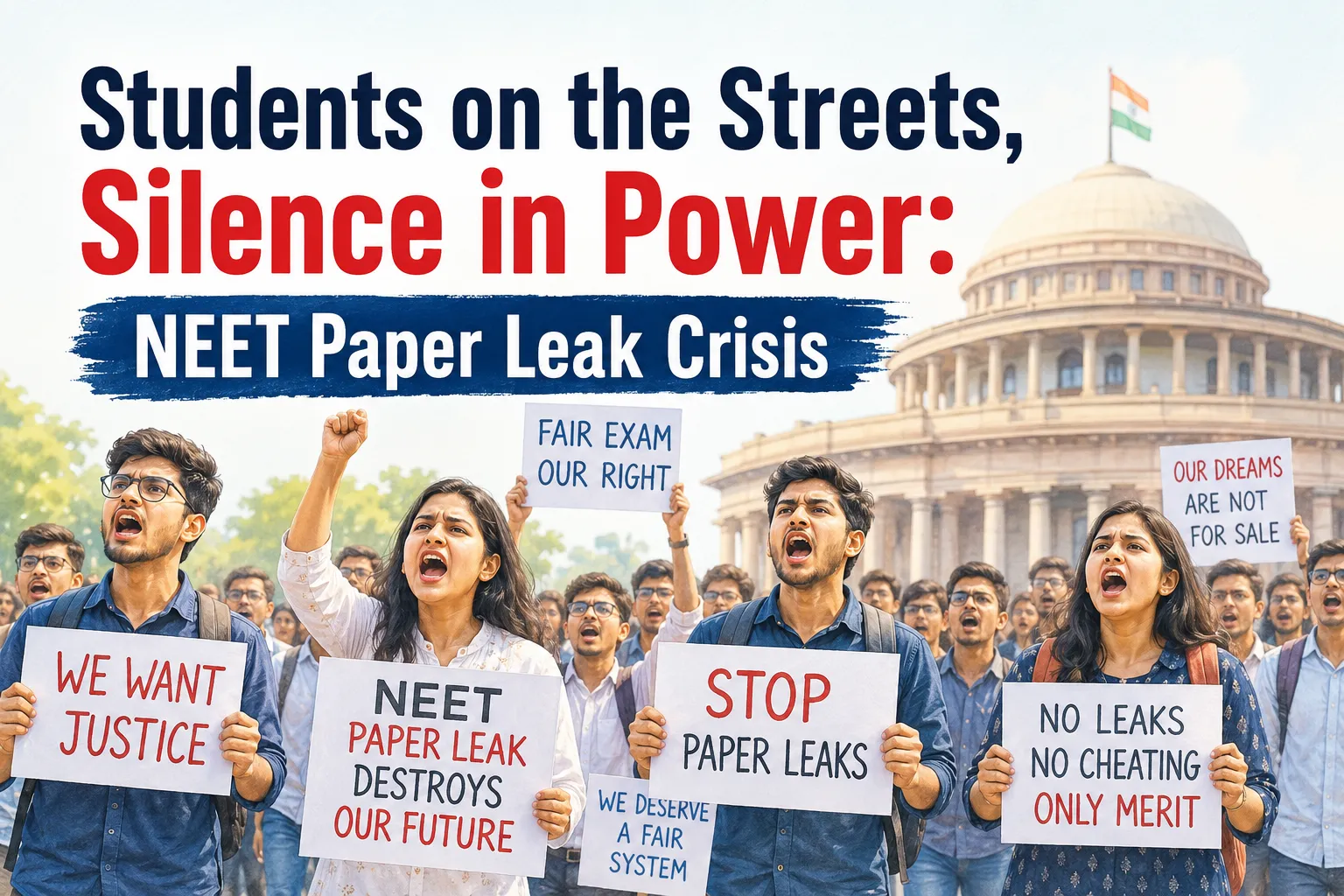
The arrest of teachers associated with coaching institutions in Pune in connection with the NEET paper leak investigation has once again exposed a troubling reality about contemporary Indian education. The issue is no longer confined to examination security, administrative lapses, or technological safeguards. At its core lies a far deeper question: what happens when education becomes an industry and aspiration becomes a commodity?
Public debate has largely revolved around whether paper-based examinations should be replaced by computer-based testing. While such discussions are important, they risk overlooking the structural forces that repeatedly produce crises in competitive examinations. Paper leaks are symptoms. The disease lies elsewhere.
Over the past two decades, India has witnessed the emergence of a vast examination economy. What began as supplementary coaching has evolved into a parallel education system. Entire urban centres now derive their identity from entrance examination preparation. Coaching institutes, test-series providers, private hostels, digital platforms, motivational speakers, counselling agencies, and increasingly private reading rooms together constitute a multi-billion-rupee ecosystem built around competitive anxiety.
The growth of this ecosystem reflects not merely entrepreneurial success but institutional failure. Students seek coaching because schools are considered insufficient. They join private test programmes because public systems inspire little confidence. They migrate across states because opportunity appears concentrated in a few highly competitive gateways. The coaching industry has flourished in the space vacated by weakening educational institutions.
Yet the consequences extend beyond economics. The commercialization of education has transformed aspiration itself into a marketable product. Families no longer invest only in learning; they invest in hope. Coaching fees, hostel charges, transportation costs, study materials, mock examinations, online subscriptions, and private mentoring collectively consume substantial portions of household income. For many lower-middle-class families, educational expenditure now rivals expenditure on housing or healthcare.
What is particularly striking is that the burden is no longer merely financial. It has become emotional. Parents monitor examination calendars with the anxiety once reserved for medical emergencies. Students spend formative years navigating a cycle of tests, rankings, cut-offs, and uncertainty. Childhood increasingly gives way to preparation. Adolescence becomes synonymous with competition. Failure is experienced not as an academic setback but as a personal and familial catastrophe.
The NEET controversy must therefore be viewed against this broader backdrop. When allegations emerge that individuals linked to coaching networks may have participated in examination malpractice, public anger intensifies because the institution claiming to prepare students for success appears implicated in undermining the fairness of the very system on which its legitimacy depends.
This contradiction is revealing. The coaching industry derives its existence from competition. At the same time, excessive competition creates incentives for manipulation. The greater the scarcity of opportunity, the greater the commercial value of perceived advantage. Under such conditions, ethical boundaries become vulnerable to erosion.
This is not an indictment of all coaching institutions. Millions of students benefit from supplementary academic support. Many teachers perform their duties with integrity and dedication. However, the broader ecosystem increasingly resembles a marketplace where aspiration is bought, sold, packaged, and monetised.
The rise of private reading rooms offers another illustration of this transformation. Students are now paying not merely for teaching but for silence. They rent study cubicles because homes are crowded, libraries are inadequate, and campuses often fail to provide conducive academic environments. Concentration itself has become a purchasable service.
A society in which students must pay for silence, coaching, counselling, test series, digital subscriptions, and hostel accommodation before they can even compete has already moved far from the ideal of equitable education.
The deeper concern is that this system extracts disproportionately from those least able to bear the burden. Wealthier households can absorb repeated attempts, expensive coaching packages, and relocation costs. Poor and middle-class families often cannot. They invest savings accumulated over years, frequently with no guarantee of success. Educational aspiration thus becomes a form of economic risk.
The result is a paradox. Education, historically regarded as a means of reducing inequality, increasingly reproduces it through unequal access to preparatory resources. The recurring controversies around NEET should therefore compel a broader national conversation. Examination reform is necessary. Stronger security mechanisms are necessary. Technological safeguards are necessary. Yet none of these measures addresses the central issue.
The real challenge is the commercialization of hope. India does not merely have an examination system. It has an examination economy. Around every competitive test exists a network of businesses whose growth depends upon scarcity, anxiety, and aspiration. As long as educational opportunity remains concentrated within a limited number of highly competitive gateways, this economy will continue to expand.
The question before policymakers is therefore larger than preventing the next paper leak. It is whether education will remain a public pathway to opportunity or continue evolving into a marketplace where the dreams of the poor and middle class are endlessly monetised before they are ever realised.
Obeida Ashraf is a teacher by profession