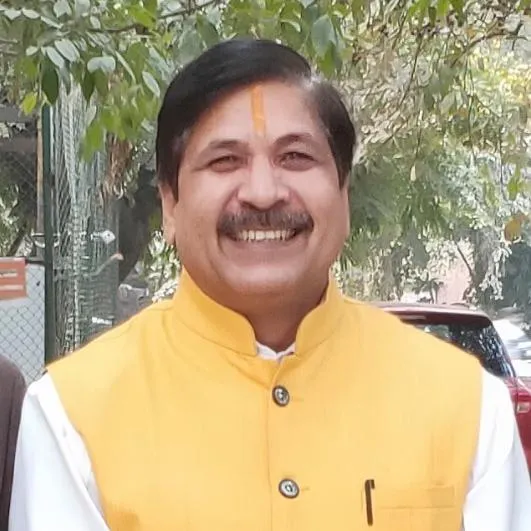
Professor Dr. Harendra Singh
(“Shikshak Shri” Samman awardee by the Govt. of U.P.)
Professor of Education and Principal Director
D.P.M. (P.G.) Institute of Education, Behsuma,
Ch. Charan Singh University, Meerut.
Email: harendra_2k@yahoo.com
The true strength of a nation is forged not merely in its legislatures, industries, or laboratories, but in its universities, where knowledge, character, and leadership are cultivated for generations. Institutions of higher learning shape the intellectual, moral, and cultural foundations upon which a nation's future rests. Among the foremost architects of modern Bharat's educational vision, Dr. Syama Prasad Mukherjee (6 July 1901-23 June 1953) occupies a place of enduring distinction. While history rightly celebrates him as a nationalist statesman, constitutional thinker, parliamentarian, and founder of the Bharatiya Jana Sangh, his equally profound contribution as an educationist, institution-builder, and visionary of higher education deserves far greater scholarly attention.
On the occasion of his birth anniversary, it is both timely and meaningful to revisit not merely his political legacy but his enduring educational philosophy, a philosophy that anticipated many of the aspirations embodied in the National Education Policy (NEP) 2020 and the national vision of Viksit Bharat 2047. Dr. Mukherjee firmly believed that the progress of a nation ultimately depends upon universities capable of nurturing intellectual excellence, scientific temper, moral character, and an unwavering commitment to national service.
Dr. Mukherjee inherited an extraordinary intellectual legacy from his father, Sir Ashutosh Mukherjee, the legendary Vice-Chancellor of the University of Calcutta, revered as the "Tiger of Bengal." Yet he did far more than preserve that inheritance; he expanded it through his own scholarship, administrative ability, and visionary leadership. At the remarkable age of thirty-three, he became one of the youngest Vice-Chancellors of the University of Calcutta. Assuming office during a decisive period in Bharat's intellectual history, he sought to transform universities from colonial institutions designed to produce administrators into centres of independent scholarship capable of nurturing national confidence and civilizational self-awareness.
For Dr. Mukherjee, a university was never merely an institution for awarding degrees or conducting examinations. It was, in his own words, "a living centre of culture, character, research and national service." Guided by this philosophy, he strengthened academic standards, encouraged scientific and technical education, promoted original research, supported Bharatn languages alongside English, and consistently defended the autonomy of universities from excessive political interference. He understood that genuine scholarship flourishes only where intellectual freedom is balanced by institutional responsibility and academic integrity.
His educational vision was remarkably ahead of its time. Decades before multidisciplinary education became a defining feature of leading universities across the world, Dr. Mukherjee advocated an integrated understanding of knowledge. He rejected the compartmentalization of disciplines, arguing instead that science, humanities, social sciences,
law, literature, philosophy, and culture together shape the complete development of the human personality. Education, in his understanding, was not merely a means of acquiring professional competence but a lifelong process of cultivating wisdom, ethical judgment, creativity, and social responsibility.
Equally significant was his conviction that educational advancement must remain firmly rooted in Bharat's civilizational heritage while remaining open to the best ideas from across the world. He believed that modernization should never demand cultural amnesia. Instead, Bharat's engagement with global knowledge should strengthen rather than weaken its civilizational identity. His observation that "Education divorced from the life and culture of the people cannot build a strong nation" remains strikingly relevant in contemporary educational discourse.
The philosophical foundations of the National Education Policy (NEP) 2020 closely reflect many of these ideas. Its emphasis on multidisciplinary learning, experiential pedagogy, flexibility in curriculum, research and innovation, Bharatiya Gyan Parampara, and holistic development mirrors principles that Dr. Mukherjee articulated decades before educational reforms across the world embraced similar approaches. His educational philosophy demonstrates that excellence in higher education is not achieved by merely imitating global models but by integrating universal knowledge with national culture and indigenous intellectual traditions.
Dr. Mukherjee also regarded universities as the intellectual guardians of democracy. He believed that constitutional institutions ultimately derive their strength not merely from laws or administrative structures but from citizens who possess critical thinking, ethical integrity, civic responsibility, and a deep sense of national duty. Democracy, in his view, could flourish only when universities produced informed citizens capable of exercising both freedom and responsibility with equal maturity.
His public speeches and parliamentary interventions repeatedly emphasized that constitutional governance depends as much upon enlightened public opinion as upon constitutional provisions. Universities therefore had a larger national mission to nurture thoughtful citizens capable of safeguarding democratic institutions, strengthening social harmony, and contributing constructively to public life. At a time when democracies across the world face challenges arising from misinformation, polarization, and declining civic engagement, his understanding of higher education appears remarkably contemporary.
Dr. Mukherjee's educational philosophy extended far beyond classrooms and campuses. He envisioned universities as engines of national transformation capable of addressing the major challenges confronting society. Whether combating poverty, reducing social inequality, promoting scientific advancement, encouraging technological innovation, or responding to environmental sustainability, universities, he believed, must actively contribute to national development rather than remain isolated centres of academic instruction.
This vision has acquired even greater significance in the twenty-first century. Artificial intelligence, biotechnology, cybersecurity, quantum computing, climate change, digital governance, and emerging technologies are fundamentally reshaping economies and societies. Preparing students merely for existing jobs is no longer sufficient. Higher education must develop innovators, ethical leaders, entrepreneurs, researchers, and lifelong learners capable of responding creatively to rapidly changing global realities. Dr. Mukherjee anticipated this transformation decades before concepts such as the "knowledge economy," "innovation ecosystem," and "human capital" entered mainstream educational discourse.
His philosophy aligns seamlessly with the aspirations of Viksit Bharat 2047, where education is recognised as the principal driver of national development. Bharat's emergence as a developed nation will depend less upon natural resources than upon the quality of its universities,
research institutions, teachers, and students. Human capital, intellectual creativity, and scientific innovation will determine the nation's future competitiveness. Dr. Mukherjee also assigned a central place to teachers in the educational process. He believed that lasting educational reform begins not with administrative restructuring but with the intellectual, professional, and moral empowerment of teachers. Competent teachers impart knowledge; inspiring teachers shape character, cultivate curiosity, and awaken a lifelong passion for learning. The renewed emphasis of NEP 2020 on teacher education, continuous professional development, multidisciplinary preparation, research-oriented pedagogy, and academic leadership strongly reflects this enduring vision. Another defining feature of Dr. Mukherjee's educational thought was his insistence on balancing university autonomy with public accountability. Academic institutions, he argued, require intellectual freedom to pursue truth without fear or favour. Yet autonomy should never become detachment from society. Universities must remain accountable for contributing to national development, scientific progress, and social well-being. This balanced perspective continues to inform contemporary debates on higher education governance as Bharat seeks to improve research quality, enhance global university rankings, strengthen international collaborations, and build world-class institutions. Perhaps the most enduring aspect of his philosophy was his unwavering emphasis on character formation. For Dr. Mukherjee, education was incomplete unless it nurtured individuals committed to truth, integrity, discipline, compassion, and public service. Knowledge without ethical values, he believed, could never sustain either democracy or civilization. In today's world, marked by rapid technological disruption, artificial intelligence, ethical uncertainty, and growing social fragmentation, his advocacy of value-based education appears more relevant than ever. As Bharat moves confidently towards becoming a global knowledge power, Dr. Syama Prasad Mukherjee's educational philosophy offers an enduring blueprint for national renewal. He envisioned universities that combined scientific excellence with civilizational confidence, academic freedom with national responsibility, innovation with ethical leadership, and global engagement with cultural rootedness. Such institutions alone can prepare citizens capable of leading Bharat in the twenty-first century. The most meaningful tribute to Dr. Syama Prasad Mukherjee on his birth anniversary lies not merely in commemorating his life but in translating his educational ideals into national action. Strengthening university autonomy, investing in frontier research, empowering teachers, promoting multidisciplinary learning, preserving Bharat's intellectual heritage, and nurturing institutions that inspire both excellence and character are essential steps towards realizing his vision. As Bharat advances towards Viksit Bharat 2047, Dr. Mukherjee's message remains profoundly relevant: the destiny of a nation is ultimately determined by the quality of its educational institutions. A country that builds world-class universities, inspires ethical scholarship, promotes innovation rooted in cultural confidence, and educates citizens with both knowledge and character secures not only economic prosperity but also democratic resilience, social harmony, and civilizational strength. His educational philosophy, therefore, is not simply a legacy of the past, it is a guiding framework for shaping the future of a developed, self-confident, and globally respected Bharat. …………………………………………………………………………………………………… (Author: Professor Dr. Harendra Singh, is a “Shikshak Shri” Samman awardee by the Government of Uttar Pradesh, a distinguished educationist, visionary academic leader, and nationalist thinker. He serves as Professor of Education and Principal Director at D.P.M. (P.G.) Institute of Education, Behsuma, Ch. Charan Singh University, Meerut.)