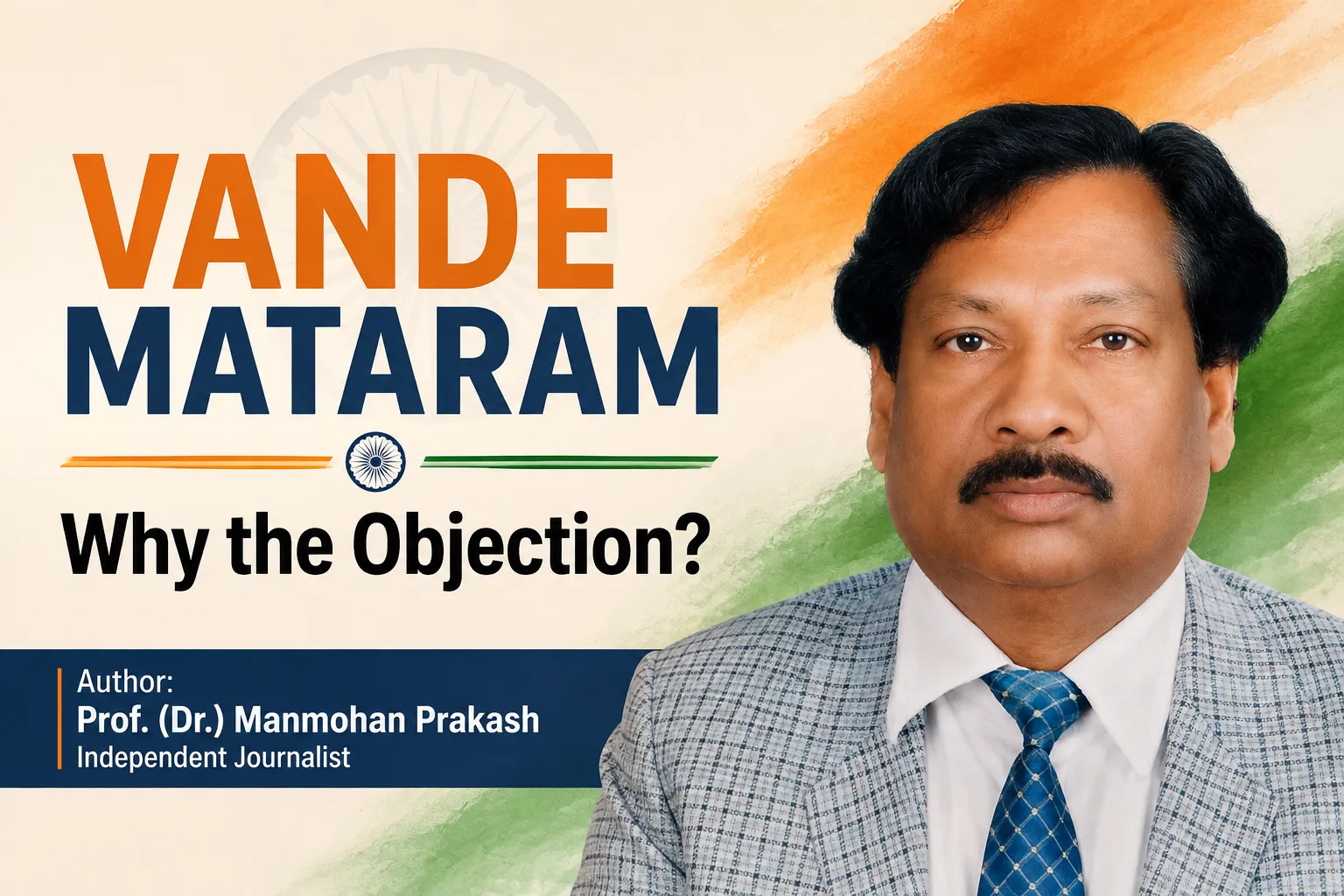
“Vande Mataram”: Why the Objection?
Author: Prof. (Dr.) Manmohan Prakash, Independent Journalist
In the history of India’s freedom movement, Vande Mataram has been a symbol of national consciousness, struggle, and sacrifice for Indians across religions, castes, and social classes. It cannot be denied that the song played an important role during the freedom movement in awakening patriotism and the spirit of independence among Indians of different faiths. For thousands of freedom fighters, it was an expression of devotion to the motherland and their aspirations for freedom.
On January 24, 1950, Dr. Rajendra Prasad announced in the Constituent Assembly that 'Jana Gana Mana' would be the National Anthem of India and that 'Vande Mataram' would also be accorded equal respect. Thus, Vande Mataram became an important part of India’s national consciousness and the legacy of its freedom struggle.
In 2026, an important new chapter was added to the history of Vande Mataram. According to guidelines issued by the Ministry of Home Affairs on January 28, 2026, the complete six-stanza version of Vande Mataram was incorporated into the official protocol. Subsequently, All India Radio began broadcasting the complete six-stanza version from March 26, 2026. This change is not merely an effort to present the song in its more complete form; it also provides an opportunity to understand and honour this historic legacy of the freedom movement in its original form.
In the same year, the Prevention of Insults to National Honour (Amendment) Act, 2026 also provided statutory protection to Vande Mataram in matters relating to national honour. Deliberately preventing the singing of the National Song or disrupting its performance now falls within the scope of the law. Therefore, it would be more appropriate to say that in 2026, the legal and protocol framework concerning the honour of Vande Mataram and the official use of its complete version has been further strengthened.
If we consider the matter in its true meaning and with an impartial perspective, Vande Mataram is neither the property of any political party nor the exclusive symbol of any particular ideology. It is part of the collective memory of India’s freedom struggle and a historic means of expressing gratitude, devotion, and respect towards the motherland.
In a democracy, the Constitution is supreme, while respect for an individual’s freedom of expression and personal faith is a fundamental spirit of democratic governance. At the same time, respect for national symbols and national heritage is also an important part of civic responsibility. The right to dissent is a strength of democracy, but turning national symbols into subjects of unnecessary political confrontation cannot be considered conducive to social harmony.
The meaning of Vande Mataram is associated with reverence and respect for the motherland. It expresses the Indian cultural perspective of viewing the land of India as a mother. Therefore, to view it solely from a religious perspective or associate it exclusively with any one community would be to limit its historical and national significance. Respecting the National Song is not a test of loyalty to any religion, caste, or political ideology; rather, it is an expression of respect for the freedom struggle in which countless Indians dedicated their lives.
It is also worth asking why we have begun to view national symbols through a political lens. The simplistic notions that a person who respects Vande Mataram must support a particular political ideology, while someone who disagrees with it must necessarily be anti-national, are not appropriate for a democratic society. The nation and its national heritage are far greater than any political party or ideology.
True patriotism is not confined merely to slogans and symbols. It is reflected in fulfilling civic duties, respecting the Constitution, protecting public property, promoting social harmony, obeying the law, and placing the national interest above personal interests. The fundamental spirit of Vande Mataram, ultimately, also inspires this very sense of devotion and gratitude towards the motherland.
Therefore, instead of turning Vande Mataram into a subject of political controversy, we should understand its historical context and meaning. The inclusion of the complete six-stanza version in the official protocol in 2026, along with statutory protection for the National Song, underscores the fact that the national dignity of Vande Mataram is not the private property of any political party or government, but a shared national heritage of India.
If a song that gave voice to the consciousness of freedom among Indians during the freedom struggle deserves our respect, then why should there be any objection to honouring it? Why should there even be a question of agreeing to sing half of it while objecting to singing the complete version? When the song was respected by Indians of different faiths during the freedom movement for so many years, why should there be objections now?
It is essential for every Indian to understand that Vande Mataram is not merely a song. It is the historical voice of the memory of India’s freedom struggle, reverence for the motherland, and national consciousness.