By ZEHRU NISSA
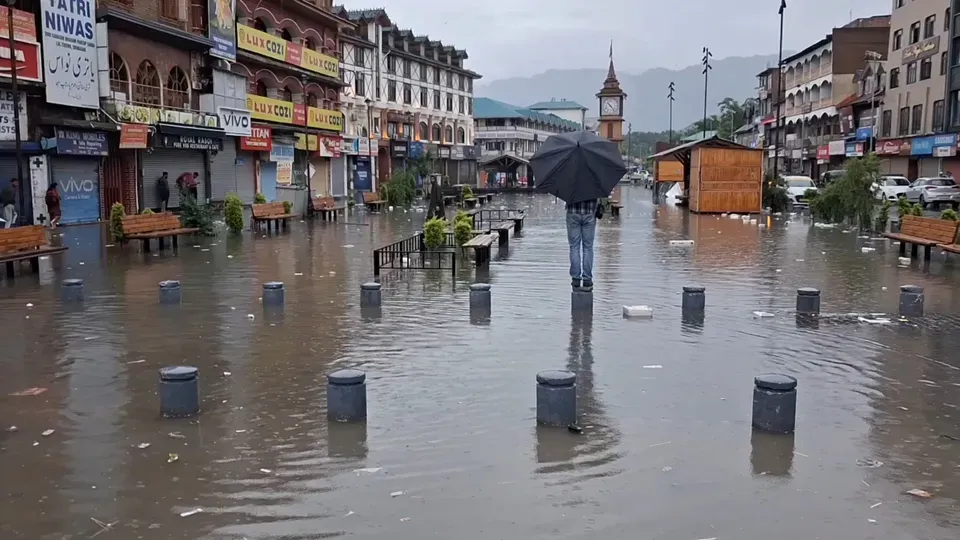
Srinagar, Jul 20: Three hours of intense rainfall on Monday brought Srinagar to a standstill yet again, exposing the City's chronic vulnerability to urban flooding. From ankle to waist-deep water, roads across Srinagar were submerged. Rainwater entered homes and shops, damaging property and merchandise. Thousands of daily wage earners lost a day's income as they remained confined to their homes.
Hospitals, including the Children's Hospital and JVC Bemina, were virtually marooned, leaving patients, attendants and healthcare workers struggling to reach or leave the facilities. The scenes were hauntingly familiar. Urban flooding after just a few hours of rainfall has become a recurring feature in Srinagar. The government itself has recently acknowledged that merely two hours of rain are enough to inundate large parts of the City. The question that now confronts the administration is unavoidable: more than a decade after the devastating 2014 floods, and after spending hundreds of crores on flood mitigation and drainage infrastructure, why does Srinagar continue to collapse under a few hours of rain?
A DECADE AFTER THE FLOODS
The September 2014 floods triggered one of the largest post-disaster reconstruction programmes in Jammu and Kashmir. Backed by World Bank funding, the Jhelum and Tawi Flood Recovery Project was launched in 2016 and continued until around 2022. Besides restoring damaged infrastructure, the project aimed to strengthen the Valley's resilience against future floods. Among its major urban interventions was the strengthening of Srinagar's stormwater drainage network.
Nearly Rs 103 crore was sanctioned for the Srinagar Municipal Corporation (SMC) to establish and upgrade 49 stormwater pumping stations under the Urban Flood Management Programme. The total World Bank-supported urban flood management component was estimated at around Rs 300 crore.
Yet, every spell of intense rainfall continues to expose glaring weaknesses in the system. Former Superintending Engineer, Irrigation and Flood Control Department, and hydraulic expert Ajaz Rasool attributes the problem to years of neglect and poor maintenance. "The month-long inundation during the 2014 floods deposited enormous quantities of silt into the drainage network. The drains remain clogged and are unable to efficiently carry stormwater. Neither surface drains nor underground drains have been properly cleaned since then," Rasool told MEDIA
He also alleged that several pumping stations have been compromised as they are now being used to pump sewage instead of stormwater, defeating the very purpose for which they were created.
STORMWATER PUMPS, SEWAGE BURDEN
Environmental activist and RTI campaigner Raja Muzaffar Bhat said 12 new pumping stations were installed along the Doodh Ganga by the Urban Environmental Engineering Department (UEED) and the SMC following the 2014 floods, while several existing stations were upgraded.
The pumping stations were constructed at locations including Chanapora Bypass, Natipora, Baghat-Barzulla, Barzulla Hospital, Magraypora, Bulbul Bagh and Tengpora.
"Their purpose was simple - to rapidly evacuate stormwater from low-lying areas into nearby water bodies during heavy rainfall and prevent urban flooding," Bhat said.
However, he alleged that many of these stations have since been connected to sewerage networks and are now pumping sewage instead of rainwater.
According to Bhat, the issue was examined by the National Green Tribunal (NGT), which found violations serious enough to impose environmental compensation. He said the government subsequently sanctioned around Rs 140 crore for the construction of two major sewage treatment plants.
"When infrastructure designed exclusively for stormwater is diverted to handle sewage, its capacity to quickly evacuate rainwater during intense rainfall is inevitably reduced," he said. "The water simply was not pumped out." Residents also alleged operational lapses.
A resident of Dalgate claimed that the pumping station in the area remained non-functional until employees were alerted after water had already entered houses.
"We had to wake up the staff to start the pumps. We were told there wasn't enough fuel to operate them before 10 am," he alleged.
DRAINAGE NETWORK THAT NO LONGER DRAINS
Experts say the problem extends far beyond pumping stations.
Over the years, Srinagar's stormwater drainage network has steadily deteriorated because of poor maintenance, unplanned urbanisation and uncoordinated infrastructure works. Repeated macadamisation has raised road levels while burying or blocking drains. Many locality drains have become isolated from the main drainage network, while others remain choked with silt, debris and solid waste. As a result, much of the City's original drainage system has become ineffective.
QUESTIONS THAT DEMAND ANSWERS
Monday's flooding has once again raised uncomfortable questions about the effectiveness of post-2014 flood mitigation measures. Even before Monday's downpour, the J&K Cabinet, chaired by Chief Minister Omar Abdullah, had announced an independent third-party audit of the Srinagar Smart City Limited (SSCL) urban transformation programme following widespread public criticism over repeated waterlogging after recent rains. The Cabinet acknowledged that recurring flooding has exposed shortcomings in the City's newly developed drainage and urban infrastructure. Residents argue that Srinagar's drainage network has failed to keep pace with rapid urbanisation. They say years of piecemeal road construction, blocked drains and poor maintenance have rendered costly flood-control infrastructure ineffective.
SMC Commissioner Faz Lul Haseeb, however, maintained that Monday's rainfall was "not normal" and exceeded the designed capacity of the City's drainage system. He said teams from the Mechanical Engineering Division and the SMC had been deployed at 60 identified flooding hotspots. Mobile dewatering pumps were pressed into service, particularly in areas without permanent pumping stations. "We have established control rooms to assist people in waterlogged areas," Haseeb said.
On the long-term solution, he said the government would assess whether the existing drainage and pumping infrastructure is adequate to meet the City's growing requirements.
But for thousands of Srinagar residents who once again found themselves wading through flooded streets, the larger question remains: after more than a decade of investment and repeated promises, why does the city continue to drown after just a few hours of rain?