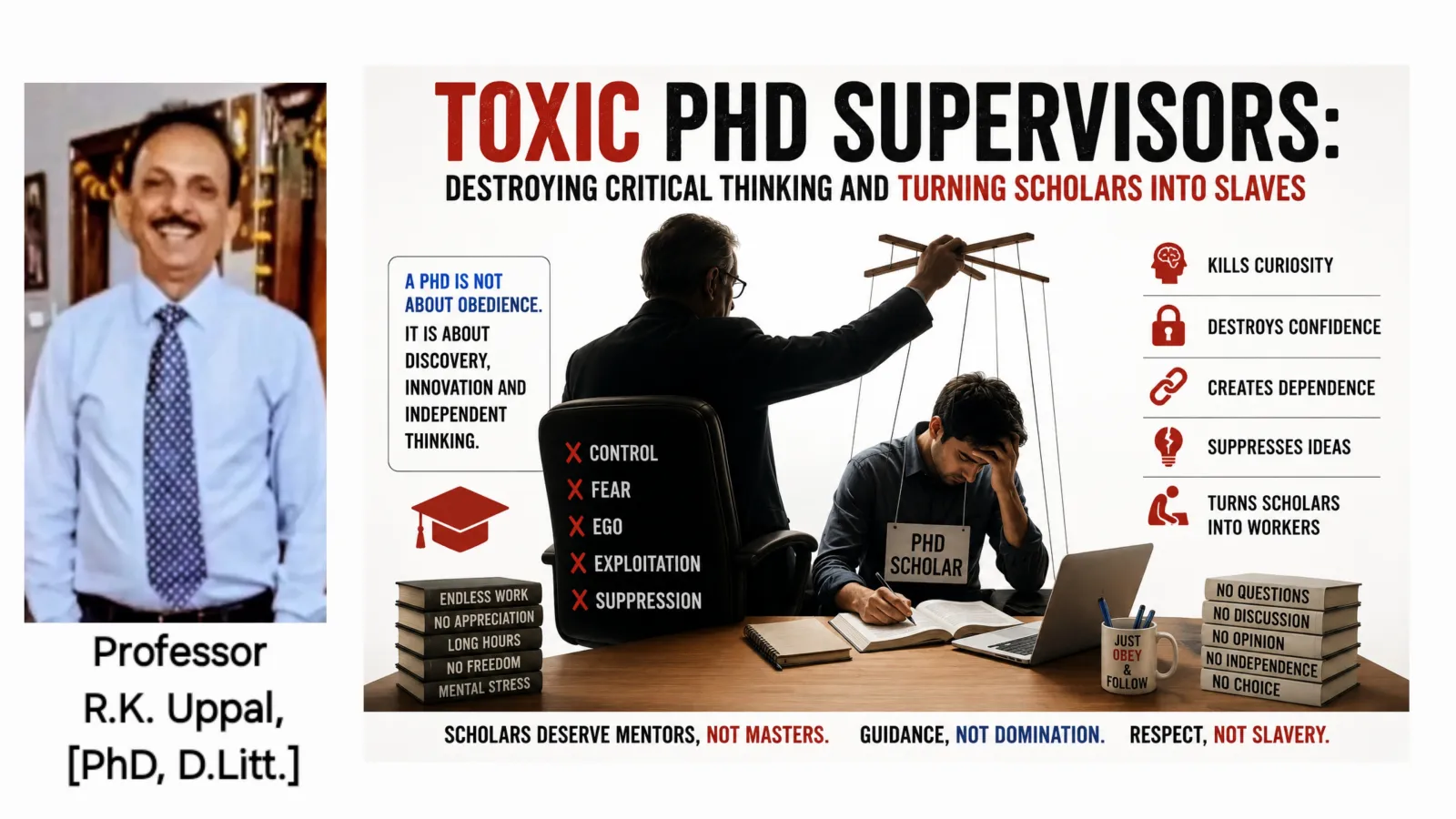
Toxic PhD Supervisors: Destroying Critical Thinking and Turning Scholars into Slaves
Professor R.K. Uppal, [PhD, D.Litt.]
A PhD is supposed to represent the highest level of academic learning, intellectual freedom and independent research. A doctoral scholar is expected to question existing knowledge, challenge assumptions, examine evidence and contribute something original to the academic world. Yet in some institutions, the relationship between PhD supervisors and research scholars has become deeply problematic. Instead of creating independent thinkers, toxic supervision can create fearful followers. Instead of mentorship, there can be control. Instead of intellectual freedom, there can be obedience. And instead of research partnership, scholars may experience exploitation.
One of the greatest casualties of toxic supervision is critical thinking.
Critical thinking is the foundation of research. A researcher must be able to ask difficult questions, challenge established theories, identify weaknesses in arguments and develop alternative explanations. But what happens when a supervisor does not tolerate disagreement? What happens when asking questions is interpreted as disrespect? What happens when a scholar is expected to accept every instruction without discussion?
The scholar gradually learns to remain silent.
This is extremely dangerous for higher education. A PhD should not train a scholar to say “yes” to everything. It should train the scholar to ask “why?”, “how?”, “what is the evidence?” and “is there another explanation?” A supervisor who encourages such questions strengthens research. A supervisor who suppresses them damages the very foundation of doctoral education. The problem becomes even more serious when research scholars are treated like personal servants. Some scholars may be expected to perform duties unrelated to their research, undertake excessive administrative work, remain available outside reasonable working hours or complete tasks primarily benefiting the supervisor rather than their own academic development. When academic dependence is used to force obedience, supervision can cross the line into exploitation.
A PhD scholar is a researcher—not a personal assistant, servant or slave.
The distinction between guidance and domination must be clearly understood. A supervisor has the responsibility to guide research, correct methodological weaknesses, improve academic writing and challenge the scholar intellectually. But guidance does not mean controlling every thought, decision or personal choice of the researcher.
Unfortunately, toxic supervision can reverse this process.
A scholar may become afraid to change a research design, question a theoretical assumption or challenge a supervisor's interpretation. Even when the scholar knows that an argument is weak, fear of academic consequences may force silence. The result is research that follows authority rather than evidence. This is particularly damaging because academic progress depends on disagreement. Major discoveries rarely emerge simply because everyone agrees with existing knowledge. Innovation requires curiosity, experimentation, criticism and the courage to challenge established thinking. Universities cannot claim to promote innovation while allowing environments in which young researchers are afraid to think independently.
Another serious concern is the misuse of research scholars as inexpensive academic labour. In a highly competitive academic environment, supervisors may face pressure to produce publications, projects, conferences and other academic outputs. Scholars can become the workforce behind these outputs rather than the primary beneficiaries of doctoral training. Their research assistance, data collection, analysis and writing may contribute significantly to academic productivity, while their own intellectual development receives inadequate attention.
The question therefore needs to be asked: Are we producing researchers or simply producing academic labour? The answer should be obvious. A PhD program should develop knowledge, confidence and originality. It should prepare scholars to become teachers, researchers, innovators and intellectual leaders. It should not turn them into individuals who are afraid of authority.
Toxic supervision can also damage a scholar's confidence. Constant criticism, public humiliation, threats, personal insults or deliberate discouragement can make a talented researcher doubt their own ability. A scholar who entered a doctoral program with enthusiasm can gradually become anxious, isolated and intellectually exhausted.
The consequences do not remain limited to one individual. When talented scholars lose confidence, research quality suffers. When young researchers stop asking questions, innovation suffers. When scholars leave academia because of toxic environments, universities lose future teachers and researchers. Therefore, improving PhD supervision is not merely a matter of student welfare. It is a matter of research quality and national academic development.
Universities must establish stronger safeguards. Research scholars should have access to transparent grievance mechanisms, independent academic committees and periodic reviews of supervisory relationships. Supervisory decisions should not depend entirely on one individual. Where appropriate, co-supervisors and doctoral committees can provide additional academic support and reduce excessive dependence on a single supervisor.
Supervisors should also be evaluated not only by the number of PhDs they produce but by the quality of mentorship they provide. How many independent researchers have they developed? Do their scholars feel free to question them? Are research contributions fairly recognized? Is the research environment respectful and professional?
A PhD scholar enters academia with a dream of creating knowledge. That dream should not be transformed into a struggle for survival under an authoritarian supervisor.
PhD scholars deserve mentors not masters. They deserve guidance, not domination. They deserve respect, not humiliation. They deserve intellectual freedom, not fear. The purpose of a PhD is to create independent mind. If supervision destroys that independence, the system has failed its most important responsibility. Stop controlling scholars. Start developing scholars. Stop demanding blind obedience. Start encouraging critical thinking. And above all, stop treating research scholars like slaves.