Lokesh Dhar
dharlokesh@gmail.com
As the Supreme Court pushes for TET compliance and the J&K Government moves to challenge the directive, the region faces an overdue reckoning with the educational consequences of patronage-based recruitment.
Jammu and Kashmir's education system stands today at a critical crossroads. Recent observations by the Union Ministry of Education have exposed a reality that parents across the region have understood for years. Dozens of Government schools have no students enrolled, thousands operate with extremely low enrolment, and Government schools continue to lose children to private institutions. Yet, instead of focusing on reversing this decline, the political debate has once again become centred on protecting vested interests rather than safeguarding the future of students.
The latest controversy revolves around the Teacher Eligibility Test (TET), a nationally accepted benchmark designed to ensure that teachers possess minimum professional competence. Following judicial directions requiring compliance with TET norms, the Jammu and Kashmir Government has announced its intention to seek legal review in order to protect the interests of affected teachers. While every employee deserves fair treatment, the larger question remains unanswered: who is protecting the interests of students?
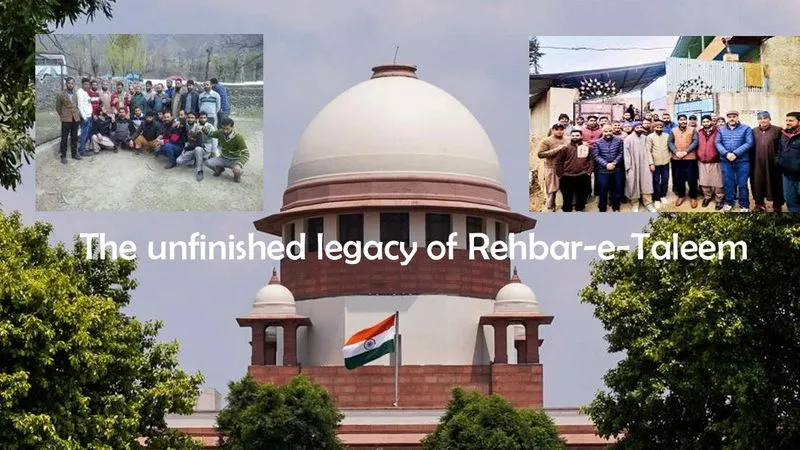
To understand the present crisis, one must revisit the legacy of the Rehbar-e-Taleem (ReT) scheme. Introduced in 2000 as a response to teacher shortages in rural areas, the scheme was initially presented as a practical solution that would provide employment to local youth while improving educational access. However, over time, serious concerns emerged regarding recruitment practices. Merit and teaching aptitude often took a back seat to political influence and local patronage networks. What was conceived as an educational intervention gradually evolved into a mechanism of political accommodation.
The consequences of these decisions did not become visible overnight. Educational decline is often slow and cumulative. Parents may tolerate poor standards for a few years, but eventually they vote with their feet. Across Jammu and Kashmir, families increasingly shifted their children from Government schools to private institutions whenever circumstances allowed. The steady migration reflected a loss of confidence in the quality of education being delivered. Empty classrooms and declining enrollment figures are not merely administrative statistics; they are indicators of public distrust.
The Teacher Eligibility Test was introduced precisely to address such concerns. It is neither punitive nor discriminatory. Across India, TET serves as a minimum benchmark for ensuring that individuals entrusted with educating children possess basic subject knowledge and pedagogical skills. It does not demand exceptional performance. It merely asks whether a teacher meets the minimum standard required to teach effectively. Children in Jammu and Kashmir deserve the same educational safeguards available to students elsewhere in the country.
Unfortunately, much of the current political discourse appears focused on protecting existing arrangements rather than improving educational outcomes. Public statements surrounding the legal challenge to TET requirements emphasise the interests of teachers but make little reference to students, learning outcomes, school quality, or enrolment decline. Such priorities reveal a deeper structural problem. Teachers constitute an organised and influential constituency. Students, particularly those from disadvantaged backgrounds, do not possess comparable political leverage.
The Ministry of Education's findings should therefore be viewed as more than a bureaucratic assessment. Schools with zero enrolment represent public resources that no longer serve their intended purpose. Thousands of institutions with fewer than thirty students indicate serious inefficiencies in infrastructure deployment and personnel allocation. The recommendation to rationalise schools is not merely a financial exercise; it is an acknowledgement that the existing system is failing to deliver quality education where it is needed most.
Responsibility for this situation cannot be assigned to abstract notions of systemic failure alone. Political choices made over many years contributed to the current crisis. Recruitment policies that prioritised patronage over merit weakened educational standards. Resistance to competency-based evaluation further entrenched mediocrity. Successive governments, irrespective of political affiliation, often found it easier to accommodate organised interests than to undertake difficult reforms.
The political arithmetic behind this pattern is straightforward. Groups benefiting from existing arrangements are organised and vocal. Students who suffer the consequences are neither. The costs of poor educational policy emerge gradually over years through lower learning outcomes, reduced employability and diminished social mobility. By the time these effects become visible, the policymakers responsible are often insulated from accountability.
Meaningful reform requires a willingness to place students at the centre of policy. First, TET must remain a non-negotiable minimum standard for teaching appointments. Existing teachers should be provided adequate support and opportunities to qualify, but the principle of competency cannot be abandoned. Second, school rationalisation must proceed wherever institutions have become educationally unviable. Resources should be concentrated where they can genuinely improve learning outcomes. Third, stronger accountability mechanisms are required to address issues such as absenteeism and poor performance. Finally, Jammu and Kashmir must undertake an honest assessment of the long-term consequences of patronage-based recruitment practices and ensure that future appointments are guided exclusively by merit and professional standards.
The children of Jammu and Kashmir did not create this crisis. They did not design flawed recruitment systems, influence political appointments, or oppose competency standards. They simply entered classrooms expecting an education that would prepare them for the future. When that expectation was repeatedly disappointed, many parents sought alternatives wherever possible.
The debate over TET and educational reform ultimately raises a fundamental question about public policy. Should education systems exist primarily to provide employment, or should they exist to educate children? Every successful society answers that question in favour of students. Jammu and Kashmir must do the same. Protecting the future of children cannot remain secondary to protecting the interests of adults. Until that principle guides educational policy, declining enrolment, failing schools and public dissatisfaction will remain symptoms of a deeper and unresolved problem.
(The author is a policy consultant focusing on policy and political issues in Jammu and Kashmir)