Col Shiv Choudhary(Retd)
shivchoudhary2@gmail.com
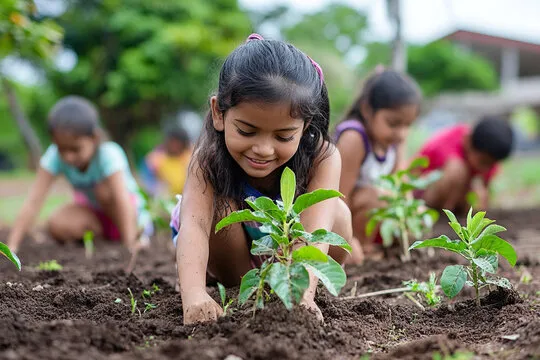
The monsoon is closeby. Within weeks, dark clouds will gather over the Himalayas, the earth will soften under the first generous rains, and nature will hand Jammu & Kashmir its single greatest opportunity of the year one that costs nothing but can change many things. If every family plants and honestly nurtures even a single sapling this monsoon, our landscape, climate, and quality of life can be transformed, not temporarily, not symbolically, but forever. This is not an environmental sermon. It is a direct, personal, and urgent appeal with your name on it.
You do not need a scientist to confirm that something has gone terribly wrong. Step outside on any summer afternoon and the heat strikes you like an open furnace. Summers our elders called warm are now medically dangerous. Heatwaves that were once rare have become annual features. Flash floods tear through river valleys every monsoon, carrying away in hours what communities built across generations. Dust coats every street, every surface and every lung. No ceiling fan or air conditioner made more miserable by poor power supply offers more than brief, expensive relief. This is neither misfortune nor divine punishment. It is the predictable consequence of losing trees, and we have been ignoring the warning for decades.
Cities without trees become heat traps where concrete and steel absorb the sun's heat all day and release it through the night. On hillsides, the absence of trees means rainwater rushes violently downhill, stripping fertile soil and flooding valleys below. The devastating floods of August 2025 grimly remind us. Without tree canopy, every dry week turns into a dust emergency, and the soil health and pollination that farmers silently depend upon slowly collapse.
The case for planting is not sentimental, it is mathematical. A single mature tree absorbs 22 kg of carbon dioxide annually, produces oxygen for two people, and cools its surroundings by up to 8 degrees Celsius. Multiply that across millions of trees and the scale of transformation becomes impossible to ignore.
Here is the truth nobody wants to say plainly: individuals wait for governments, governments wait for corporations, corporations wait for policy, and meanwhile the temperature climbs and trees keep disappearing. That cycle can only be broken by us personally, this season. Every individual must plant at least one tree this monsoon and every family at least two, not for a photograph, but as a real and sustained commitment.
Planting correctly matters as much as planting at all. Dig pits at least 60 centimetres deep, enrich them with compost, ensure proper drainage, and lay a mulch ring of dry leaves around each sapling to retain moisture. Water consistently for three full years and protect the tree until it no longer needs you. Connected spacing is not a minor detail. Large canopy trees need 6 to 8 metres between them, medium trees 4 to 5 metres, and smaller species 2 to 3 metres. Families in houses should plant in courtyards, along boundary walls, and on the public verge outside their gate. Families in apartments have no exemption as a balcony container or building compound works equally well.
Our natural heritage should guide every planting choice. The Chinar belongs to the centre of every vision, its magnificent canopy cooling entire streets, its cultural roots as deep as its actual ones. Deodar cedar belongs on the higher slopes, holding the Himalayan skyline that is slowly disappearing. Walnut trees deliver shade and income simultaneously, and Apple trees are carbon sinks and economic assets combined. For Jammu region, Gulmohar, Bargad, Amla, Arjun, Sukhchain, Simal, Plash, Mulberry, Jacranda and Amaltas provide fast shade, dust filtration, and a beauty that transforms an ordinary road into somewhere worth walking.
A grown tree is not decoration, it is infrastructure that works every hour of every day without salary, without electricity, and without complaint. Thus, the Government must act, not merely perform. Urban planning must make tree plantation mandatory in every construction approval. No building permission should be granted without a genuine green plan. Felling a mature tree must require independent assessment and the planting of at least ten replacements.
Every highway, district road, and village path needs a funded roadside plantation programme maintained with the same seriousness as the road surface itself. Native saplings must be freely available to every household that requests them. Forest and social forestry staff, and critically the labourers deployed by their contractors must work at ward, mohalla, and village level with good awareness about pit dimensions, spacing, drainage pattern, fencing, and aftercare.
There is a hard truth that must be stated plainly. Too many plantation drives have become annual rituals of waste saplings planted amid publicity, only to perish within weeks because nobody returns to care for them. Public money is spent, targets are declared achieved, and the environment gains nothing. Success must be measured not by saplings put in the ground but by trees that actually survive. Every programme must be independently monitored, survival rates publicly displayed, and funds transparently accounted for. Accountability must replace ceremony.
What Jammu & Kashmir needs is not another government scheme but a genuine people's movement with the moral urgency of the Chipko movement, which proved that ordinary citizens could change national policy. Planting trees must become not a duty but an identity, a source of pride, a community competition.
Every school, department, and social group should compete for the highest tree survival rate. Every mohalla should proudly display the number of trees it has nurtured. Every child should grow up responsible for one living tree, learning stewardship through action rather than textbooks.
Imagine roads canopied by mature shady trees where people walk in cool shade even in June. Imagine parks alive with birdsong, several degrees cooler, where children sit without fear of heatstroke. Imagine hillsides held firm by deep roots, sending monsoon rain gently downstream rather than violently into homes.
This is not a dream, it is the documented outcome of communities that chose action over indifference. Future generations will not remember the speeches delivered or the meetings held. They will remember whether we left them a greener, cooler, and more beautiful and green environment. The rains are knocking, the choice is ours and the time is now.
(The writer is a motivational speaker )