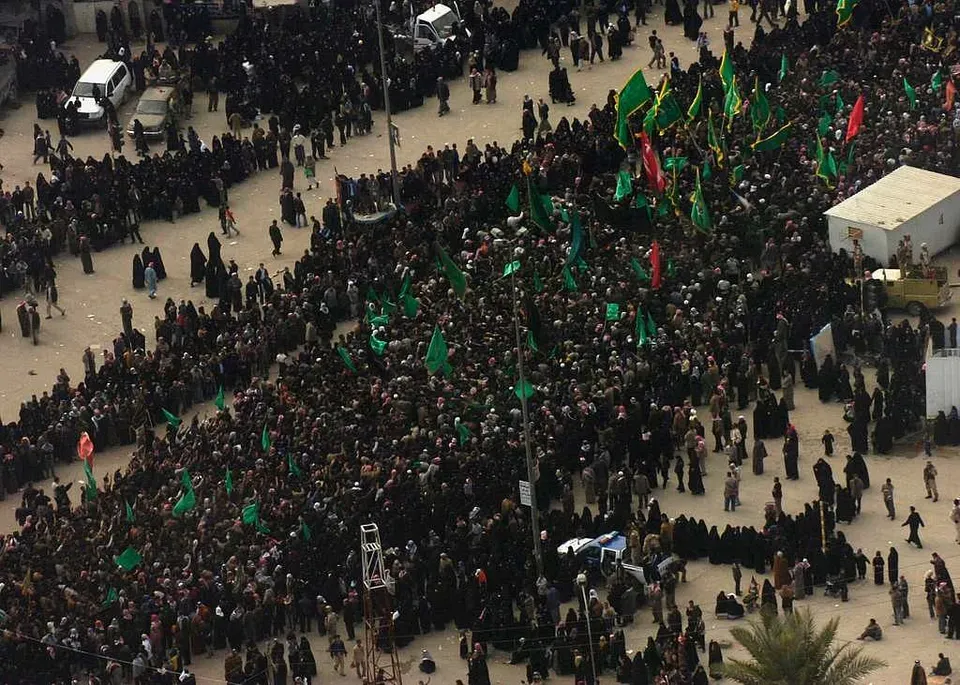
This year, Ashura feels different to me.
For years I had studied the story of Karbala. I had listened to scholars recount it, read books about it, and shed tears in its remembrance. But recently, Allah (swt) granted my family and me the opportunity to visit Iraq. Three generations made the journey together—my father, my mother, my sister, myself, and my nine-year-old daughter, Tajalli.
As we stood in Najaf, Kufa, and Karbala, I found myself reflecting not only on history, but on inheritance. We visited the humble home of Imam Ali (AS), where the leader of a vast Muslim nation lived in striking simplicity beside the mosque from which he taught, governed, and was ultimately martyred while in prayer. That visit stayed with me, for it reminded me that true greatness in Islam has never been measured by wealth, palaces, or power, but by character. It was perhaps for that reason that, standing before the maqam of Imam Ali (AS), I found myself reflecting not only on the man himself, but on how my love for him had reached me. It did not come primarily from books or lectures. It came from my father. I had watched his voice soften whenever he spoke of Imam Ali (AS). My father, in turn, had inherited that love from his grandfather. What had been passed down through generations was not merely information, but affection, reverence, and a moral vision. Then I watched my daughter walk those same courtyards. History, I realized, does not stop. It passes through us. And nowhere is that more evident than in Karbala.
Nothing prepares you for Karbala. You arrive believing you know the story. Yet standing there, Karbala refuses to feel like history. It feels like a question directed at every generation:
What will you do when truth becomes costly?
Standing in Karbala, that question no longer felt theoretical.
Imam Hussain ibn Ali (AS) was not merely the beloved grandson of Prophet Muhammad (SAW) he was the living conscience of Islam at a moment when its soul stood at a precipice. His stand at Karbala was not a thirst for power; it was a sacred resistance. A defiant refusal to let the faith of his grandfather (SAW) be hollowed out by tyranny, repackaged as a dynasty, and wielded as a tool of domination.
This was no ordinary political dispute—it was a seismic clash between two visions of Islam. On one side stood the Prophetic legacy: a model of justice, equity, humility, fair play, and truth—where leadership was a duty of moral accountability, not a prize of power, and authority existed to serve the people rather than rule over them. On the other stood a rising monarchy, veiled in religious language but rooted in tribal loyalty and dynastic ambition. It was not a contest over governance. It was a struggle for the soul of the faith itself. One path led to moral leadership guided by revelation; the other to a throne upheld by bloodline, coercion, corruption, and control.
Even the eminent companions of the Prophet (SAW), those who loved Imam Hussain (AS) deeply, advised caution. Their concern was sincere. But where they saw the danger of the present, Imam Hussain (AS) foresaw the danger of the future. They feared for his life. He feared for the soul of the Ummah.
He could have remained in Makkah, sheltered in its sacred sanctuary. But Imam Hussain (AS) knew the regime of Yazid would stop at nothing—not even defiling the Kaaba with his blood. And so he left. Not in fear, but in reverence. He refused to allow the House of God to become the site of a political murder.
He made his purpose crystal clear:
"Indeed, I did not rise out of arrogance or rebellion, nor for corruption or oppression. I rose only to reform the Ummah of my grandfather Muhammad (SAW)." In Karbala, Imam Hussain stood as a lone light against a sea of darkness. On the eve of battle, he gave his seventy-two companions permission to leave. He told them that the enemy sought only him. They were free to go. Not one left. They remained because they recognized the truth and understood that some things are more important than survival.
On the Day of Ashura, even as thousands surrounded him, Imam Hussain did not abandon prayer. Amid arrows and bloodshed, when the time for salah arrived, he stood before Allah (swt). Such was the spiritual gravity of his presence that even some among the opposing army paused to pray behind him. While standing in Karbala, another figure occupied my thoughts as much as Imam Hussain himself: Sayyida Zainab (AS). When the battle was over, when the family of the Prophet (SAW) lay martyred upon the sands, it was Zainab who carried the message forward. When asked what she saw that day, she said with unwavering clarity:
"I saw nothing but beauty."
It is one of the most astonishing statements in human history.
Because Karbala was not a tragedy in the ordinary sense. It was a triumph veiled in sacrifice, a victory etched in blood, and a lesson for all time. It was the triumph of truth over tyranny, the radiance of love refusing to surrender, and the sacrifice of faith standing tall in the face of brute force. Standing there, I finally began to understand why Karbala continues to move hearts fourteen centuries later.
And yet, despite its enduring power, some still ask a seemingly practical question: What did Karbala actually achieve?
Yet some, bound by the narrow confines of material logic, still ask: Why did he rise? What changed? They measure Karbala through the lens of short-term success—seats of power, political gains, and visible victories. But Karbala was never about temporal outcomes. It was a moral revolution, a fire lit in the heart of history. What they fail to grasp is that a Muslim is not commanded to guarantee results—only to pursue grand and principled objectives through righteous means and entrust the outcome to Allah (swt). That is the operating principle of Islam. And Imam Hussain embodied that principle with unmatched clarity and courage.
Wherever there is tyranny and oppression, Imam Hussain stands as a shining lodestar—guiding the oppressed, inspiring the just, and reminding the world that dignity never bows to corrupted power. And that kind of stand, in the eyes of eternity, is the highest form of success.
Allama Iqbal captured the eternal nature of this struggle:
"Moses and Pharaoh. Shabbir (Imam Hussain) and Yazid. These two forces always emerge in life."
And Josh Malihabadi gave us the unforgettable line:
"Islam is revived after every Karbala."
Because every age has its Yazid.
And every age needs its Imam Hussain.
During our visit, I found myself reflecting on that reality not only in the shrines and sermons, but within my own family. One evening in Karbala, I found myself watching my family more than the shrine itself. My daughter walked through the courtyards with wonder in her eyes, absorbing memories she may not fully understand today but will carry for the rest of her life. And then there was my mother.
After a long day of visitation and prayer, everyone was exhausted and ready to return to the hotel. Tajalli and my sister were waiting for her to finish her prayers so we could leave. Yet instead of concluding, she quietly began another two rak‘ahs. Later she told us what had happened. Standing in the Haram of Imam Hussain, she had suddenly felt the presence of her own mother in her heart. She was overwhelmed by memories and found herself praying for her. Then, with a smile, she added that she had remembered her father as well—“Dads always get tagged along with the moms.”
It struck me then that history is not preserved in books alone. It survives because people carry it. Karbala lives because each generation receives its trust and passes it on to the next. In that moment, watching my mother remember her parents and my daughter absorb memories she may carry for a lifetime, I realized once again that history does not stop. It passes through us.
In an age searching desperately for heroes, I find myself returning not to celebrities, politicians, billionaires, or influencers, but to a different lineage altogether: Muhammad (SAW), Imam Ali, and Imam Hussain. The Prophet Muhammad (SAW) taught that truth is worth sacrificing for, Imam Ali showed what justice looks like when one possesses power but refuses to be corrupted by it, and Imam Hussain showed what faith looks like when one possesses truth but is stripped of worldly power.
The chain is unbroken: there is no Hussain without Ali (AS), and there is no Ali (AS) without Muhammad (SAW).
The world offers many heroes, but most eventually disappoint us. Power changes them. Wealth corrupts them. Time exposes them. Yet the closer one looks at Muhammad (SAW), Imam Ali, and Imam Hussain, the greater they appear. They are not merely figures of history but enduring moral compasses. That is why fathers continue to tell their stories to their children, why pilgrims cross oceans to stand in Najaf and Karbala, and why their names continue to inspire hearts long after the names of kings, conquerors, and rulers have faded into obscurity. My father carried that love to me, and now, by Allah's grace, I hope to carry it to my daughter. Perhaps that is the deepest lesson of Karbala: truth survives when each generation chooses to carry it forward.
As our family left Karbala, my daughter carried home a small silver ring she had purchased in the bazaar near the Haram. My mother carried memories and prayers. My sister carried her own reflections from the journey. My father carried stories inherited from his elders. And I carried a renewed conviction that Karbala is not merely something we commemorate once a year. It is a trust passed from one generation to the next.
Empires have risen and fallen since Karbala. Dynasties have come and gone. Kings who commanded vast armies are remembered only by specialists, while the name of Imam Hussain continues to move millions who never met him, never saw him, and yet love him. That is because truth possesses a kind of life that power can never understand. The sword may win a battlefield, but only sacrifice wins history.
In Karbala, Imam Hussain drew a line—not merely in the sands of a desert, but in the conscience of humanity. He did not draw it with ink. He drew it with his blood. His sacrifice drew the line between Islam as a kingdom and Islam as a cause, between faith that serves power and faith that speaks truth to power.
And that line still speaks.
Every time tyranny rises, Karbala answers. Every time the soul of Islam is threatened, the blood of Imam Hussain speaks again.
Karbala is not a moment frozen in history. It is a movement that lives on wherever truth is chosen over falsehood, wherever dignity refuses to bow before oppression, and wherever human beings choose to bow only to God and never to corrupted power. Such souls, whether they realize it or not, continue to walk the path first illuminated by Prophet Muhammad (SAW), embodied by Ali, and immortalized at Karbala by Hussain.
Author is a student of faith, history, and the human experience. He writes occasionally to share reflections and insights gathered along the journey of life.