Prof. R.K. Uppal. [PhD, D.Litt.]
…………………………………………………………………………….
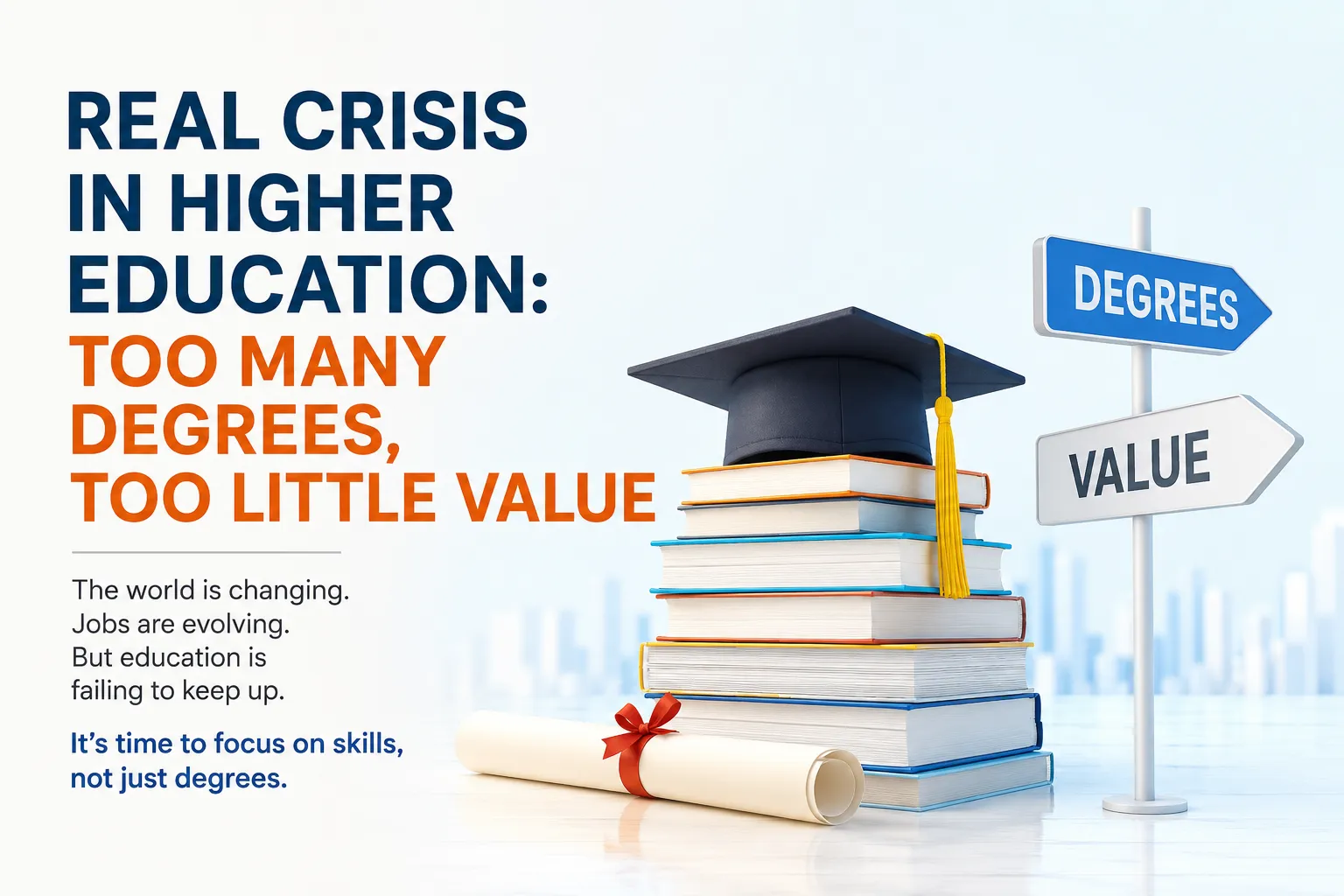
Higher education has long been celebrated as the foundation of economic growth, social mobility, and national development. Governments have expanded universities, increased enrollment capacity, and encouraged young people to pursue higher education as the key to a better future. On the surface, this appears to be a success story. More students are entering colleges and universities than ever before, and degree holders are increasing rapidly across the world. However, beneath these impressive numbers lies a disturbing reality. The real crisis in higher education today is not the shortage of degrees—it is the declining value of those degrees.
For decades, a university degree was viewed as a passport to employment, financial security, and professional advancement. Families made significant sacrifices to ensure that their children could attend college. Students invested years of their lives believing that education would open doors to rewarding careers. Unfortunately, that promise is becoming increasingly difficult to fulfill. Millions of graduates are entering labor markets where jobs are scarce, competition is intense, and employers are questioning whether graduates possess the skills required for the modern workplace.
The problem is not that too many people are pursuing education. Education remains one of society's most powerful tools for personal and national development. The problem is that higher education systems in many countries have become obsessed with quantity while neglecting quality and relevance. Universities proudly report rising enrollment figures, expanding campuses, and increasing graduation rates. Yet far less attention is given to a crucial question: Are graduates actually prepared for the realities of today's economy?
Graduate unemployment and underemployment have become alarming concerns. Many degree holders find themselves working in jobs that do not require university qualifications. Others struggle for months or even years to secure meaningful employment. This situation creates frustration among graduates, disappointment among families, and inefficiencies within the economy. A degree that does not significantly improve employability gradually loses its value in the eyes of students and employers alike.
One major reason for this crisis is the widening gap between university education and industry requirements. The world of work is changing rapidly due to technological advancements, artificial intelligence, automation, and globalization. Employers increasingly seek candidates with practical skills, digital literacy, critical thinking abilities, communication skills, adaptability, and problem-solving capabilities. However, many universities continue to rely on outdated curricula and traditional teaching methods that emphasize theoretical knowledge rather than practical competence.
Students often spend years memorizing information for examinations but receive limited exposure to real-world challenges. Internship opportunities remain insufficient, industry engagement is often weak, and experiential learning is not always prioritized. As a result, graduates may possess academic credentials but lack the skills necessary to thrive in modern workplaces. Employers are therefore forced to spend additional time and resources training new hires, creating frustration on both sides.
The rapid rise of artificial intelligence has further exposed the weaknesses of traditional higher education systems. AI is transforming industries at an unprecedented pace. Tasks that once required human effort are increasingly being automated. Entire professions are evolving, and new career opportunities are emerging. Yet many universities continue to operate as though these transformations are peripheral rather than central to the future of work. Students are graduating into an AI-driven economy without adequate preparation for the challenges and opportunities it presents.
Another troubling aspect of the crisis is credential inflation. As more people obtain degrees, employers often raise educational requirements for positions that previously required lower qualifications. In many cases, degrees become screening tools rather than indicators of competence. This creates a cycle in which students pursue additional qualifications simply to remain competitive, even when those qualifications do not necessarily improve their skills or productivity. The result is a labor market where credentials are abundant but genuine expertise remains scarce.
Research priorities within universities also deserve scrutiny. Many institutions emphasize publication counts, citation metrics, and ranking performance rather than research impact. Faculty members are often rewarded for producing large quantities of research papers, regardless of whether their work contributes to solving real-world problems. While academic research remains essential, universities must ensure that research activities also support innovation, entrepreneurship, industrial development, and societal progress. Knowledge that remains confined to journals has limited value compared to knowledge that generates meaningful change. Universities must confront these challenges with honesty and urgency. Incremental reforms are no longer sufficient. The future demands a fundamental rethinking of higher education's purpose and priorities. Institutions must move beyond the simple goal of producing graduates and focus instead on producing capable, innovative, and employable graduates.
Curricula should be regularly updated in collaboration with industry experts to reflect changing workforce needs. Practical learning, internships, apprenticeships, and project-based education should become central components of degree programs. Universities must integrate digital skills, artificial intelligence, entrepreneurship, and interdisciplinary learning into their academic frameworks. Students should graduate not only with knowledge but also with the ability to apply that knowledge effectively. Equally important is the need for stronger accountability. Universities should be evaluated not only on enrollment numbers or graduation rates but also on graduate outcomes, employability, research impact, innovation, and contributions to society. Success should be measured by the value institutions create rather than the number of degrees they award.
Higher education remains one of humanity's greatest achievements, but it cannot survive on reputation alone. The world is changing too quickly, and students face challenges too significant for universities to remain complacent. The future belongs to institutions that prioritize relevance, innovation, and impact over tradition and bureaucracy. The real crisis in higher education is not a shortage of degrees. It is the growing gap between degrees and value. Until universities address this gap, they risk producing more graduates but fewer opportunities, more credentials but less competence, and more promises than they can realistically deliver. The time has come for higher education to focus not on how many degrees it awards, but on how much those degrees truly matter.