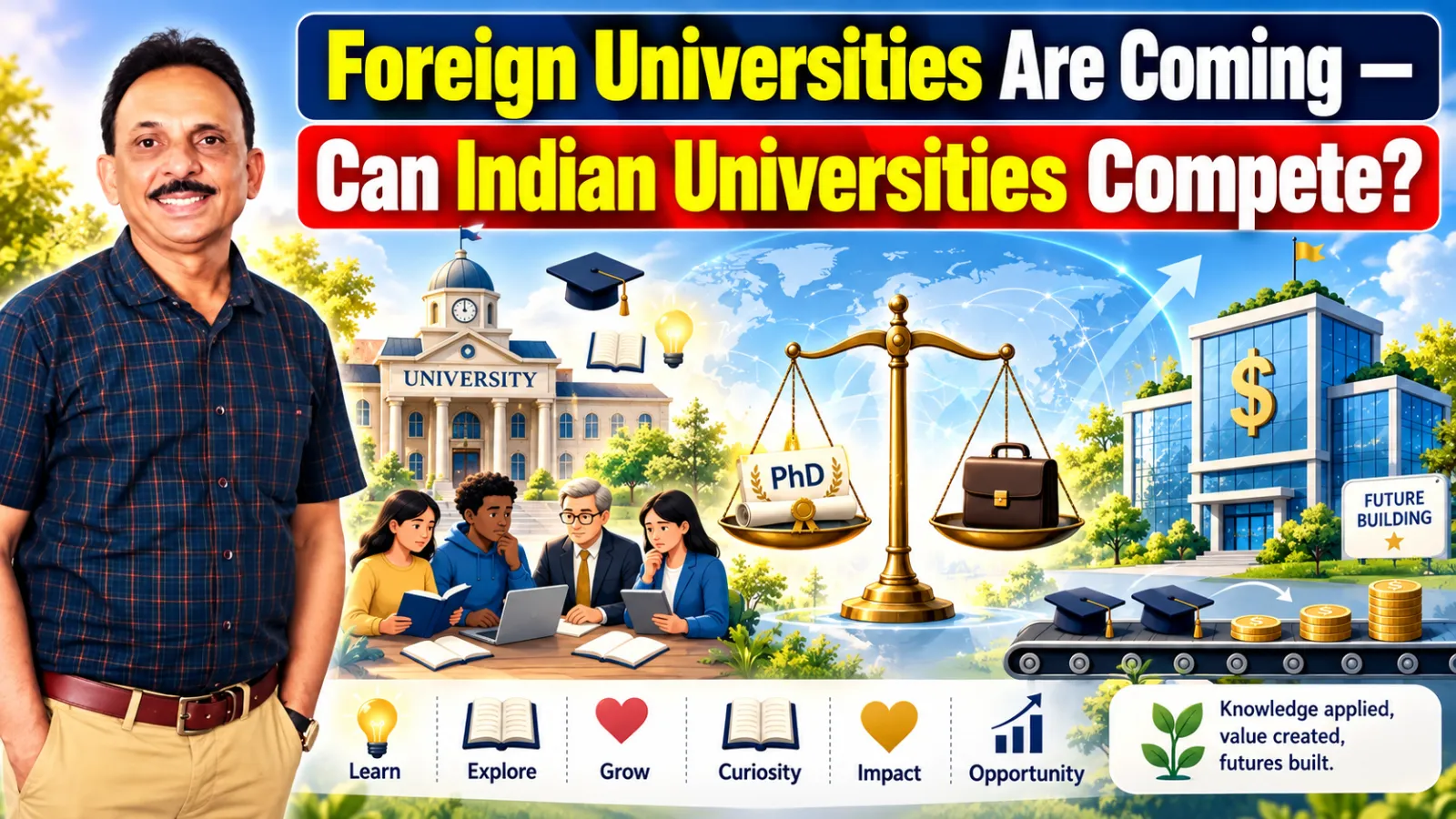
Private Universities: PhD or Business Model?
Growing Commercialization of Doctoral Education
Prof. R.K. Uppal
A PhD is supposed to be a journey of knowledge, inquiry and discovery—not a transaction in which a scholar pays heavily and hopes that a degree will eventually follow. Yet the rapid expansion of doctoral education, particularly in the private university sector, is raising uncomfortable questions about whether academic purpose is always keeping pace with institutional expansion.
Private universities have undoubtedly widened access to higher education and research. They have created new opportunities for students who might otherwise struggle to find doctoral seats. Many private institutions have also developed modern infrastructure, research centres and interdisciplinary programmes. But expansion alone cannot be treated as evidence of research excellence.
The central question is simple: Are we producing researchers—or merely increasing the number of people enrolled in PhD programmes? The University Grants Commission’s Ph.D. Regulations, 2022, apply to universities established under Central, State or Provincial legislation and to deemed universities. The regulations emphasize research training, qualified supervision, and research integrity and defined admission procedures.
The most sensitive issue is money. Doctoral education inevitably involves costs. Universities need laboratories, libraries, databases, research facilities, administrative systems and qualified faculty. Charging reasonable fees is therefore not inherently incompatible with quality research.
The problem arises when the financial relationship begins to overshadow the academic relationship. A research scholar should not feel primarily like a fee-paying customer. A university should not measure doctoral success simply by the number of registrations. And a PhD programme should never become dependent on continuously expanding enrolment without corresponding academic capacity.
The danger is particularly serious when students from middle-class and modest-income families invest substantial amounts of money, time and years of their professional lives in doctoral education. For them, a PhD is not simply another qualification. It can represent years of sacrifice and expectations of an academic or professional career.
If the academic environment is weak, the cost is not merely financial. The scholar can lose years of life, research opportunities and career momentum. Too Many Scholars, Too Few Mentors
One of the most fundamental requirements of doctoral education is qualified supervision. The UGC’s 2022 regulations specify eligibility requirements for research supervisors and prescribe limits on the number of scholars that professors, associate professors and assistant professors may supervise. The regulations allow up to eight PhD scholars for an eligible professor, six for an associate professor and four for an assistant professor.
These limits reflect a basic academic reality: supervision is not a mass-production activity. A supervisor must read drafts, challenge assumptions, guide methodology, monitor progress, recommend literature, discuss findings and help a researcher develop independent intellectual judgment.
When one supervisor has too many scholars, meaningful supervision becomes difficult. The danger is that supervision can turn into signatures, routine meetings and administrative compliance rather than genuine intellectual mentorship. This is where universities must exercise restraint. PhD seats should follow academic capacity—not the other way around.
The Silent Crisis of Scholar Dependence. Doctoral scholars often occupy a vulnerable position. They depend on supervisors for guidance, progress assessments, recommendations and sometimes access to institutional resources.
This creates an imbalance of power. A healthy doctoral system must protect scholars from arbitrary treatment, unnecessary delays, intimidation, discrimination, harassment and academic exploitation. At the same time, scholars must also be held to high standards of originality, discipline, research ethics and academic responsibility.
The answer is not to weaken the authority of supervisors. It is to create accountable supervision. Research Advisory Committees, transparent progress monitoring, documented academic requirements and effective grievance mechanisms can help prevent individual relationships from becoming excessively dependent or arbitrary. The 2022 UGC framework also requires institutions to maintain information on supervisors and registered scholars and emphasizes research integrity and plagiarism detection.
A PhD Is Not a Guaranteed Career Ticket. Another uncomfortable reality needs to be confronted.
India cannot solve its employment problem simply by producing more PhDs. A doctoral degree represents advanced research training; it does not automatically guarantee a teaching position, promotion or academic career. If universities continue expanding doctoral enrolment without considering the broader employment and research ecosystem, thousands of young researchers may emerge with impressive qualifications but limited opportunities.
Universities exist to create knowledge, not merely credentials. Quality Must Become the Bottom Line. The solution is not to attack private universities as a category. Many private universities are making serious contributions to research and higher education. The issue is whether every institution offering doctoral education can demonstrate the academic capacity required to do so. A credible PhD programme should be judged by the quality of its supervisors, research infrastructure, publications, methodology training, external evaluation, research ethics, completion standards and contribution to knowledge—not simply by the number of scholars admitted.
The UGC regulations already provide an important framework: defined admission procedures, supervisor eligibility, limits on supervision, research advisory mechanisms, coursework and external thesis evaluation.
The challenge is implementation. Regulation on paper is not enough. Universities must build a culture in which academic quality has greater importance than enrolment targets.
The PhD Must Be Saved from Commercialization India needs more research—but it needs better research. It needs more PhDs—but it needs PhDs produced through rigorous scholarship, competent supervision and intellectual honesty. Private universities can play a major role in building India’s research ecosystem. But their credibility will ultimately depend on whether they treat doctoral education as an academic mission or primarily as an expanding revenue stream.
The warning is clear: when research becomes secondary to revenue, the PhD loses its meaning. A doctoral scholar is not a customer. A supervisor is not merely an administrative functionary. A thesis is not a formality. And a PhD is certainly not a product to be sold. The future of Indian research depends on remembering this fundamental principle: A PhD must be earned through knowledge, originality and rigorous scholarship—not purchased through fees. That is the standard every university—public or private—must be prepared to defend.