Private Universities and Faculty Exploitation:
A Silent Crisis in Higher Education
Prof. R.K. Uppal
……………………………………………………………
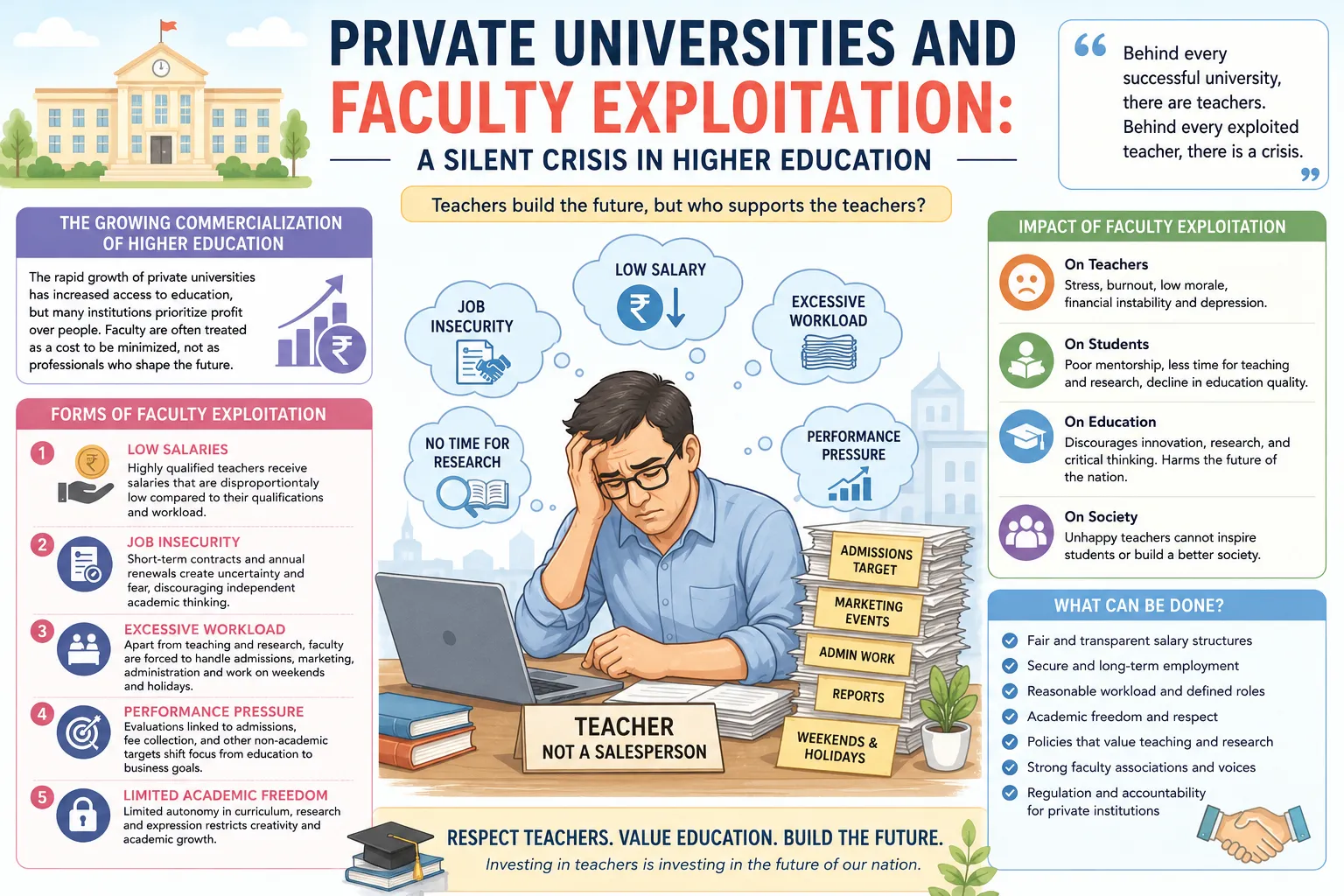
One of the most common forms of exploitation is the poor remuneration of teaching and non-teaching staff. Despite possessing advanced qualifications such as PhD, UGC-NET, and JRF, many faculty members receive salaries that are substantially lower than those prescribed by the University Grants Commission. Contractual appointments, delayed salary payments, and the absence of annual increments are common complaints in many institutions. Another major issue is job insecurity. Faculty members are often employed on short-term contracts and can be dismissed with little notice. The lack of tenure or long-term employment discourages independent research and academic freedom. Many teachers feel compelled to comply with administrative demands rather than focus on quality teaching and scholarship.
The growth of private universities has been one of the most significant developments in India's higher education sector over the last two decades. With increasing demand for quality education and limited capacity in public institutions, private universities have played an important role in expanding access to higher learning. They have introduced new academic programmes, modern infrastructure, industry-oriented courses, and international collaborations. However, behind this remarkable growth lies a challenge that often receives inadequate attention—the exploitation of employees. This silent crisis affects faculty members, administrative staff, and support personnel and has serious implications for the quality and future of higher education.
A university's greatest asset is not its buildings or technology but its people. Teachers, researchers, administrators, and support staff collectively shape the academic environment and determine the institution's success. Unfortunately, in many private universities, employees face issues such as low salaries, job insecurity, excessive workloads, limited career growth, and inadequate recognition for their contributions. While these concerns do not apply to every institution, they are widespread enough to warrant serious discussion.
One of the most common grievances is inadequate compensation. Many highly qualified faculty members, including those holding PhD degrees and prestigious research qualifications, receive salaries that do not correspond to their educational background, expertise, and responsibilities. In some institutions, salary structures lack transparency, and annual increments are modest despite increasing workloads and institutional expectations. The gap between qualifications and remuneration can discourage talented individuals from pursuing long-term careers in academia.
Job insecurity is another major concern. A considerable number of employees are appointed on contractual or probationary terms, with limited assurance of long-term employment. Contract renewals may depend on administrative decisions that employees perceive as lacking transparency. This uncertainty creates stress and makes it difficult for faculty members to focus entirely on teaching, research, and academic innovation. The absence of stable employment conditions can also lead to high staff turnover, disrupting academic continuity and affecting students.
Another issue is the growing commercialization of higher education. As private universities operate in a competitive environment, maintaining financial sustainability and increasing student admissions often become institutional priorities. In some cases, faculty members are expected to participate in admission campaigns, promotional events, marketing activities, and other non-academic tasks. While institutional development requires collective effort, excessive involvement in such activities can divert attention from the core academic responsibilities of teaching, research, and student mentoring.
Workload management has also emerged as a significant challenge. Faculty members are often expected to teach multiple courses, supervise student projects, conduct research, publish papers, attend meetings, prepare accreditation reports, and perform administrative duties simultaneously. During admission seasons or accreditation visits, additional responsibilities may further increase work pressure. Long working hours and unrealistic expectations can contribute to stress, burnout, and reduced job satisfaction.
Research and professional development opportunities are equally important for academic excellence. Universities are expected to encourage faculty members to attend conferences, undertake research projects, publish scholarly work, and engage in continuous learning. However, limited financial support and insufficient institutional encouragement may restrict these opportunities in some private institutions. Without adequate investment in faculty development, universities may struggle to maintain academic standards and innovation.
Regulatory agencies can also contribute by including employee welfare indicators in quality assessment and accreditation processes. Factors such as faculty retention, professional development opportunities, transparent governance, and employee satisfaction should be considered alongside infrastructure and academic outcomes. Such measures would encourage institutions to create healthier and more sustainable work environments.
A positive workplace culture is equally essential. Open communication between management and employees, mechanisms for addressing grievances, and recognition of outstanding performance can strengthen trust and institutional commitment. Employees who feel respected and valued are more likely to contribute creatively and enthusiastically to the university's mission. India aspires to become a global knowledge economy and a leader in higher education. Achieving this vision requires not only modern campuses and innovative curricula but also a strong commitment to the well-being of those who make education possible. Universities cannot produce world-class graduates if the educators themselves face persistent insecurity, excessive pressure, and inadequate support.
Private universities have made significant contributions to expanding educational opportunities and meeting the growing demand for higher education. However, their long-term success depends on creating workplaces where employees are treated with dignity, fairness, and respect. Academic excellence cannot be sustained through infrastructure and technology alone; it requires motivated, secure, and professionally fulfilled educators and staff. The future of higher education depends on recognizing that employees are not merely operational resources but the intellectual foundation of every institution. Investing in their welfare is not simply an ethical responsibility—it is a strategic necessity. A university that values its employees ultimately strengthens its students, enhances its reputation, and contributes more effectively to national development. The silent crisis of employee exploitation must therefore be addressed if higher education is to fulfil its promise of building a stronger and more prosperous India.