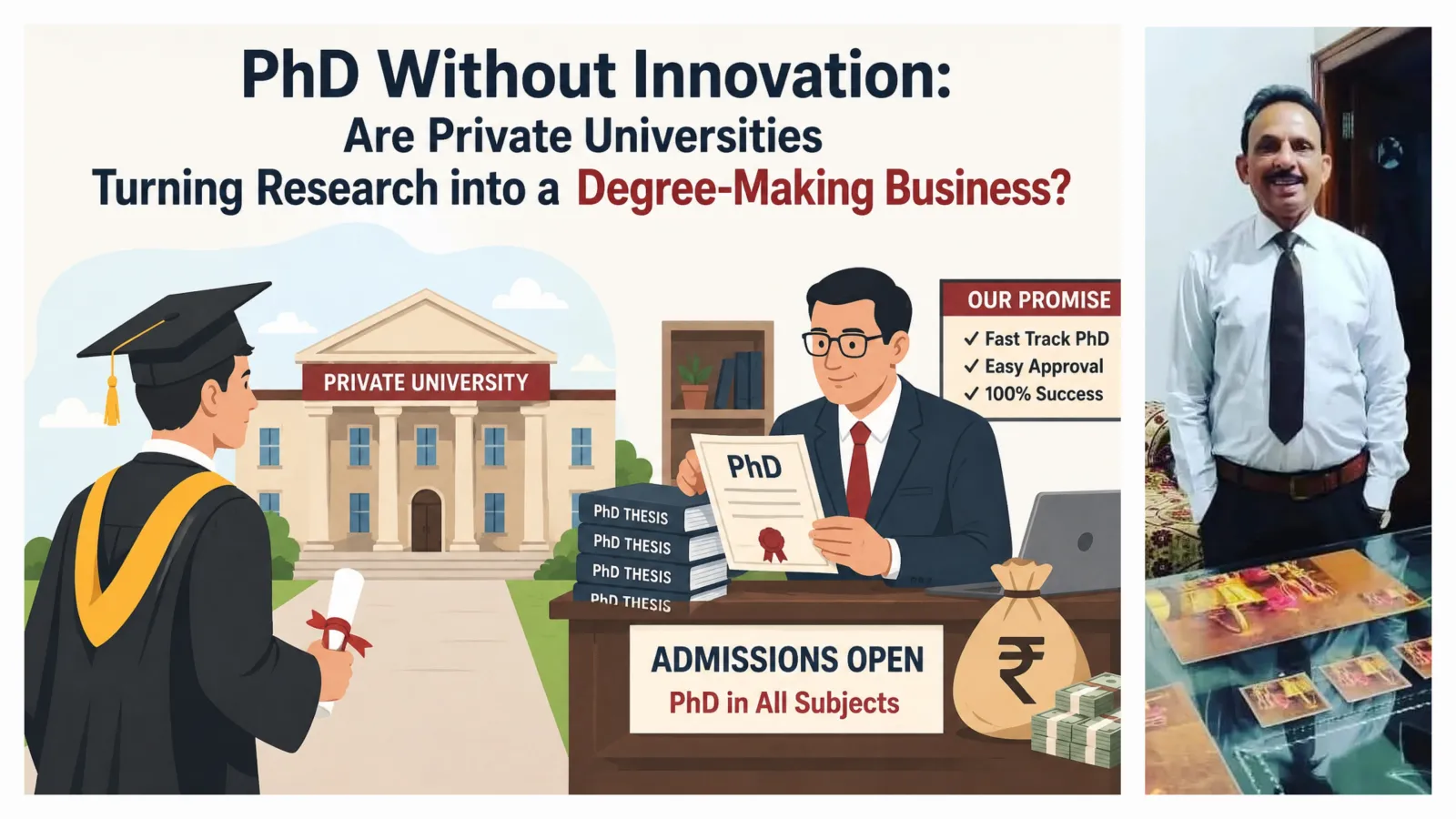
PhD Without Innovation: Are Private Universities
Turning Research into a Degree-Making Business?
Prof. R.K. Uppal. [PhD, D.Litt.]
India’s higher education landscape has undergone a dramatic transformation over the past few decades. Private universities have emerged as major players, expanding access to undergraduate, postgraduate and doctoral education. The growth of PhD programs has created opportunities for thousands of aspiring researchers who previously had limited options. Yet this expansion also raises an uncomfortable question: Are we producing scholars who create new knowledge, or simply increasing the number of people holding doctoral degrees?
A PhD is supposed to represent the highest level of academic training. It is not merely a certificate awarded after several years of study. A genuine doctorate requires originality, rigorous investigation, critical thinking, methodological discipline and a meaningful contribution to existing knowledge. When these fundamental principles are weakened, the value of the doctoral degree itself comes under question.
The most important issue is innovation. A doctoral researcher should ideally address a significant problem, identify a gap in existing knowledge and develop new evidence, ideas or solutions. However, concerns about repetitive research topics, limited originality and superficial investigations have raised questions about the quality of doctoral research in some institutions. If researchers repeatedly examine familiar subjects without generating fresh insights, the country may end up producing more theses without producing more knowledge.
This is particularly important for India, which has ambitious goals in science, technology, education and economic development. Universities are expected to contribute to national innovation through research. PhD scholars should be at the forefront of this process. Their work should help solve problems related to agriculture, healthcare, climate change, artificial intelligence, manufacturing, education, social development and countless other areas. A doctoral system that prioritizes the completion of a thesis over meaningful discovery risks missing this larger purpose.
The quality of supervision is another major concern. A strong PhD programme depends heavily on capable and committed supervisors. A supervisor is not simply someone who signs forms or monitors deadlines. The supervisor is expected to challenge assumptions, strengthen methodology, identify weaknesses and encourage the researcher to think independently.
Private universities expanding doctoral admissions must therefore ask whether they have enough qualified researchers to provide high-quality supervision. A university may have impressive buildings and modern facilities, but its doctoral programme ultimately depends on the academic strength of its faculty. Research culture cannot be manufactured through infrastructure alone.
Research infrastructure itself remains crucial. Serious doctoral work often requires access to laboratories, specialized equipment, academic databases, journals, software, fieldwork facilities and research funding. In disciplines where experimental or data-intensive research is required, inadequate facilities can severely limit the quality of a thesis.
There is also a larger question concerning the commercialization of doctoral education. Private universities operate in a competitive educational environment and financial sustainability is a legitimate concern. But a PhD cannot be treated like an ordinary commercial product.
When doctoral education becomes excessively driven by revenue, the academic relationship between university and scholar can change. The student risks becoming primarily a fee-paying customer rather than an emerging researcher. This creates difficult questions about admission practices, supervision capacity, infrastructure and the overall academic environment.
Publication pressure is another issue that deserves careful examination. Academic publications are an important part of research. They allow scholars to communicate findings and participate in national and international academic debates. But the obsession with publication numbers can produce undesirable consequences.
The role of the external examiner is particularly important. A doctoral thesis should face rigorous and impartial academic scrutiny. External evaluation can help ensure that the thesis meets the expected standards of originality, methodology and contribution to knowledge. The examination process should be about academic quality rather than merely completing a procedural requirement.
Another uncomfortable question concerns the career consequences of producing large numbers of PhDs without strengthening the research ecosystem. If doctoral enrolment expands rapidly while academic, industrial and research employment opportunities remain limited, highly qualified graduates may face frustration and underemployment. Producing PhDs must therefore be accompanied by investment in research institutions, universities, laboratories, industry partnerships and innovation ecosystems.
Regulators also have an important responsibility. Rules governing doctoral education must not remain merely on paper. Their implementation must be regularly monitored, and institutions failing to maintain academic standards should face meaningful consequences. Transparency about faculty qualifications, research output, supervision capacity, research facilities and doctoral outcomes can also help prospective scholars make informed decisions.
Ultimately, the success of a PhD programme should not be measured simply by the number of scholars admitted or degrees awarded. The more meaningful questions are: What new knowledge was created? What problems were solved? What innovations emerged? What research changed professional or social practice?
India does not merely need more PhDs. It needs PhDs capable of advancing knowledge, challenging conventional thinking and creating solutions.
The challenge before private universities is therefore not simply to expand doctoral education, but to protect its intellectual purpose. A PhD should be a symbol of discovery, not merely a document of completion.
If India wants to become a genuine knowledge and innovation economy, its universities must produce researchers who do more than write theses. They must produce scholars who question, discover, innovate and create knowledge that matters.