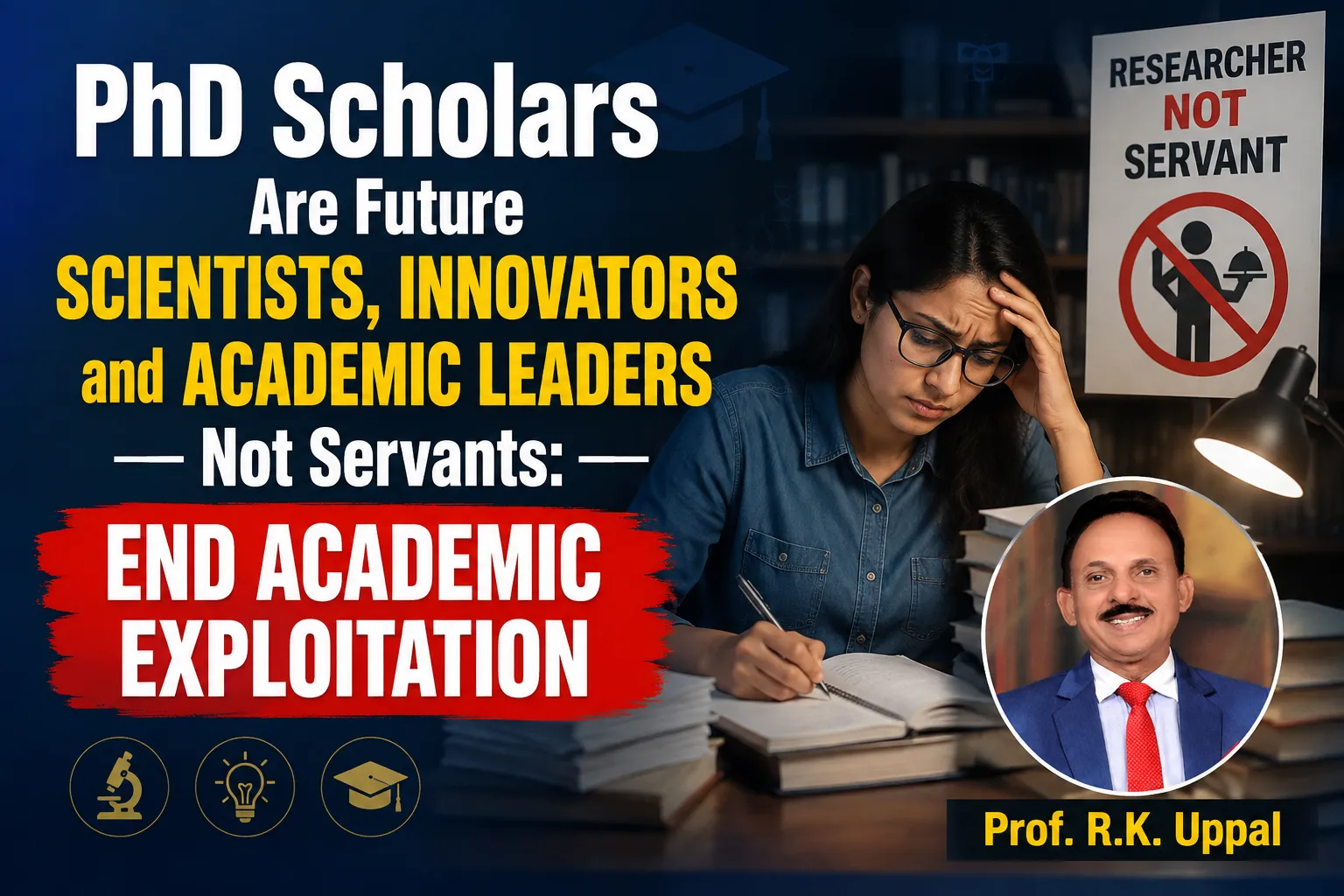
PhD Scholars Are Future Scientists, Innovators and Academic Leaders - Not Servants: End Academic Exploitation
Prof. R.K. Uppal
A PhD scholar is not a servant, personal assistant, clerical worker, admission agent or unpaid employee. A PhD scholar is a future scientist, innovator, teacher, researcher and academic leader. Yet in many institutions, particularly where academic systems are poorly regulated, doctoral scholars are increasingly exposed to practices that have little connection with genuine research. This culture of exploitation must end. Universities must understand that protecting the dignity, independence and intellectual freedom of PhD scholars is not a favour—it is an essential condition for building a strong knowledge economy.
The purpose of doctoral education is to create new knowledge. A PhD is not merely another degree to be collected for promotion or employment. It represents years of intellectual effort, experimentation, analysis, critical thinking and original research. A scholar enters a doctoral programme with the expectation that the university and supervisor will provide an environment in which ideas can develop freely. The supervisor should act as a mentor, guide and academic role model—not as a master exercising unlimited authority over a subordinate.
Unfortunately, the imbalance of power between supervisors and scholars can sometimes create opportunities for exploitation. Scholars may be expected to perform unrelated administrative duties, prepare personal documents, undertake excessive routine work, manage non-academic activities or perform tasks that have little relationship with their research. Such practices consume valuable research time and weaken the very purpose of doctoral education.
The most dangerous consequence is the destruction of academic freedom. A scholar who constantly fears displeasing a supervisor may hesitate to question established ideas, propose alternative theories or challenge research assumptions. But genuine research requires intellectual courage. Science advances because researchers ask difficult questions, challenge conventional wisdom and sometimes disagree with established authorities. A PhD environment that punishes independent thinking cannot produce world-class researchers.
The supervisor–scholar relationship must therefore be based on mentorship, mutual respect, transparency and academic accountability. A supervisor has authority because of academic expertise, not because a scholar is powerless. Supervisory authority should be used to develop a researcher's capabilities, not to control or intimidate them.
Universities also need to recognize the economic vulnerability of many PhD scholars. Doctoral researchers frequently devote several years of their lives to research while receiving limited financial support. If they are simultaneously burdened with excessive non-research responsibilities, the opportunity cost becomes enormous. They lose research time, publications suffer, innovation declines and the quality of the eventual thesis is compromised.
The answer is not simply to produce more PhDs. India needs better PhDs—research that solves real problems, creates intellectual property, develops useful technologies, influences public policy and contributes to industry and society. A doctoral thesis should not be treated as a 200-page formality designed merely to satisfy institutional requirements. It should demonstrate originality, relevance and measurable intellectual or practical contribution.
Supervisors must also be evaluated on the quality of mentorship they provide. The number of scholars under a supervisor should not become a symbol of academic power. A supervisor with dozens of researchers but little meaningful research output may be less valuable to the academic system than a mentor who successfully develops a small group of independent scholars. Universities should measure doctoral supervision through research quality, completion outcomes, publications, patents, innovations, collaborations and the professional development of scholars.
There must also be an effective grievance-redressed mechanism. A scholar should be able to report academic exploitation without fear of retaliation. Complaints should be examined independently, confidentially and fairly. No student should be forced to choose between protecting their dignity and completing their PhD.
Technology can help universities create greater transparency. Research milestones, supervisory meetings, progress reviews and academic responsibilities can be documented through institutional systems. This does not mean creating a surveillance culture; rather, it means establishing transparent academic processes in which both supervisors and scholars understand their responsibilities.
A PhD supervisor should be able to say: "My success is not measured by how much work my scholar does for me; it is measured by how much independent capability the scholar develops." This should become the foundation of doctoral supervision.
A healthy academic culture does not produce obedient followers. It produces independent thinkers. The greatest achievement of a supervisor is not to create scholars who depend permanently on their authority, but researchers who eventually become capable of leading laboratories, universities, research institutions and innovative enterprises themselves.
India has enormous intellectual talent. Thousands of young people enter doctoral programmes with dreams of becoming scientists, professors, innovators and researchers. Their enthusiasm must not be destroyed by hierarchical exploitation, unnecessary control or irrelevant workloads. Their years of doctoral study should be years of intellectual growth—not years of fear and servitude.
The message is therefore clear: PhD scholars are not servants. They are India's future knowledge creators. Supervisors must mentor them, universities must protect them, and regulatory authorities must ensure accountability. The time has come to move from the culture of control to the culture of mentorship, from academic exploitation to academic empowerment, and from degree production to genuine knowledge creation. A strong India needs strong researchers. Strong researchers need freedom, dignity and responsible mentorship. End academic exploitation. Respect the PhD scholar. Build the scientist, innovator and academic leader India needs.