Prof. R.K. Uppal. [PhD, D.Litt.]
………………………………………………………………………………….
The National Education Policy (NEP) 2020 represents one of the most ambitious reforms in the history of Indian education. Introduced after more than three decades, it seeks to transform the country's education system from one driven by rote learning and rigid structures into one that promotes creativity, critical thinking, innovation, multidisciplinary learning, and global competitiveness. It reflects a bold vision of preparing India's youth for the challenges and opportunities of the twenty-first century.
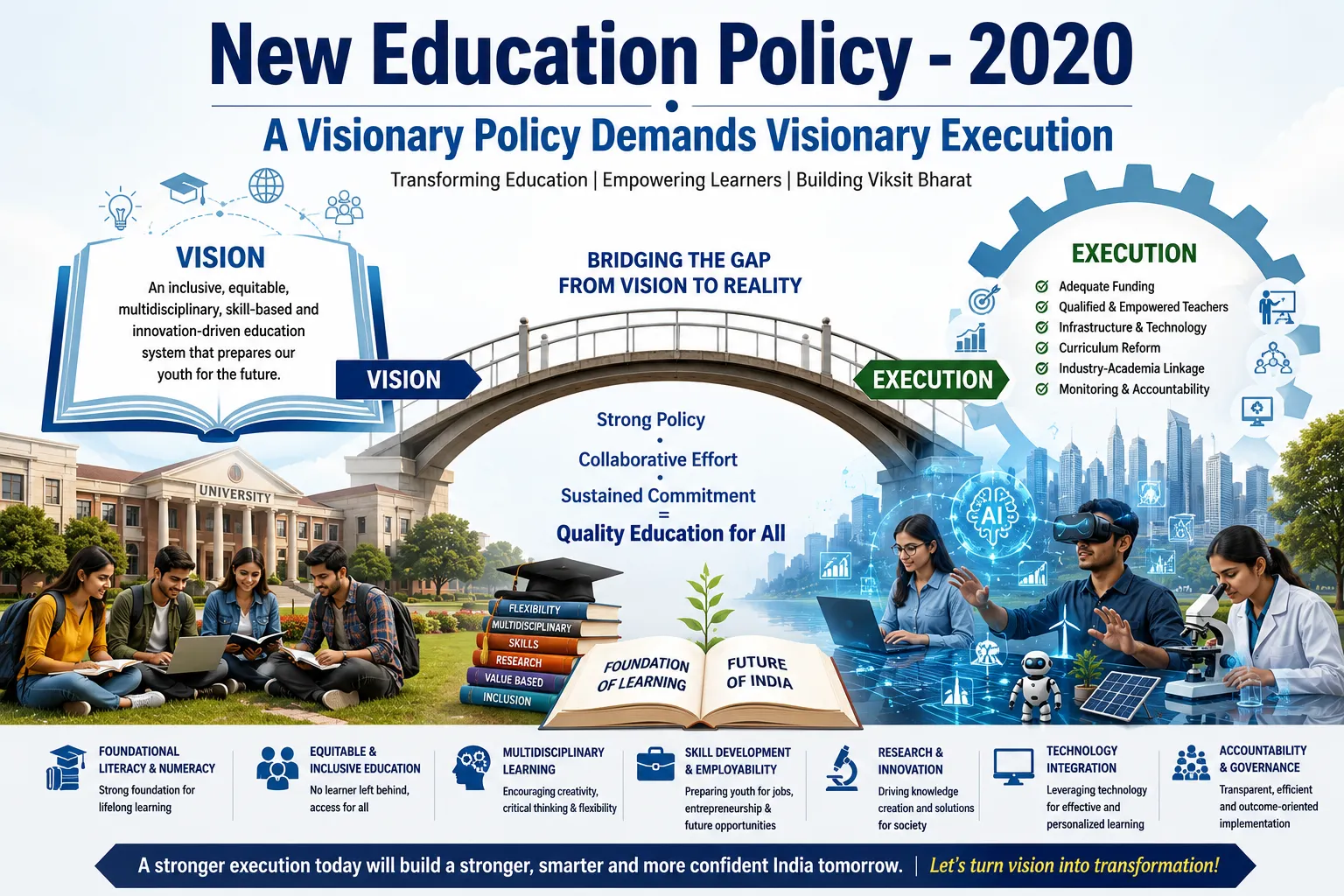
There is little doubt that NEP 2020 is visionary in its intent. It recognizes the need to equip learners with skills rather than merely degrees, encourages flexibility in learning pathways, emphasizes research and innovation, promotes vocational education, supports the integration of technology, and seeks to strengthen the relationship between education and industry. If implemented effectively, the policy has the potential to reshape India's educational landscape and contribute significantly to the nation's economic and social development.
However, every great vision demands equally great execution. This is where the real challenge begins.
Nearly six years after its announcement, the implementation of NEP 2020 remains uneven across the country. While several premier institutions have successfully adopted multidisciplinary programmes, flexible curricula, digital learning platforms, and skill-based education, many universities and colleges—particularly in rural and semi-urban India—continue to struggle with inadequate infrastructure, financial constraints, faculty shortages, and administrative limitations. The gap between policy and practice remains significant.
Educational reform cannot succeed through policy documents alone. It requires classrooms equipped with modern technology, laboratories that support experimentation, libraries with updated resources, and institutions led by competent academic administrators. Unfortunately, many higher educational institutions continue to face shortages of basic facilities, making it difficult to translate the policy's vision into meaningful classroom experiences.
Perhaps the most important stakeholders in educational reform are teachers. No education system can rise above the quality of its teachers. NEP 2020 rightly emphasizes faculty development, research, and academic excellence. Yet many institutions continue to face acute shortages of qualified faculty. In several private universities, highly qualified teachers with NET qualifications and doctoral degrees receive salaries that are far below professional expectations. Many are also expected to spend considerable time on admissions, administrative work, and institutional promotion, leaving less time for quality teaching, mentoring, and research. Such practices undermine the very objectives that NEP 2020 seeks to achieve.
Research and innovation form another cornerstone of the policy. India aspires to become a global knowledge economy, but meaningful research requires sustained investment, advanced infrastructure, academic freedom, and collaboration with industry. While the proposed National Research Foundation is an important initiative, the broader research ecosystem still faces significant challenges. Limited funding, inadequate laboratory facilities, bureaucratic hurdles, and a continuing emphasis on publication numbers rather than societal impact have slowed the pace of innovation. Building a research-driven nation demands far greater investment than currently available.
The policy also aims to bridge the gap between education and employment. Skill development, internships, vocational education, and industry collaboration are expected to improve graduate employability. However, millions of educated young people continue to struggle in the job market. Employers frequently report that graduates possess theoretical knowledge but lack practical skills, communication abilities, digital competencies, and problem-solving capabilities. Curriculum reform must therefore be accompanied by deeper partnerships between educational institutions and industry, ensuring that graduates are prepared for real-world challenges.
Digital education has emerged as another important pillar of NEP 2020. Online learning platforms, digital libraries, and technology-enabled classrooms have expanded educational opportunities. Nevertheless, the digital divide continues to affect millions of students, particularly those from rural and economically weaker backgrounds. Unequal access to internet connectivity, digital devices, and technical support limits the effectiveness of technology-based learning. Digital transformation must therefore be inclusive rather than selective.
Governance reforms also require greater attention. Universities need genuine academic autonomy, transparent governance, and reduced bureaucratic interference if they are to innovate and compete globally. Institutional leaders should be empowered to make academic decisions while remaining accountable for measurable outcomes. Excessive regulation often discourages experimentation and delays decision-making, slowing the pace of reform.
Another concern is the variation in implementation across states. Education is a shared responsibility, and differences in administrative capacity, financial resources, and institutional preparedness have resulted in uneven progress. A national policy can achieve its objectives only when every state and every institution possesses the capacity to implement it effectively.
The success of NEP 2020 ultimately depends not on the brilliance of its vision but on the seriousness of its execution. Governments must substantially increase investment in education, strengthen teacher recruitment and professional development, modernize educational infrastructure, expand research funding, encourage industry partnerships, and establish robust systems for monitoring outcomes. Institutions, in turn, must embrace innovation while maintaining high standards of quality and accountability.
India stands at a critical moment in its educational journey. With the world's largest youth population, the country has a unique opportunity to become a global leader in knowledge, research, entrepreneurship, and innovation. NEP 2020 provides a comprehensive roadmap toward that goal. Yet even the most visionary roadmap is meaningless unless travellers are able to complete the journey.
The true measure of NEP 2020 will not be the number of policies announced, committees constituted, or guidelines issued. Its success will be judged by whether students become more employable, teachers more empowered, researchers more innovative, institutions more autonomous, and graduates better prepared to contribute to society and the economy.
NEP 2020 has given India a visionary blueprint for educational transformation. The responsibility now lies with governments, universities, educators, industry, and society to ensure that this vision is matched by equally visionary execution. Only then can the promise of NEP 2020 become a lasting reality for millions of Indian learners.