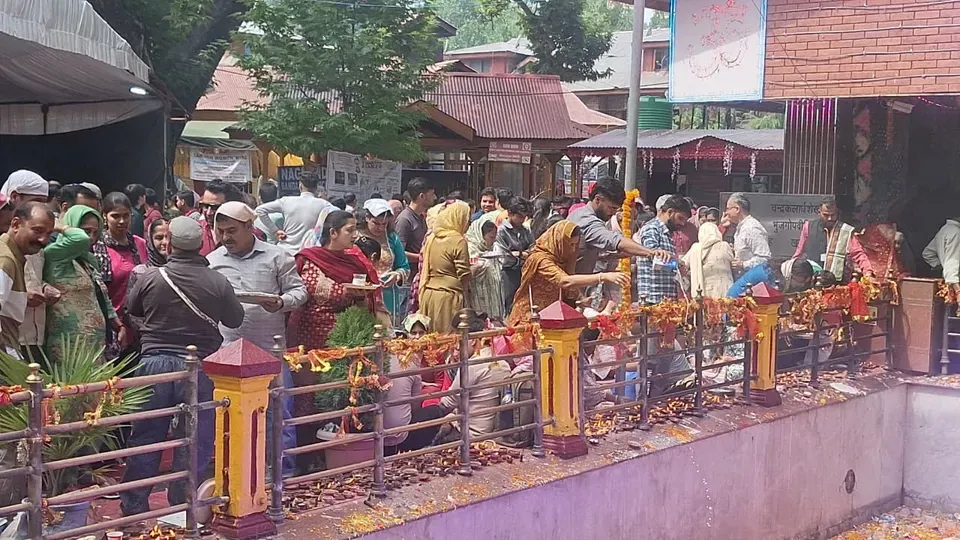
Tulmulla, Jun 22: The annual Kheer Bhawani Mela at Mata Ragnya Devi shrine in Tulmulla Ganderbal witnessed more than prayers on Monday.
For thousands of Kashmiri Pandits, it rekindled hope of reunion with their faith, their homeland, and neighbours they once called family.
From 6 am, the spring at Tulmulla echoed with hymns.
Elderly devotees touched the temple stones with tears, while children born outside Kashmir saw the shrine for the first time. Though away from their homes and roots in Kashmir since three decades, the annual Kheer Bhawani Mela every year rekindles a new hope among the displaced Kashmiri Pandits of their return and rehabilitation in their ancestral land.
For Kashmiri Pandits, Jyeshtha Ashtami at Mata Kheer Bhawani shrine is not just a festival, it’s a homecoming.
“We left in 1990. Today I am offering kheer at the same spot where my grandmother did,” said Sunita Dhar from Jammu. “Seeing Muslim brothers serve us water and help with tents, it feels like nothing changed.”
Amid the spiritual atmosphere at the Kheer Bhawani Temple in Tulmulla, several Kashmiri Pandit families visiting the shrine voiced a strong desire to return permanently to their homeland, saying Kashmir remains an inseparable part of their identity and memories.
During their visit to the temple, members of the Kashmiri Pandit community said they long to live once again in the Valley alongside their Muslim neighbours, just as they did for generations before displacement.
As Sarla Koul, 75, put it while packing her kheer bowl: “My address is Jammu. But my home is still Kashmir.”
“We live in Jammu, but our hearts live here,” said Vijay Raina, 68, who travelled 18 hours from Delhi. “One day a year, Tulmulla lets us be Kashmiri again, speak the language, eat nadru, and sleep under these chinar trees.” "Kashmir is our birthplace. We have countless memories attached to this land and we want to come back and live here," said a member of a visiting Pandit family. "Whenever we visit Kashmir, whether during the Kheer Bhawani Mela or on other occasions, we receive a warm welcome from our Muslim brothers and neighbours. Their affection and hospitality make us feel at home.”
They described Kashmir not merely as a place of residence but as their homeland, where their roots and cultural heritage remain deeply embedded.
"We do not want to remain away from Kashmir. We want to return and live here permanently. My son also loves Kashmir and wishes to spend more time in the Valley. We miss this place immensely," she said, adding that Kashmir continues to hold a special place in the hearts of Kashmiri Pandits living outside the Valley.
The devotees highlighted the centuries-old tradition of communal harmony in Kashmir and expressed hope that the spirit of coexistence between communities would continue to grow stronger.
They said they wish to live with their Muslim neighbours in the same atmosphere of mutual respect, friendship, and brotherhood that once characterised Kashmiri society.
What strengthened that hope of reunion was Tulmulla itself.
Local Muslim families opened homes, set up langars, guarded vehicles, and guided elderly devotees.
Youth volunteers from nearby villages managed crowds with shrine committees. “Kashmiri Pandit brothers are our guests and our own. This shrine belongs to all of us,” said Bilal Bhat, a Tulmulla resident who has volunteered at the Mela for several years.
As bhajans continued, many devotees spoke of “coming back for more than Mela next year”.
They said that for a community displaced for 36 years, Kheer Bhawani remains the thread that ties them to Kashmir.
As 82-year-old Makhan Lal from Delhi put it: “My body lives in Jammu, but my soul lives here. If Tulmulla can welcome us like this every year, maybe one day we won’t have to leave again.”
Locals said that for Ganderbal, it’s not just a religious gathering — it’s Kashmir’s quiet message that reunion is still possible.
Travelling all the way from Jammu and other parts of the country where they are settled since their displacement, the atmosphere in today’s congregation created nostalgia about the times when Kashmiri Pandits and Muslims lived side by side across the length and breadth of Kashmir.
Ashok Kaul, a pandit who was living in Mattan, Anantnag, before migration to Jammu in 1991 said that they yearn for peace to prevail in Kashmir so that they return to their homeland.
The Kashmiri Pandits praised the hospitality exhibited by local Muslims.
“The atmosphere here is very good. Our eyes are filled when we see our Muslim brothers. My friends have come here and we felt so good to meet. We get to meet once a year,” Rakesh Raina, who lives in Jagati, Jammu, said. “We are getting to see the same brotherhood for which Kashmir was famous. We prayed for the return of those good old days and that we live like we used to be,” he said.
Manzoor Ahmad, a local civil society member, said the Muslim community welcomed the guests with open arms and wanted Kashmiri Pandits to return to the Valley.
"Every year we celebrate this festival. It is an unbelievable, unexpected crowd here. We have kept open our houses for our guests. We want this love, brotherhood, and peace we see here to remain forever,” he said.