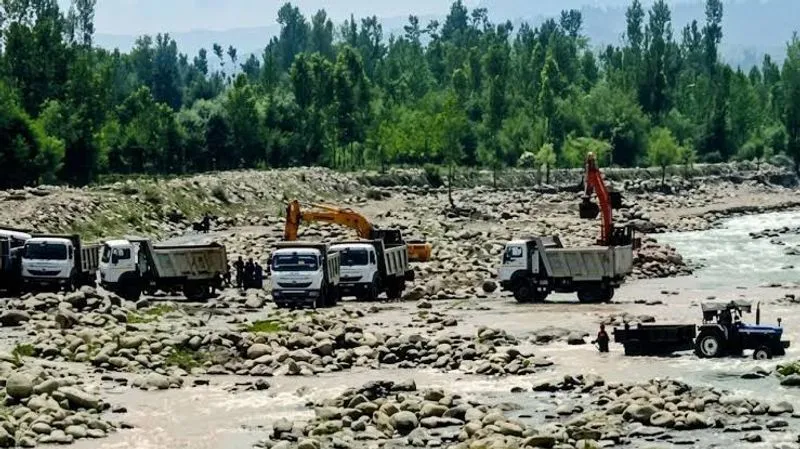
BUDGAM, Jun 12: "Indiscriminate" and "unscientific" mining in the Sukhnag river here has resulted in significant alteration in its morphology and damage to the underlying aquifer systems, with likely long-term adverse impacts on the ecosystem and dependent livelihoods, according to a joint panel report.
Once a river with abundant, gushing waters, the Sukhnag has now almost dried up in Sail village in central Kashmir's Budgam district, with residents blaming riverbed mining.
The Sukhnag river is a 54-km tributary of the Jhelum, originating in the Tosa Maidan area of the Pir Panjal range and fed by the Ashtar spring and Shin Mahnew glacier, serving as an important ecological and economic lifeline for local communities.
However, the river has of late faced severe environmental stress due to riverbed mining.
A report by a joint panel of the Ministry of Environment, Forest and Climate Change (MoEF&CC), the National Institute of Himalayan Environment (NIHE) and the Jammu and Kashmir Pollution Control Committee (JKPCC) has flagged the "indiscriminate and unscientific" extraction of minerals from the river.
In the report submitted to the National Green Tribunal (NGT) last month, the panel highlighted the extent of damage, stating there were indications of excavation "below the active river bed and into the alluvial aquifer zones", which can cause "irreversible" hydrogeological damage and deplete aquifer storage capacity.
The joint committee carried out a site inspection of the Sukhnag River on March 18 this year to assess riverbed material extraction and its environmental implications in compliance with NGT directions.
It found visible signs of "indiscriminate and unscientific extraction" within the active river channel as well as peripheral catchment areas.
"The extent of excavation within the riverbed raised serious environmental concerns," the report said.
The Sukhnag spans an approximate width of 95 metres, with the active water channel confined to about 21 metres, while a substantial portion of the riverbed appears to have been excavated.
The committee estimated that 10.6 lakh to 15.3 lakh tonnes of riverbed material may have been extracted from the surveyed stretch.
Based on field measurements, the total quantity of extracted material is estimated at around 15.3 lakh tonnes, while even a conservative estimate places it at 10.62 lakh tonnes, the report said.
The panel said large-scale, unregulated and potentially illegal extraction had caused significant alteration of river morphology and damage to aquifer systems.
It noted that the absence of scientific assessment and non-compliance with regulatory provisions pointed to serious institutional lapses.
Environmental degradation is likely to have long-term impacts on the river ecosystem, fisheries-dependent livelihoods, and water availability, the report added.
The committee also flagged procedural and regulatory lapses in mining operations, saying permissions for extraction of about 5 lakh metric tonnes were granted without preparation of a Detailed Project Report (DPR) or scientific modelling as mandated.
Data from the District Mineral Officer, Budgam, shows that 6,32,940 tonnes were permitted for extraction between 2020 and 2024 through disposal and short-term permits.
Of this, 4,85,194 tonnes, or about 77 per cent, were allocated to a single firm -- NKC Projects Pvt Ltd, an infrastructure and civil construction company based in Gurugram, the report said.
The Fisheries Department reported that around 2,000 trout fish were lost in one case due to diversion of water supply to a farm owned by Peerzada Rayees Ahmad, allegedly linked to illegal mining activities at night.
The committee recommended a moratorium on all mining activities within 5 km upstream and downstream of Sail Bridge until the river system is adequately restored.
It also called for strict enforcement of guidelines, mandatory DPRs with scientific modelling, filling of deep trenches and re-levelling of the riverbed, and restoration of natural flow patterns.
It further recommended installation of real-time monitoring systems such as CCTV surveillance at mining hotspots and comprehensive river restoration measures.
While the panel said no mining activity was observed during the site visit, locals alleged irreversible ecological damage.
"There is a lowered riverbed, springs and irrigation channels have dried up, and there is also loss of aquatic life," said resident Mehraj-ud-din Mir.
He said grazing land has been destroyed, springs and streams have dried up, embankments damaged, and paddy fields affected, leading to water scarcity. Environmental and RTI activist Raja Muzaffar Bhat, who approached the NGT, termed the mining a "loot" of Kashmir's natural resources.
He alleged that around 200 dumpers were being extracted daily without proper tendering or auction, and that short-term permits were misused for long durations.
Bhat further alleged use of heavy machinery in violation of court guidelines and estimated losses of Rs 250-300 crore to the exchequer, claiming no action had been taken against the company. (Agencies)