For decades, Jammu and Kashmir was synonymous with shutdowns, stone pelting, and the spectre of terrorism. Streets emptied at the call of a hartal. Families lived under the shadow of violence, businesses shuttered routinely, and an entire generation grew up believing conflict was their only inheritance. That J&K feels like a distant memory today. The path to peace was neither linear nor easy. Eradicating entrenched terrorism and separatism demanded unflinching political will. PM Modi adopted a clear, uncompromising doctrine: zero tolerance for terrorism, befitting responses to Pakistan after every major attack, and suspension of dialogue when dialogue was exploited as cover. Surgical strikes in 2016, the Balakot air strikes in 2019, and, most recently, Operation Sindoor collectively rewrote the terror equation. Each decisive response signalled to sponsors of terrorism that India's patience was finite and its resolve absolute. The message was unambiguous - provocation carries consequences.
Simultaneously, the Modi Government pursued equally determined peace initiatives. The abrogation of Article 370 dismantled the constitutional ambiguity that separatist forces had long exploited. Integration into India's mainstream opened floodgates of central schemes - direct benefit transfers, Ujjwala, Ayushman Bharat, and PMAY housing - reaching ordinary Kashmiris without the corruption of middlemen. Terror incidents have dropped, whilst stone-pelting incidents, which numbered over 2,100 in 2018, have fallen to virtually zero. Not long ago, local governance through a three-tier Panchayati Raj system was in place, bringing democracy to every village doorstep.
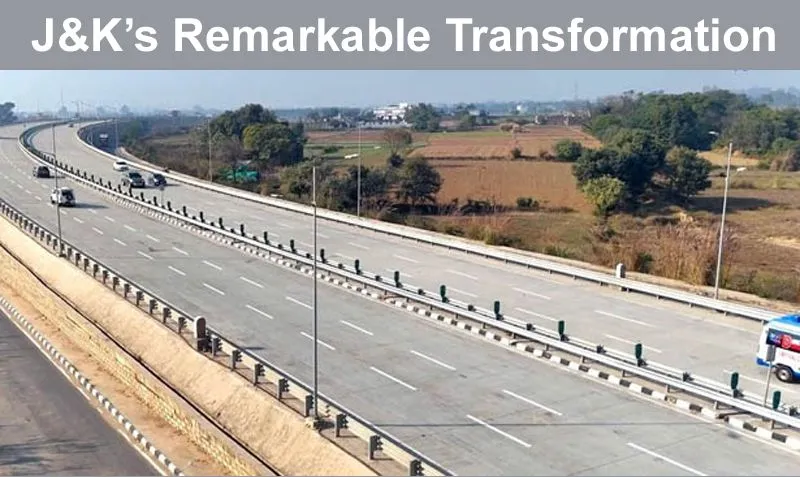
Youth, once foot soldiers of the stone-pelting brigades, were engaged through skill development programmes, sports infrastructure investment, and entrepreneurial opportunities. Women were drawn meaningfully into self-help groups, microfinance schemes, and the formal economy, becoming genuine partners in J&K's socio-economic revival. Agriculture, horticulture, and tourism received sustained investment, with over two crore tourists' footfall - figures reminiscent of J&K's golden era. Film shoots and cultural celebrations have returned to the Valley, restoring a vibrancy long suppressed by fear. Mega infrastructure projects - the world's highest railway arch bridge, Asia's longest tunnel, rail connectivity to Kashmir and rapidly expanding road and air connectivity - have stitched the region's remotest corners into India's growth fabric. New medical colleges, IITs, IIMs, and AIIMS have expanded educational and healthcare horizons for an aspirational generation.
The results speak eloquently. Stone pelting has vanished. Hartals are history. J&K's cricket team has lifted the Ranji Trophy. These are not mere symbols - they represent a generation that has decisively chosen aspiration over agitation, enterprise over extremism.