India's Coaching Industry Is Looting Students and Hijacking Education
Govt. Must Enact a Tough National Law
Prof. R.K. Uppal. [PhD, D.Litt.]
…………………………………………………………………………………………………..
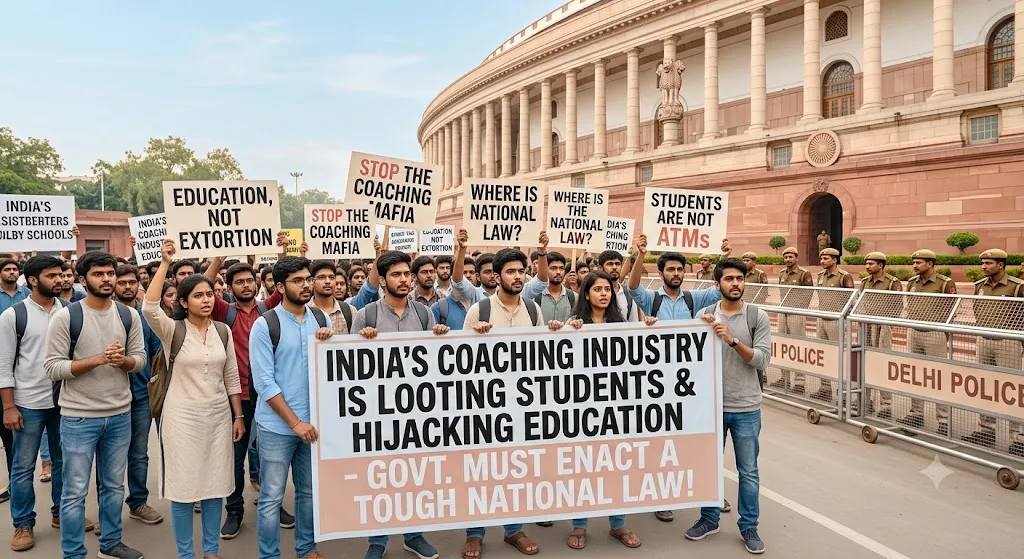
India's private coaching industry has grown into a multi-billion-rupee business with astonishing speed. What began as a supplementary academic support system has evolved into a parallel education system that dominates the aspirations of millions of students. Across cities, towns, and even rural areas, coaching centers are mushrooming without adequate regulation, charging exorbitant fees, making unrealistic promises, and placing immense psychological pressure on young minds. The time has come for the Government of India to recognize this as a serious national concern and enact a comprehensive law to regulate the coaching industry.
The most alarming aspect of this phenomenon is the commercialization of education. Education is a public good meant to nurture knowledge, creativity, and character. However, many coaching centers have transformed it into a highly profitable business where success is marketed as a commodity. Expensive fee packages, aggressive advertising campaigns, celebrity endorsements, and exaggerated claims of guaranteed success have become common marketing tools. Parents, driven by anxiety about their children's future, often spend their lifetime savings or incur heavy debts to afford these programmes.
The mushrooming of coaching centers is also exposing the weaknesses of India's formal education system. If schools and colleges were effectively delivering quality education, students would not feel compelled to spend several additional hours every day in coaching classes. Instead of strengthening classrooms, improving teaching quality, modernizing curricula, and enhancing learning outcomes, society has increasingly accepted coaching centers as an unavoidable part of academic life. This trend weakens confidence in schools and shifts the focus of education from learning to examination.
The psychological burden imposed by this coaching culture is equally disturbing. Students often attend school during the day and coaching classes in the evening, leaving little time for recreation, sports, creativity, or family interaction. Endless assignments, mock tests, and constant competition create enormous stress and anxiety. Many young students suffer from burnout long before they enter higher education. Education should inspire curiosity and confidence, not fear and exhaustion.
Another disturbing trend is the misleading advertising adopted by many coaching institutes. Massive billboards, newspaper advertisements, social media campaigns, and television commercials frequently highlight a handful of successful students while concealing the thousands who fail to achieve the advertised results. Scholarship schemes are sometimes used primarily as marketing tools rather than genuine financial assistance. Such promotional practices exploit the hopes of students and parents who are desperately searching for academic success.
The absence of uniform regulation has allowed coaching centers to operate with considerable freedom. Many institutions function without standardized fee structures, transparent refund policies, qualified faculty requirements, or proper infrastructure. Consumer protection mechanisms remain weak, leaving students and parents with limited options when disputes arise. Complaints regarding unfair fee collection, false promises, poor teaching quality, and inadequate facilities often go unresolved.
The coaching industry also contributes significantly to educational inequality. High-quality coaching is often affordable only for financially stronger families. Students from economically weaker backgrounds frequently find themselves at a disadvantage, regardless of their talent or determination. This widens social disparities and undermines the constitutional principle of equal educational opportunity. Academic success should depend on ability and hard work, not on a family's capacity to pay enormous coaching fees.
Several tragic incidents involving students preparing for competitive examinations have also highlighted the urgent need for reform. Academic pressure, unrealistic expectations, social comparison, and prolonged stress have, in some cases, contributed to severe mental health challenges. Although coaching centers cannot be held responsible for every individual case, they must share responsibility for creating a healthier academic environment that prioritizes student well-being alongside academic achievement.
India urgently needs a strong National Coaching Regulation Act. Such legislation should establish mandatory registration and accreditation of all coaching centers, ensuring compliance with minimum standards for infrastructure, faculty qualifications, student safety, and academic practices. Fee structures should be transparent, refund policies should be clearly defined, and misleading advertisements should attract strict penalties. Independent grievance redressal mechanisms should be available in every state to protect students and parents from unfair practices.
The proposed law should also regulate class timings, prohibit excessive academic workloads, and mandate counselling services for students experiencing stress or anxiety. Coaching centers should be prohibited from making unrealistic guarantees regarding examination success or employment outcomes. Regular audits and inspections should ensure continued compliance with national standards.
At the same time, regulation alone is not enough. Governments must invest substantially in improving the quality of school and higher education so that students receive excellent instruction within the formal education system itself. Teacher training, digital learning resources, modern laboratories, research-oriented teaching, and continuous curriculum reform should become national priorities. Strong public education remains the most effective long-term solution to reducing excessive dependence on coaching centers.
Parents also have an important role to play. Academic excellence should never come at the cost of children's mental health, emotional development, or overall well-being. Families should encourage balanced learning, critical thinking, and realistic expectations instead of measuring success solely through examination ranks.
India stands at a critical crossroads. If the coaching industry continues expanding without effective regulation, education will increasingly become a commercial marketplace rather than a system for nation-building. Students deserve quality education, ethical guidance, and equal opportunities—not exploitation driven by commercial interests.
The Government of India can no longer remain a silent spectator. A tough national law regulating coaching centers is not merely an administrative necessity; it is an educational imperative. By establishing transparency, accountability, affordability, and student welfare as guiding principles, India can restore public confidence in its education system and ensure that learning once again becomes the true purpose of education rather than an expensive race for examination scores.