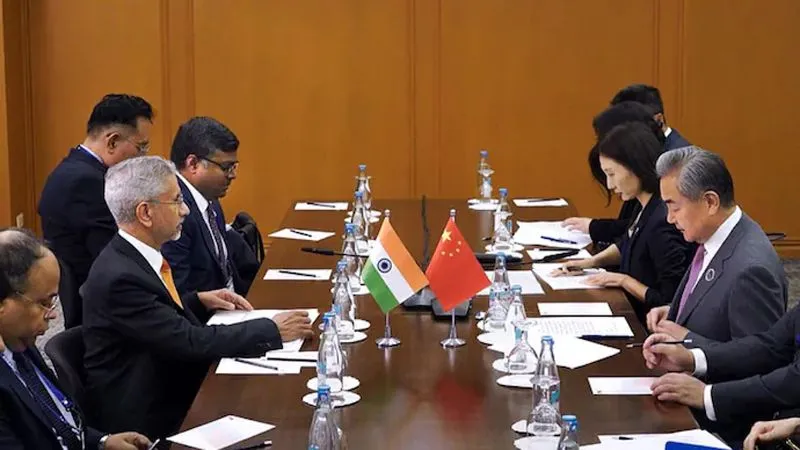
MANILA, July 22: India on Wednesday said its relations with China are "gradually normalising" but warned that lasting peace along the disputed border remains the foundation for stable ties, while pressing Beijing to address trade imbalances, improve market access and ensure more predictable supply chains.
External Affairs Minister S. Jaishankar, in talks with Chinese Foreign Minister Wang Yi on the sidelines of the ASEAN Foreign Ministers' Meeting in Manila, said bilateral ties had steadily improved since Prime Minister Narendra Modi and President Xi Jinping met in Kazan in October 2024, with further momentum generated by their subsequent meeting in Tianjin.
"Since the meeting of our leaders in Kazan in October 2024, relations between India and China have been gradually normalizing," Jaishankar said.
He, however, made clear that progress in ties depends on continued stability along the Line of Actual Control (LAC).
"Peace and tranquility in the border areas is obviously the pre-requisite for normal ties. Since October 2024, both sides have engaged to ensure that important objective. This will continue to need our constant attention," he said.
The remarks underscore New Delhi's position that broader political and economic engagement with Beijing cannot be fully restored without sustained peace along the border.
Jaishankar said India welcomed the recent confidence-building measures, including the resumption of direct flights, relaxation of visa procedures, the restart of the Kailash Mansarovar Yatra and the reopening of border trade.
However, he signalled that economic issues remain a major source of concern.
"There are also important dimensions of our ties that need to be addressed. Fair market access and a trade balance ranks high in that regard. There are also concerns about predictability of supply chains," he said.
He also called for greater official and people-to-people exchanges and urged both countries to resume bilateral mechanisms and dialogue platforms in line with mutually agreed priorities.
Jaishankar reiterated that while differences between the two neighbours were inevitable, they should not be allowed to escalate into disputes.
"Our leaders had agreed that differences should not become disputes. It is the responsibility of diplomacy to properly manage them," he said.
The meeting comes as New Delhi and Beijing continue efforts to stabilise ties following years of strained relations after the 2020 border clashes. While diplomatic engagement has resumed and military tensions have eased since late 2024, India has continued to seek greater access for its exports, a narrower trade deficit and fewer disruptions to supply chains dominated by Chinese manufacturers.
Jaishankar also thanked Beijing for supporting India's BRICS chairmanship this year and said the two sides should exchange views on pressing regional and global developments amid what he described as an "extremely complicated" international situation.
Referring to differences between the two neighbours, Jaishankar said it was natural for "two large and important nations" to have differing interests, but emphasised that diplomacy must prevent those differences from escalating.
"Our leaders had agreed that differences should not become disputes. It is the responsibility of diplomacy to properly manage them," he said.
(UNI)