Thousands of PhDs, But Where Is the Innovation?
Dr. R. K. Uppal, Professor Emeritus [PhD, D.Litt.]
…….………………………………………………………
India today is witnessing an unprecedented rise in the number of PhD scholars and universities offering doctoral programs. Every year, thousands of students are awarded doctoral degrees across disciplines ranging from engineering and management to social sciences and humanities. On paper, this appears to be a major academic achievement and a sign of intellectual growth. However, a serious question continues to trouble policymakers, educators, and industry leaders alike: if India is producing such a large number of PhDs, why is the country still struggling to become a global leader in innovation and high-quality research?
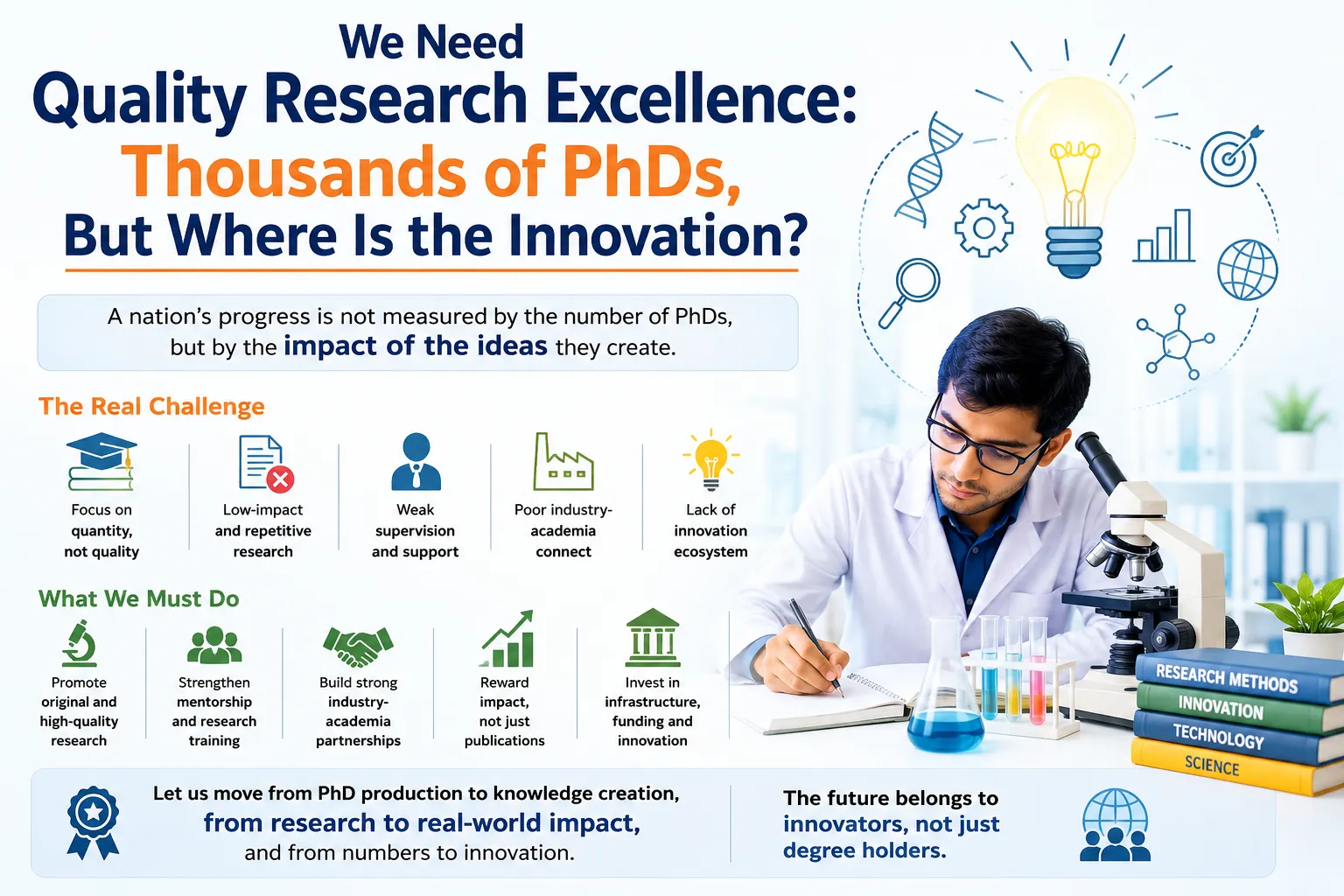
The real challenge is not the quantity of PhDs but the quality and originality of research being produced. A doctoral degree should represent the highest level of intellectual contribution, where scholars generate new knowledge, solve real-world problems, and contribute meaningful innovations to society and industry. Unfortunately, in many institutions, the PhD has increasingly become a formal qualification rather than a symbol of deep research excellence.
One of the major reasons behind this crisis is the commercialization of higher education. Many universities, especially in the private sector, aggressively expand PhD admissions without developing the necessary research ecosystem. Laboratories remain outdated, libraries lack quality journals, and research funding is inadequate. Yet institutions continue producing large numbers of doctoral graduates every year. In some cases, the focus shifts from creating knowledge to generating revenue and improving institutional rankings through numerical targets.
Another serious issue is the declining standard of supervision and evaluation. A strong PhD system requires experienced supervisors who can guide scholars toward original and globally relevant research. However, many faculty members themselves are overburdened with administrative work, excessive teaching loads, or pressure to publish large numbers of papers for promotions. As a result, meaningful mentorship often suffers. Some scholars complete doctoral work with minimal intellectual rigor, leading to repetitive and low-impact research.
The “publish or perish” culture has also damaged the spirit of genuine inquiry. Universities and regulatory agencies often measure academic success through the number of publications rather than their quality or impact. This has encouraged a dangerous race for quantity. Thousands of papers are published in low-quality or predatory journals that contribute little to scientific progress. Researchers become more concerned about meeting promotion requirements than solving important national or global challenges.
India’s weak connection between academia and industry further deepens the innovation gap. In countries that lead the world in research and technology, universities work closely with industries, startups, and government agencies. Doctoral research is often linked directly to industrial needs, technological development, and economic transformation. In contrast, many Indian PhD theses remain confined to university shelves with little practical application. Research topics are frequently theoretical, outdated, or disconnected from national priorities.
“Innovation cannot flourish in an environment where creativity is discouraged and conformity is rewarded. Many students enter PhD programs not because of a passion for research but due to unemployment, career uncertainty, or the need for academic qualifications. This weakens the culture of curiosity and experimentation that is essential for world-class research. A genuine researcher must be trained to question existing ideas, challenge accepted theories, and think independently. Unfortunately, rote learning and examination-oriented education often continue even at the doctoral level.”
The rapid rise of artificial intelligence tools has added another dimension to the problem. AI technologies such as chat bots and automated writing systems can assist research, but their misuse is becoming a growing concern. In some cases, scholars depend excessively on AI-generated content instead of developing original analytical and critical thinking skills. If universities fail to establish strict ethical standards, the credibility of doctoral research may suffer even further.
India must recognize that becoming a global knowledge superpower requires more than increasing enrollment in PhD programs. Countries like the United States, Germany, South Korea, and China invested heavily in research infrastructure, scientific culture, and innovation ecosystems over several decades. Their universities produce patents, technologies, startups, and Nobel-level research because they emphasize excellence, originality, and accountability.
Reforming India’s PhD system therefore requires urgent and bold action. First, admissions to doctoral programs should be based strictly on merit, research aptitude, and institutional capacity. Universities lacking proper infrastructure or qualified supervisors should not be allowed to enroll unlimited numbers of PhD scholars. Second, the evaluation process must become far more rigorous and transparent. External experts from reputed national and international institutions should play a stronger role in assessing doctoral work.
Third, research funding must increase substantially. Innovation cannot emerge from poorly funded laboratories and weak academic environments. Government and private industry should jointly support research projects that address national priorities such as healthcare, agriculture, renewable energy, artificial intelligence, rural development, and manufacturing.
Fourth, India must strengthen collaboration between universities and industry. PhD scholars should work on practical problems that contribute to technological advancement, entrepreneurship, and economic growth. Internships, industrial research partnerships, and startup incubation should become integral parts of doctoral education.
Fifth, academic performance should be measured by impact rather than mere publication numbers. Patents, policy contributions, technological innovations, community impact, and high-quality international research should receive greater recognition than bulk publication in questionable journals.
Finally, India must rebuild the culture of intellectual honesty and academic integrity. Universities should adopt strict anti-plagiarism standards and develop ethical guidelines for the use of AI in research. Doctoral education should train scholars not merely to earn degrees but to become creators of new knowledge and solutions.
India has immense intellectual talent and one of the world’s largest youth populations. The country has the potential to become a global leader in science, technology, and innovation. However, this transformation cannot happen through mass production of doctoral degrees alone. A nation does not become a research superpower by counting theses and publications. It becomes one by producing ideas, inventions, discoveries, and solutions that change the world.
The future of India’s higher education system depends on one fundamental shift: moving from quantity-driven PhD production to quality-driven research excellence. Until that happens, the question will continue to haunt Indian academia — thousands of PhDs, but where is the innovation?