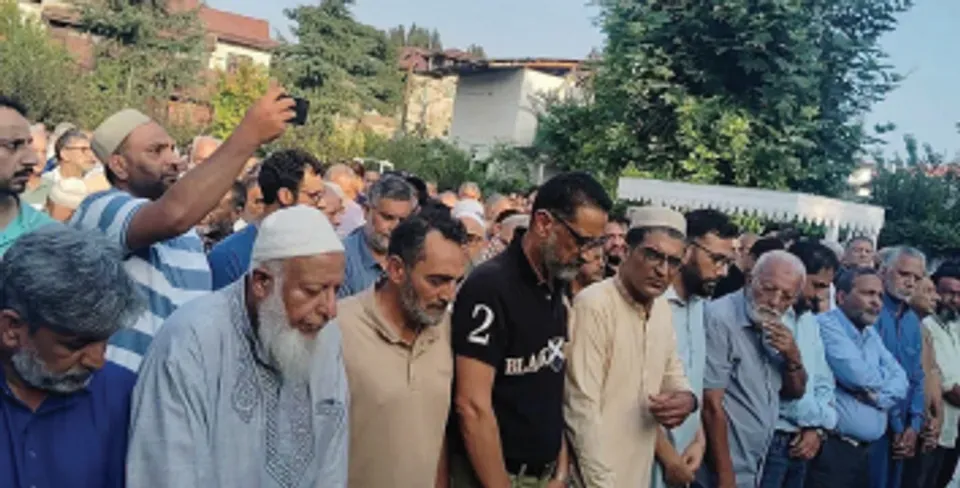
Prominent civil society activist and engineer Mohammad Anwar Ashai, scion of the distinguished Ashai family of Downtown Srinagar, passed away peacefully at his residence on Tuesday. His demise has been widely mourned across social, religious, political and civil society circles in Kashmir.
Anwar Ashai was the son of the legendary educationist and political activist Khwaja Ghulam Ahmad Ashai, a pioneering figure in the educational and political awakening of Kashmiri Muslims.
Khwaja Ghulam Ahmad Ashai was among the earliest highly educated Kashmiri Muslims of his generation, having distinguished himself at the matriculation level before pursuing graduation and post-graduation. He later became the first Registrar of the University of Jammu and Kashmir.
He was also among the founders of the historic Reading Room Party, which played a seminal role in the political awakening of Kashmiri Muslims and in the developments that eventually led to the formation of the Muslim Conference, Kashmir's first major organised Muslim political platform.
The Ashai family itself occupies a notable place in Kashmir's social, literary and commercial history. The family traces its lineage to Mukhtar Shah Ashai, remembered as a prominent shawl merchant associated with Kashmir's celebrated shawl trade and as a patron of religious shrines in Srinagar. The family also traces its lineage to the celebrated 17th-century Persian poet of Kashmir, Mulla Tahir Ghani Kashmiri, whose poetry occupies an eminent place in the Persian literary tradition.
Anwar Ashai inherited this tradition of intellectual curiosity and public engagement. His involvement in public affairs began during his student days. As a student leader, he participated actively in the political and social movements of his time and was also imprisoned. Remarkably, he pursued and completed his engineering studies during his period of incarceration.
An engineer by profession, Ashai's engagement with society extended far beyond his professional career. From his adolescence until the closing years of his life, he remained deeply interested in public affairs and was known as a widely read, articulate and socially conscious individual with a keen interest in Kashmir's history, politics, education and contemporary challenges.
He was closely associated with the Kashmir Centre for Social and Development Studies (KCSDS) and remained actively involved in its deliberations and programmes. He contributed to the organisation of seminars, round-table conferences and public discussions on a wide range of issues, including the environment, education, healthcare, social reform and other matters affecting the people of Jammu and Kashmir.
Friends and colleagues remembered him as a dignified, warm and engaging personality whose conversations reflected both his extensive reading and his deep understanding of Kashmir's history and society. He believed strongly in informed public discourse and remained willing to speak, deliberate and contribute whenever issues of larger public concern arose.
Members and associates of KCSDS remembered him as a valued colleague whose commitment to civil society and concern for Kashmir's social, educational and developmental issues remained undiminished throughout his life. His passing, they said, has created a void not merely among his family and friends but also within the wider circle of Kashmir's civil society.
Hundreds of people from different walks of life participated in his funeral prayers, which were led by prominent Islamic scholar Moulana Showkat Hussain Keng. His mortal remains were subsequently laid to rest at the family's ancestral graveyard at Ashai Kocha, Fateh Kadal, Srinagar.
According to family sources, the congregational Fateha Khawani will be held at the ancestral graveyard at 2:30 PM on Friday, August 14.