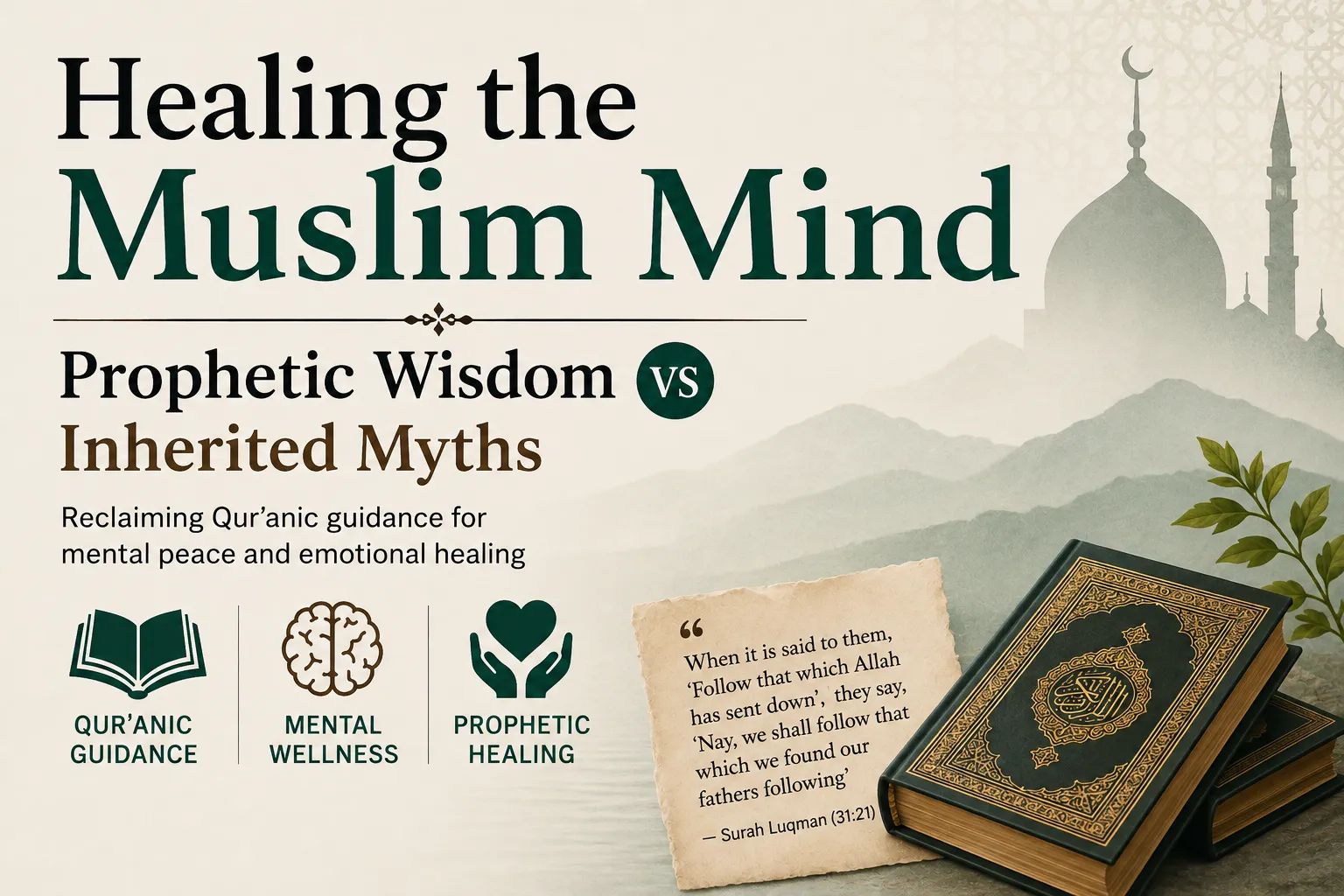
Healing the Muslim Mind: Prophetic Wisdom Versus Inherited Myths
By Fiza Altaf
Walk into almost any Kashmiri household during a time of grief, anxiety, or mental distress, and you will hear advice pouring in from every direction. Some of it comes from genuine faith. Some of it, quietly and unknowingly, comes from centuries of local custom that has nothing to do with Islam at all. Over time, the two have blended so seamlessly that most of us can no longer tell where one ends and the other begins.
This confusion matters more than we admit, especially when it comes to mental health. In a society still hesitant to talk openly about anxiety, grief, or emotional struggle, many people quietly turn to whatever remedy is closest at hand—a ritual passed down by a grandmother, an amulet, or a saying repeated so often that it feels sacred. Few pause to ask: does this actually come from the Qur’an and the authentic Sunnah, or is it simply something we inherited?
The Qur’an and the Ahadith of the Prophet Muhammad (peace be upon him) offer something far more grounded than these inherited myths: a genuine, tested framework for facing psychological pain. Dr. Feryed Hussain, a British clinical psychologist who later served as Associate Professor of Clinical Psychology at the International Islamic University of Malaysia, makes exactly this case in her book Therapy from the Qur’an and Ahadith. Every connection she draws between scripture and psychological themes was reviewed by scholars before publication, precisely to ensure that the guidance remains authentic rather than sentimental.
Take bereavement. In Kashmiri households, and indeed across much of South Asia, grief is often accompanied by guilt—the family blaming itself for not doing enough, or attaching the death to omens and superstitions. The Qur’an addresses this directly:
«“And no person can ever die except by Allah’s leave and at an appointed term.”
— Surah Al-Imran, 3:145»
Death is not something a family failed to prevent. It was never in their hands to begin with. This single ayah, properly understood, can lift a burden of guilt that no cultural remedy ever could.
Or take guilt itself, one of the most corrosive emotions in any mental health struggle. Popular culture often teaches that certain sins are unforgivable. Yet the Prophet (peace be upon him) narrated the story of a man who had killed ninety-nine people and still sought a path to repentance. Even after killing a hundredth person while journeying towards sincere repentance, the mercy of Allah reached him before his death (Sahih Bukhari and Sahih Muslim).
Compare that to the Qur’an’s own words:
«“Allah accepts only the repentance of those who do evil in ignorance and foolishness and repent soon afterwards.”
— Surah An-Nisa, 4:17»
This is not a religion built on permanent shame. Where our culture insists otherwise, it is culture speaking, not Islam.
Perhaps the cleanest warning against confusing the two comes directly from the Qur’an itself:
«“When it is said to them, ‘Follow that which Allah has sent down,’ they say, ‘Nay, we shall follow that which we found our fathers following.’”
— Surah Luqman, 31:21»
This ayah was revealed about disbelievers clinging to ancestral custom over revealed truth, yet it reads like a mirror held up to how many of us treat inherited habits as though they were religious obligations.
A Faith That Commands Us to Seek Help
Critically, where our culture often champions silent endurance as a form of piety, the Sunnah actively commands the opposite. The Prophet (peace be upon him) said:
«“There is no disease that Allah has created, except that He also has created its cure.”
— Sahih al-Bukhari»
This is not a call for fatalism, but a divine invitation to pursue healing.
Similarly, he said:
«“The strong believer is better and more beloved to Allah than the weak believer, while there is good in both.”
— Sahih Muslim»
This is a clear command to strengthen oneself spiritually, physically, and mentally.
Read together, these ahadith push back against a quiet fatalism that sometimes passes as piety in our communities: the idea that struggling with one’s mental state is simply a weakness of faith to be endured in silence rather than a condition with a real, legitimate cure to be sought out.
Seeking professional help—whether from a psychologist, a counsellor, or a trusted scholar trained in mental health—is not a sign of weak faith. It is an act of strength. Our mental health is not different. The brain, after all, is part of the body. When it falls ill, it deserves the same attention and care.
This is the prophetic legacy we have forgotten. In our communities, we are quick to take a sick child to the doctor but slow to acknowledge that an anxious mind or a depressed heart needs help just as urgently. We whisper about mental illness as if it were a shameful secret, while the Prophet (peace be upon him) spoke openly about sadness, grief, and even the heaviness of the heart. He taught specific duas for anxiety and distress. He normalized the struggle.
This is not to say that our grandmothers’ prayers or the rituals of our communities are without value. Often, they come from a place of deep love and concern. But when culture substitutes for scripture, and when inherited habits are mistaken for divine guidance, we risk losing the very healing that Allah and His Prophet (peace be upon him) have entrusted to us.
The Qur’an invites us to think, to question, and to return to its sources with fresh eyes—not to discard our heritage, but to purify it. In matters of the heart, as in all matters, the best guidance is the one that has been divinely preserved, not the one that has merely been passed down.
So let us speak openly, seek treatment actively, and reclaim the prophetic legacy of holistic healing.
About the Author
Fiza Altaf is currently pursuing a BA in Islamic Studies (5th semester) at Amar Singh College, Cluster University, Srinagar. Her academic interests include the intersection of Islamic teachings and mental health, with a focus on prophetic traditions and their contemporary application.