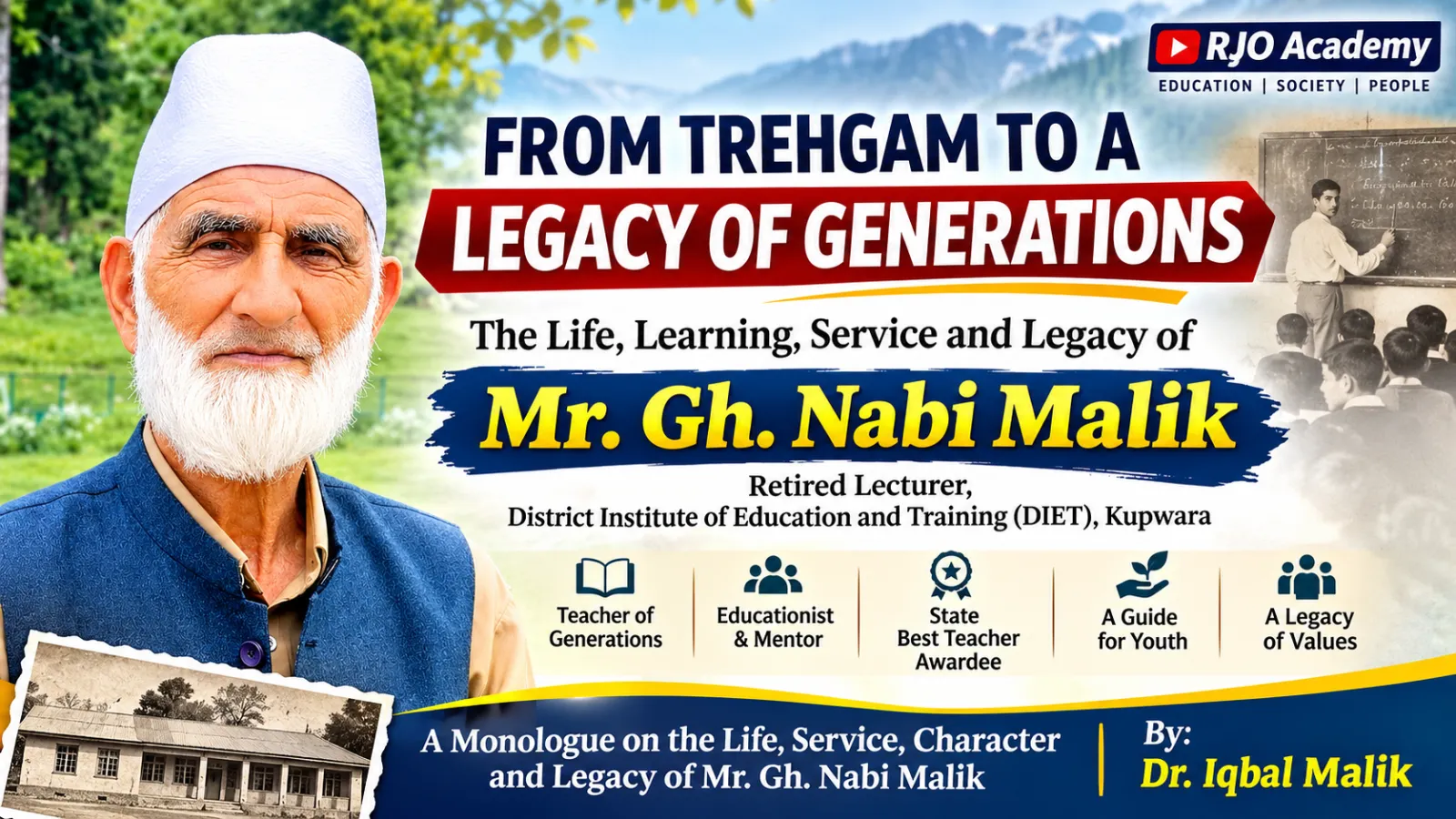
FROM TREHGAM TO A LEGACY OF GENERATIONS The Life, Learning, Service and Legacy of Mr. Gh. Nabi Malik
A Monologue on the Life, Service, Character and Legacy of Mr. Gh. Nabi Malik
Retired Lecturer, District Institute of Education and Training (DIET), Kupwara
By: Dr. Iqbal Malik
A Life That Began with a Village and Became a Legacy
There are lives that can be measured by designations, appointments, promotions and dates, and there are lives that must be understood through the people they touched. The life of this distinguished educator belongs to the second category. His story is not merely the record of a government employee who entered the teaching profession in the late 1950s and retired after decades of service. It is the story of a man who grew from the soil of historic Trehgam, passed through the classrooms of Hirri and the schools of remote Kashmir, accepted responsibility wherever he was posted, and gradually transformed the profession of teaching into a lifelong form of public service.
Born in June 1941 at Trehgam, he entered the world in a place whose history reaches deep into the political and cultural memory of Kashmir. Trehgam is remembered in connection with the Chak period and with the historical development of the region. To be born there was to grow up surrounded by a landscape in which history was not something found only in books; it lived in names, places, family memories and community narratives. From that setting emerged a young boy whose future would ultimately be written not through inherited privilege, but through education, discipline and service.
His life carries an especially meaningful irony. Circumstances did not allow him to pursue the professional education of engineering or medicine, despite his intellectual ability. Yet the door that closed before him opened into another calling. He entered education, and in doing so he entered a profession through which he would influence generations. The boy who could not become an engineer or doctor became a teacher; the teacher became a headmaster and senior educator; the educationist became associated with teacher training; and the individual eventually became part of the educational memory of the communities in which he served.
The Child of Trehgam and the Beginning of Learning
The first chapter of his educational life began in the familiar surroundings of Trehgam. In 1951, he pursued high school education in the locality. These were years when educational facilities in rural Kashmir were far removed from the scale and accessibility of the present day. For a young student, therefore, the classroom represented much more than a place of instruction. It was a doorway into a larger world of knowledge, possibility and aspiration.
In 1954, his journey took him to Hirri, where he continued his education and completed the eighth standard. The move broadened his educational horizon and brought him into contact with teachers whose influence would remain part of his formative years. Among those associated with this stage was M. M. Kazmi Sahib from Srinagar, who served as headmaster. The presence of experienced teachers and a disciplined school environment helped strengthen the intellectual qualities already visible in the young student.
He possessed a particular aptitude for Mathematics and English and showed interest in General Knowledge and Persian. These were not accidental strengths. They revealed a mind capable of both analytical reasoning and linguistic engagement. Mathematics trained him to think with precision; English opened another intellectual and communicative world; General Knowledge expanded his awareness beyond the immediate locality; and Persian connected him with a linguistic and cultural tradition deeply rooted in Kashmir's intellectual history.
1957: The Student Who Rose Above Circumstances
The year 1957 marked an important milestone. He passed the 10th standard with First Division and secured the second position in the district grouping of that period, associated with the areas that later came to be represented through Bandipora, Baramulla and Kupwara. The achievement was significant not simply because of the rank itself, but because it demonstrated what a determined student could accomplish in an environment where opportunities were comparatively limited.
At that age, the world of professional education seemed open before him. His intelligence and academic performance suggested the possibility of higher studies in prestigious and technically demanding fields. Yet family circumstances did not permit him to proceed towards engineering or medical education. This was one of those quiet turning points in a person's life that rarely appears in official records but often determines the shape of an entire future.
He did not allow an unrealised ambition to become a permanent grievance. Instead, he entered the field that was available to him and, through commitment, made it his own. This is perhaps one of the most important lessons contained in his life: a person's greatness is not always determined by the path originally imagined for him. Sometimes greatness lies in taking the path that circumstances permit and walking it so faithfully that it becomes a path of distinction.
1958: Rs. 58 and the Beginning of a Lifetime of Service
On 12 December 1958, an order of the Department of School Education associated with Deputy Director Ab. Aziz brought him into government teaching service. His first posting was at Dahama Boys School. His first salary was Rs. 58. Today, the amount may appear almost symbolic, but in the biography of a life it has a significance far beyond its monetary value. Those Rs. 58 marked the first official reward for his labour as a teacher and the first page of a service journey that would eventually span more than four decades.
He entered the profession at a time when the teacher occupied a distinctive place in rural society. A teacher was not simply an employee who entered a classroom, completed a timetable and returned home. The teacher was often a guide, counsellor, disciplinarian, intellectual reference point and trusted member of the community. In many villages, the teacher represented the possibility of a different future. Gh. Nabi Malik accepted that responsibility at the beginning of his career and gradually made it part of his identity.
The first classroom became the first field of service. There he encountered students with different abilities, family circumstances and aspirations. He learned that teaching was not merely the transmission of information; it was the cultivation of confidence. A student might need a lesson in Mathematics, but another might need encouragement to remain in school. One might need academic guidance, while another might simply need someone to believe that he or she could succeed. The teacher's real work, therefore, extended beyond the blackboard.
From Classroom Experience to Professional Formation
His early service included association with schools such as High School Hirri. By 1963, he was connected with High School Hirri, continuing to deepen his experience as a teacher. His professional life was developing through repeated contact with students, colleagues and school administration. He was not content merely to remain within the limits of what he already knew; his subsequent pursuit of professional training demonstrated a willingness to strengthen his own capacity as an educator.
During 1965–66, he pursued B.Ed. training at the College of Education, where Sajida Zamir Ahmad served as Principal. This period was important because it added formal pedagogical training to the practical experience he had accumulated in schools. The teacher who had learned through the daily realities of the classroom was now studying the principles and methods of education in a more systematic setting.
Professional training can change a teacher in a subtle way. It teaches that good intentions alone are not enough; teaching requires method, planning, assessment, communication and an understanding of how students learn. For him, the B.Ed. qualification became another step in a larger progression—from an intelligent student to a trained teacher, and from a trained teacher towards institutional leadership.
1968: When Teaching Became Leadership
March 1968 brought another decisive chapter. Under the government policy then applicable to qualified BA/B.Ed. teachers, he was posted as Headmaster. The designation represented more than promotion. It marked a transition from responsibility for one's own classroom to responsibility for an entire educational institution.
A headmaster must carry the concerns of teachers, students, parents and the institution simultaneously. The headmaster must maintain discipline without destroying confidence, uphold standards without losing compassion, and administer rules while understanding the realities of the people to whom those rules apply. The position demands judgement as much as authority. Gh. Nabi Malik's movement into headship therefore represented the natural development of a career built on experience and professional preparation.
He produced best architects of education as Prof. Mushtaq Ahmad Wani, Tahir Mohiuddin, Mohammad Sultan Bhat and others form part of the professional landscape through which he travelled. Some were teachers, some scholars and some associated with educational or intellectual life. Their presence in his story reminds us that institutions are built by people. The history of a school is never only the history of its building; it is the history of the teachers who entered its rooms, the students who passed through its gates and the relationships that shaped its culture.
Karnah: The Test of a Teacher in a Difficult Land
In 1974, he was posted to Karnah in the Master Grade. For any educationist, service in a remote and mountainous area carries its own demands. Karnah, with its difficult terrain and severe winters, required resilience from anyone committed to maintaining regular educational life. Heavy snowfall could interrupt movement and communication, yet the need for education did not disappear with the winter.
In such places, the teacher becomes part of the geography of hope. A school may stand against a difficult landscape, but its importance is measured by what happens inside it. A child who attends school in a remote area carries the possibility of a future beyond the limitations of geography. The teacher who remains present under difficult circumstances becomes an important bridge between that child and the wider world.
His association with Karnah was therefore more than another posting in a service record. It was a period in which professional duty was tested against physical difficulty. His continued service in the area and his later return to Karnah became part of the enduring narrative of his commitment to education in challenging circumstances.
1978: Senior Responsibility and Public Recognition
By December 1978, he had risen to the position of Senior Master at Ramgarh. Two decades had passed since his first appointment. The young teacher who had begun with a salary of Rs. 58 had now accumulated substantial classroom and administrative experience. He had become a senior figure in the educational environment and a person entrusted with greater institutional responsibility.
Then came one of the most memorable recognitions of his professional life. On 26 January, he received a State Award as a Best Teacher, presented by the then Minister of Education, Ab. Gani Lone. Such an award carries significance because it transforms private dedication into public recognition. It tells a teacher that the work performed quietly in classrooms has been noticed and valued beyond the boundaries of the school.
Yet the deepest meaning of such an award lies not in the certificate or ceremony. It lies in what the recognition represents: the belief that teaching matters. A teacher may never know the full consequences of a lesson taught decades earlier. A word of encouragement may become the confidence of a future professional; a correction may become a habit of discipline; a book recommended by a teacher may change a student's intellectual direction. The State Award therefore became one visible symbol of an influence that was, by its nature, much larger than the award itself.
1978–1985: Continuing the Work
The period from 1978 to 1985 continued the mature phase of his career. His association with Karnah again forms part of this period. By then he was no longer a novice in the profession. He had acquired the perspective of a teacher who had seen different schools, different students and different administrative environments. Experience had taught him that educational progress depends upon consistency: the daily opening of the school, the regularity of the teacher, the attention given to the student and the willingness to remain committed even when circumstances are not ideal.
His work during these years illustrates an important quality of long service: continuity. The public often remembers dramatic achievements, but institutions are sustained by people who continue doing their work year after year. A teacher who remains committed for decades contributes to an institutional memory. Younger teachers learn from such people, students encounter a stable educational culture, and communities come to associate the school with trust and reliability.
1991–1992: Sogam and the Expanding Horizon of Education
During 1991–92, he served at Sogam. By this stage, his career had moved beyond the early identity of a classroom teacher. The cumulative experience of decades had prepared him for another dimension of education: the development and support of teachers themselves. This transition is important because the influence of an educator changes as his career progresses. A young teacher primarily reaches students. A senior teacher reaches students and colleagues. A teacher educator can reach teachers who themselves influence hundreds of students. In this way, the later phase of Gh. Nabi Malik's career expanded the circle of his educational influence.
DIET: From Teaching Children to Strengthening Teachers
His association with the District Institute of Education and Training marked a significant culmination of his professional journey. The DIET environment placed him within a broader framework of teacher education and institutional capacity building. Here, the experience accumulated over decades in schools could be converted into guidance for teachers and educational practice.
There is a profound continuity between a good classroom teacher and a good teacher educator. Both require understanding people. Both require patience. Both depend upon the ability to explain, listen, encourage and correct. The difference lies mainly in the scale of influence. In a classroom, a teacher may influence a group of students; in teacher education, the same experience can be carried by teachers into many classrooms and many generations of students.
His professional journey therefore appears almost circular in the best sense. He began as a student, became a teacher, became a headmaster and senior educator, and ultimately contributed to the preparation and strengthening of other teachers. The student who once stood before a teacher in Trehgam and Hirri eventually became part of the educational structure that shaped other teachers across the region.
30 June 1999: The Closing of a Service Chapter
On 30 June 1999, at the age of 58, the veteran educator retired from active government service. The date closed a formal chapter, but it could not close the larger story of his relationship with education. Retirement ends an appointment; it does not erase a teacher's influence. If one looks back from that final date, the journey is remarkable in its progression. In 1958, he began at Dahama Boys School with a first salary of Rs. 58. More than four decades later, he retired after serving in schools, administrative positions, difficult geographical locations and teacher education institutions. Between those two points lay thousands of working days, countless interactions with students and colleagues, and a lifetime of experiences that cannot be fully captured in a service book.
The retirement of an educator is therefore different from the retirement of a routine occupation. The official file may be closed, but memories remain open. Students remember voices, teachers remember colleagues, families remember sacrifices, and communities remember individuals who served them. In that sense, 30 June 1999 was not an ending. It was the point at which his formal service gave way to his lasting legacy.
The Man Behind the Designation
Every biography becomes incomplete if it records only the professional identity of a person. he was not only a teacher, headmaster, senior master or lecturer. He was a father, brother, uncle, friend, guide and member of a wider community. His family life and personal relationships reveal the human dimension behind the professional designation.
He carried the responsibilities of fatherhood and family life while maintaining the demands of a public career. He raised sons and daughters and became an elder within the family. In this role, the principles of education continued in a different form. The values that a teacher communicates to students discipline, learning, dignity, responsibility and perseverance are equally important within a family.
He also maintained friendships and associations across different stages of his life. Names such as Pir Hassan Sahib, Master Rafiq Sahib Wani, Mohammad Yousuf Masoodi Sahib and Qazi Hameed Sahib of Karnah are part of the circle of people remembered in connection with his journey. Such relationships demonstrate that a professional life is also a human network, built through trust, shared experience and mutual respect.
The Quiet Work of Helping Others
There is another dimension of his life that deserves recognition: the quiet assistance he offered to people. The recollections associated with him include instances in which he helped and encouraged individuals in educational and employment related matters, including people connected with local school arrangements and opportunities. Such acts may not appear in formal records, but they often constitute the most enduring part of a person's influence.
Public service is sometimes imagined as something that occurs only through official orders and institutional positions. In reality, it also happens through small acts of guidance. A teacher who recommends a student, encourages a young person, helps someone understand an educational opportunity or simply gives confidence to a person who is uncertain may alter the course of a life. These are invisible achievements, but they are real achievements.
A Family Man Who Educated Through Example
His role as a father and family elder forms an important part of his legacy. To raise children well is itself a lifelong educational task. It requires patience, sacrifice, discipline and the ability to balance affection with responsibility. The same qualities that shaped his professional identity were reflected in his family life.
A good teacher teaches through words; a good parent teaches through both words and example. The family remembers the habits that cannot be written into a textbook: waking for duty, keeping promises, respecting people, valuing education, enduring difficulty and continuing one's work without complaint. These are lessons that remain long after formal education has ended.
The Historical Meaning of His Generation
His life also belongs to a larger chapter in the educational history of Kashmir. He entered government service in the late 1950s, a period when modern education was still expanding across rural and mountainous areas. Over the course of his career, he witnessed the gradual strengthening of school institutions, teacher qualifications, administrative systems and professional training.
His generation of teachers stood at a bridge between two worlds. They inherited older traditions of respect for scholarship while participating in an emerging system of modern public education. They taught in places where the school was often one of the most important institutions in the community. They carried books into villages, carried institutional responsibilities through difficult terrain and helped ordinary families imagine educational futures for their children.
In this larger historical context, his life becomes more than a private biography. It becomes a small but meaningful chapter in the story of educational transformation in the region. The history of education is not made only by policies and buildings. It is made by individuals who turn policy into practice and buildings into living classrooms.
The Unfulfilled Path That Became a Fulfilled Mission
Perhaps the most moving element of his story is the path he did not take. His academic ability could have led him towards engineering or medicine, but family circumstances prevented that possibility. It would be easy to describe this only as a missed opportunity. Yet his life offers a different interpretation. He did not receive the professional education he might once have imagined, but he entered another profession and made it a mission. Instead of building bridges as an engineer, he helped build intellectual bridges between generations. Instead of treating patients as a doctor, he helped educate young minds before they entered their chosen professions. Instead of working within one specialised field, he worked across classrooms, schools and teacher education institutions.
This does not diminish the value of engineering or medicine. It reveals something equally important: the social worth of education itself. Every profession begins somewhere, and often it begins with a teacher. The doctor needs a teacher, the engineer needs a teacher, the administrator needs a teacher, the scholar needs a teacher. In choosing education, Gh. Nabi Malik chose a profession whose influence could travel through the achievements of others.
The Meaning of the Best Teacher Award
His recognition as a State Best Teacher therefore acquires a deeper meaning when viewed against the whole arc of his life. The award was not an isolated moment. It came after years of classroom service, professional training, headship, difficult postings and sustained commitment. It was the public recognition of a private habit: the habit of taking one's duty seriously.
The most valuable teachers are rarely remembered only for the information they taught. They are remembered for the standards they set. They make students believe that effort matters. They make punctuality meaningful. They make knowledge respectable. They show that a difficult circumstance is not an excuse to abandon responsibility. These qualities are more enduring than any particular syllabus, because they become part of a student's character.
A Legacy Measured in Human Beings
If the legacy of a teacher had to be measured, it would be impossible to do so through the conventional units of service. The correct measure would be the lives touched. How many students found confidence? How many learned to value education? How many teachers were influenced by his experience? How many people were helped by his advice? How many family members learned resilience from watching him? The answers may never be fully counted.
That is why the life of an educator should be remembered as a human narrative rather than a bureaucratic record. A service book can tell us when a person joined, where he was posted and when he retired. It cannot tell us the expression on a student's face after receiving encouragement. It cannot record the gratitude of a parent. It cannot preserve the warmth of a friendship or the quiet satisfaction of having helped someone find a direction in life.
The Architect of a Family Legacy
Beyond his contribution to education and society, the retired educationist occupies a special place within his family as one of its principal architects of knowledge, character and social cohesion. His contribution to the Malik family cannot be measured simply by the positions held by its members. His greater achievement lies in the manner in which he encouraged, guided and nurtured successive generations, helping to create a family deeply connected with education, public service, discipline and social responsibility.
In this sense, He may rightly be described as a mastermind of the family's legacy. He has been instrumental in raising and guiding a khandan in which education and public service became important pillars of life. His son, Mr. Shahnawaz Ahmad Malik, a Senior Lecturer and Botanist, is a well-known teacher in his area and represents the continuation of the educational tradition associated with his father. Through him, his influence as an educationist has extended into another generation.
His role was not limited to his own children. He also guided and supported his nephew, Mr. Mohammad Amin Malik, who served in the Department of Jammu and Kashmir Police and retired as a Deputy Superintendent of Police (DySP). Known for his honesty and professional integrity, his career in the police service reflects the values of discipline, responsibility and public service that Mr. Malik consistently encouraged among those around him. Similarly, his daughters have pursued their professional responsibilities in the field of education and public service, carrying forward the family's commitment to learning and social contribution.
His influence also extended to his brother, Mr. Bashir Ahmad Malik, who served as a police officer and retired from the department. Another nephew, who served as a Senior Engineer, Mr. Manzoor Ahmad Malik further represents the breadth of professional achievement within the family. Seen collectively, these lives tell a larger story: He did not merely build a career for himself; he helped create an environment in which the members of his family could aspire to education, professional excellence and responsible service.
Perhaps the most significant aspect of his role within the family is his ability to act as a bridge of socialization between generations. He has remained a connecting point among brothers, sisters, nephews, nieces, children and the younger members of the extended family. His relationships have been marked by affection, guidance and respect. Within the family, he is remembered not merely as an elder, but as a beloved brother, a dependable guide, a gentle presence and, in the language of family affection, a hero and a legend.
His contribution has also extended beyond the boundaries of his family. As a member of civil society, he has played a meaningful role in keeping alive the historical identity of Trehgam, a place whose past carries considerable importance in the history and cultural memory of Kashmir. His efforts and participation in highlighting the historicity of Trehgam demonstrate his belief that communities must preserve and communicate their historical memory to future generations.
His association with Jamia Masjid Trehgam is another important dimension of his community life. His involvement and contribution there remain part of the social and religious memory of the locality. Through such participation, he has remained connected with the institutions and traditions that have shaped the community around him. What distinguishes Mr. Malik throughout these different spheres family, education and society is the consistency of his character. He is an example of generosity, gentleness and humility. He does not seek importance through position; rather, people accord him importance because of the respect he has earned through his conduct. His life demonstrates that leadership within a family or community does not always require an official designation. Sometimes it emerges naturally from wisdom, affection, experience and the ability to bring people together.
Thus, his story is also the story of a family shaped by education, service and values. His greatest legacy may ultimately be found not in the titles attached to his own name, but in the lives he helped shape, the professionals he encouraged, the family bonds he strengthened and the community history he helped preserve. In this wider sense, he stands as a bridge between the past and the present, between generations and between education and social responsibility a figure whose influence continues to live through the people and values he helped nurture.
A Personal Reflection: My Experience of Knowing Gh. Nabi Malik Sahab (As ABBA JAAN)
My association with him is not merely that of a relative by marriage. As his niece is my wife, I have had the privilege of interacting with him on many occasions and of listening closely to his views, experiences and reflections. Over time, these interactions have given me an opportunity to know him not only as a distinguished educationist and retired lecturer, but also as a thoughtful human being whose understanding of life extends far beyond the classroom.
Whenever I have had the opportunity to sit with him and converse, our discussions have often moved naturally towards the history of Kashmir, its changing political landscape, the transformation of society and the changing nature of education. His understanding of Kashmir is not confined to dates, rulers and political events. He looks at history through the experiences of ordinary people, their memories, values, hardships, relationships and aspirations. His perspective reflects what may be called the people's history of Kashmir the history that lives in homes, villages, schools, families and the memories of generations.
I have particularly valued his observations about the changing political scenario of Kashmir. Having lived through several decades of social and political transformation, he possesses a rare ability to compare the Kashmir of his youth with the Kashmir of today. His reflections are often based not merely on books but on personal experience, observation and a lifetime of interaction with people from different walks of life. Listening to him gives one a sense of how profoundly society has changed and how many values have remained important despite those changes.
Our conversations have also frequently centred on education. In this field, his experience is immense. He has witnessed the educational system of Kashmir evolve through different periods and has himself been a part of that transformation. He understands education not simply as the process of passing examinations or obtaining employment, but as a means of developing character, discipline, confidence, responsibility and social awareness. I have found him particularly concerned about the educational future of young people. Even today, his advice to the youth reflects the wisdom of a teacher who has spent a lifetime observing both the opportunities and challenges faced by successive generations.
One of the most remarkable aspects of his personality is the breadth of his intellectual interests. He possesses an impressive command of grammar, mathematics and the social sciences. His ability to move comfortably between language, numbers, history and society is a reflection of the depth of his academic training and his lifelong habit of learning. What makes this knowledge more meaningful is that he does not use it to create distance between himself and others. Instead, he uses it to explain, guide and encourage.
Yet, beyond his scholarship and professional accomplishments, what has impressed me most is his generosity of spirit. I have found him to be a person who respects people irrespective of their position, background or circumstances. He gives value to ordinary people and listens to them with patience. His respect for others does not appear to be a formal courtesy; it seems to be an integral part of his character. In an age when social status and material achievement can sometimes influence human relationships, his manner reminds us that dignity belongs to every individual.
His generosity is also visible in the way he interacts with young people. I have personally observed how readily the youth approach him for advice, particularly on matters relating to education and life. For many young people, he has become more than a former teacher. He is an adviser, a listener and a source of practical wisdom. His guidance is generally rooted in experience rather than abstract theory. He encourages young people to value education, remain disciplined, respect their elders, understand their responsibilities and develop a broader view of life.
There is also something deeply reassuring about his presence within the family. His life represents a bridge between generations. The older generation sees in him the values of perseverance, learning and service, while the younger generation can look towards him for guidance and inspiration. For the family, therefore, his legacy is not restricted to his official designation or the awards he received during his professional career. His greater legacy lies in the values he has transmitted through his conduct, relationships and guidance.
As someone who has interacted with him closely over the years, I consider this veteran educationist a living link between several generations of Kashmir. His memories contain a Kashmir that many younger people know only through stories. His professional journey reflects the history of education in the region, while his personal experiences provide insight into the changing social and cultural character of Kashmir. Conversations with him therefore often feel like conversations with a living archive of experiences.
In my view, he is a legend of generations. This description is not based merely on his length of service or professional achievements. It comes from the lasting impression he has made upon people through knowledge, humility, generosity and guidance. He represents a generation for whom education was associated with discipline, character and service. At the same time, he continues to remain relevant to younger generations because his advice is grounded in values that transcend time.
For me personally, knowing him has been an enriching experience. Our conversations have expanded my understanding of Kashmir's history, politics, education and social values, but they have also taught me something more fundamental: that knowledge becomes meaningful when it is accompanied by humility and concern for others. His life demonstrates that a teacher's influence does not end with retirement. A genuine teacher continues to educate through conversation, conduct, example and the wisdom accumulated over a lifetime.
I therefore regard this remarkable teacher not only as an accomplished educationist and an elder of the family, but also as a role model for generations. His life is a reminder that the true measure of a person is not only what he achieves for himself, but also the knowledge he shares, the people he respects, the young minds he guides and the values he leaves behind.
For our family, he is an elder whose presence carries history, experience and wisdom. For his former students and the youth who continue to seek his counsel, he remains a teacher. For those who know his professional journey, he is an educationist who dedicated decades to learning and teaching. And for me, he is a person whose conversations have provided a deeper understanding of Kashmir, its people and its changing times. Above all, he is an example of how a life devoted to knowledge, dignity, service and human values can become a legacy that continues long after one's formal career has ended.
The Final Reflection
When we look back at his life, the first image may be that of a student from historic Trehgam. The next may be that of a young teacher entering government service on 12 December 1958 with a salary of Rs. 58. Then comes the trained teacher, the headmaster, the Master Grade educator in Karnah, the Senior Master at Ramgarh, the recipient of the Best Teacher State Award, the educationist at Sogam and the experienced professional associated with DIET. But behind all these images stands one continuous person: a man who made education the central thread of his life.
His journey is powerful because it contains both limitation and achievement. He could not pursue the professional courses that his academic ability might have supported. Yet he did not allow circumstance to define the limits of his contribution. He found another road and travelled it with such commitment that it became a road of distinction. In that transformation lies the deepest lesson of his biography.
He began as a child in a historic village. He became a student of distinction. He entered government service as a young teacher. He grew into a headmaster and senior educator. He served in remote and demanding areas. He received public recognition as a Best Teacher. He contributed to teacher education. He raised a family, sustained friendships and helped people around him. Finally, he retired from formal service in 1999, carrying with him the accumulated experience of a lifetime devoted to education.
Yet perhaps the finest way to remember him is not through the dates alone. It is through the idea that a teacher's life continues in the lives of others. A lesson once taught may become a habit. An encouragement once given may become a career. A standard once demonstrated may become a principle. A friendship once formed may remain a memory for decades. In this way, the teacher does not really retire; the influence simply changes its form.
His story therefore deserves to be remembered as a story of learning transformed into service and service transformed into legacy. From the historic soil of Trehgam to the classrooms of Kashmir, from the modest beginning of Rs. 58 to the dignity of a State Best Teacher Award, from the first posting at Dahama to the later responsibility of teacher education, his life reflects the quiet power of an educationist who chose to spend his most productive years in the service of knowledge and people.
His formal journey ended on 30 June 1999. His educational journey did not. For as long as students remember their teachers, as long as families value the people who guided their children, and as long as communities remember those who served them with sincerity, his name and work will remain part of that living memory. His life stands as a reminder that the most enduring monuments are not always built of stone. Some are built in human minds, in character, in relationships and in generations. That is the true monument of a teacher.
A Brief Closing Portrait
the retired educator may be remembered in official language as a retired Lecturer associated with DIET Kupwara. But official language can never contain the whole person. He was a son of historic Trehgam, a student of distinction, a teacher of generations, a headmaster, a senior educator, a colleague, a friend, a father, a brother, an uncle and a guide. His life joined the private world of family with the public world of education, and in both he carried the same essential values: learning, responsibility, dignity and service.
His story is ultimately a tribute to the teacher himself to the man who stands before a classroom with little more than knowledge, patience and hope, yet has the power to change the direction of a life. In that sense, his journey is not merely a biography of one educationist. It is a tribute to an entire generation of teachers who built futures quietly, faithfully and without seeking applause.