FROM THE SPIRITUAL SOIL OF ZURHAMA TO THE SERVICE OF GENERATIONS
By: Dr. MOHD IQBAL MALIK
(Sr. Assistant Professor Department of Higher Education Govt of Jammu and Kashmir currently working at Govt Degree College Baramulla)
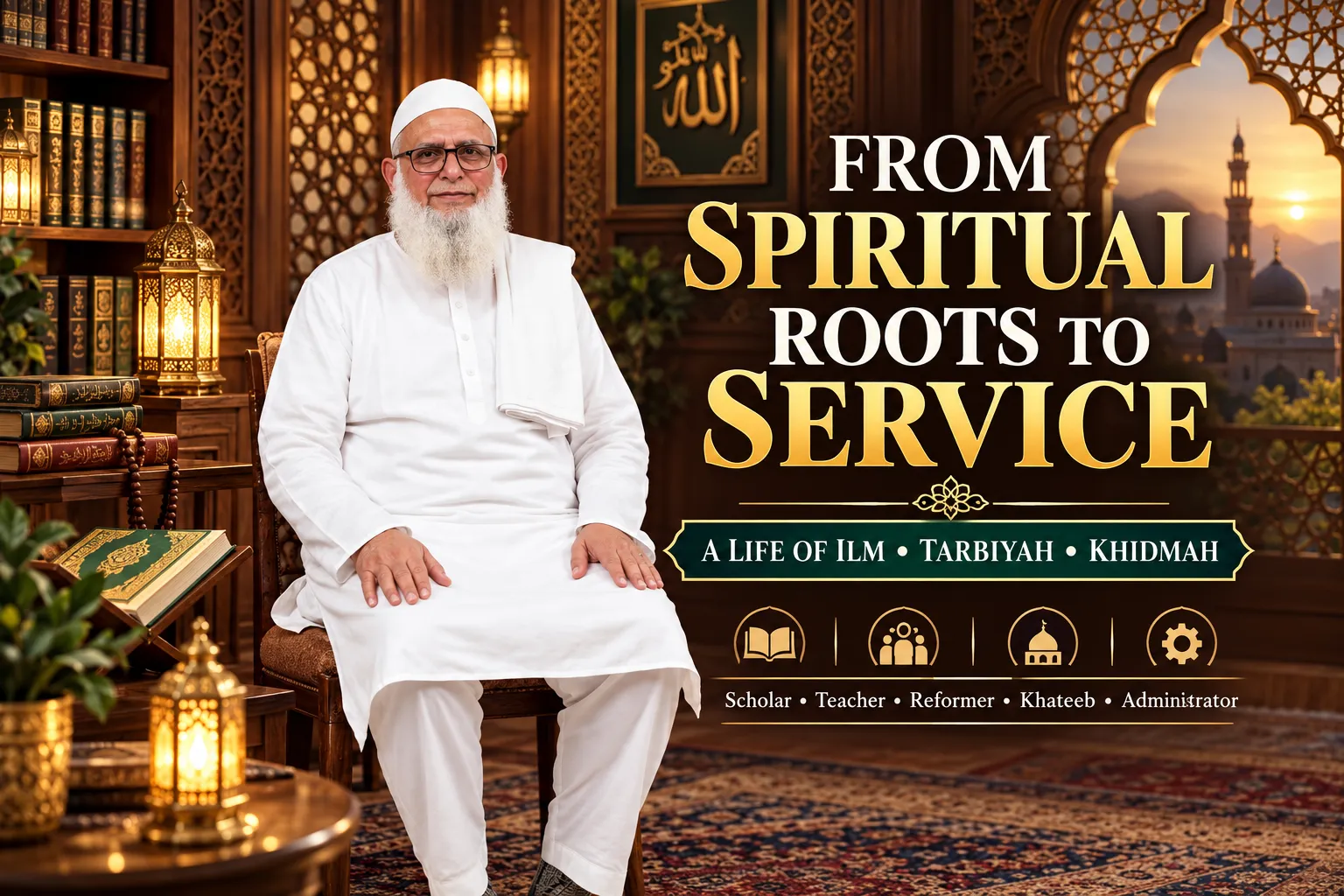
Maulana Mohammad Amin Pir, A Scholar • A Teacher • A Reformer • A Khateeb • An Administrator • A Spiritual Guide
There are individuals whose lives become a living testimony to the power of knowledge, character, service and spiritual commitment. They do not merely occupy positions; they cultivate people, establish institutions, shape minds and leave behind a legacy that continues through generations.
Maulana Mohammad Amin Pir of Zurhama is one such distinguished personality. A respected ʿĀlim, Mudarris, Khateeb, administrator, reformer and spiritually inclined scholar, he has dedicated several decades of his life to Islamic education, moral formation and social service.
His journey is not merely the story of an individual scholar. It is the story of a man who inherited a tradition of spirituality, pursued the path of knowledge, transformed knowledge into teaching, teaching into institution-building, and institution-building into a wider service to society.
Maulana Mohammad Amin Pir was born in Zurhama into a noble and spiritually distinguished family deeply rooted in religious values and community life.
His early personality was profoundly influenced by his revered father, Hazrat Ali Mohammad Pir, a well-known spiritual personality of his time, popularly remembered as “Ali Sahab.”
Ali Sahab was respected for his piety, spirituality, wisdom, humility, generosity and compassionate relationship with people. Under the affectionate and morally enriching guidance of his father, Maulana Mohammad Amin Pir received education that went beyond books.
He was introduced at an early age to the values of honesty, humility, simplicity, respect for elders, compassion for humanity, service to society and devotion to faith.
Thus, before becoming a scholar of texts, he received the deeper education of character and conscience.
The influence of his father became an important foundation of his later personality. The humility, simplicity and spiritual orientation for which Maulana Mohammad Amin Pir is known can be viewed as part of this formative inheritance.
His life consequently represents a beautiful continuation of a family tradition in which spirituality was lived, knowledge was respected, and service to people was regarded as a moral responsibility.
Growing up in an environment enriched by religious values, Maulana Mohammad Amin Pir developed a deep inclination towards Islamic learning.
He subsequently pursued his religious education in the Deobandi scholarly tradition, acquiring grounding in the traditional Islamic sciences.
For him, education was never merely a means of acquiring a title. It was preparation for a lifetime of teaching, guidance and service.
The knowledge that he acquired gradually became a responsibility upon his shoulders a responsibility to transmit it to the next generation.
This understanding eventually led him towards the noble profession of Tadris, where his real scholarly journey began
Approximately four decades ago, Maulana Mohammad Amin Pir established a madrasa at Hirri.
This became an important turning point in his life.
The madrasa was not merely a place where religious subjects were taught. Under his dedication, it became a centre of Qur'anic learning, memorisation, religious scholarship, discipline and moral training.
Over the years, he contributed to the education and preparation of hundreds of Huffaz-e-Qur'an and religious scholars.
Many students who passed through his educational environment subsequently became:
Huffaz-e-Qur'an
Ulema
Imams
Khateebs
Mudarriseen
Religious and community workers
A great teacher does not merely produce students; he produces teachers who continue producing generations after him.
As a Mudarris, Maulana Mohammad Amin Pir represents the traditional Islamic ideal of a teacher whose responsibility extends far beyond the classroom.
His educational approach encompasses knowledge, discipline, Tarbiyah, spirituality and character-building.
For him, a student is not merely someone who needs information. A student needs to be shaped into a person of character, responsibility and moral consciousness.
His decades of teaching demonstrate the patience required to educate young minds and the commitment necessary to nurture them over many years.
His contribution as a teacher can therefore be understood through three words:
The transmission of authentic Islamic learning. The cultivation of discipline, manners and moral consciousness.
Another important chapter of Maulana Mohammad Amin Pir's life began with his association with Madrasa Banat under the guidance of Hazrat Maulana Pir Shams-ud-Din Lolabi. For approximately two decades, he has served in an important academic and administrative capacity, including as Chief Mudarris and Head of the institution. His responsibilities here have gone beyond teaching individual students. He has been involved in the wider task of academic supervision, discipline, institutional development, teacher coordination and student Tarbiyah. His administrative contribution reflects an understanding that a successful madrasa requires more than classrooms. It requires:
vision, discipline, academic commitment, moral leadership and human sensitivity.
Among the important aspects of his institutional contribution is his association with the educational development of Hidayat-ul-Banat in District Kupwara. Under sustained academic and administrative guidance, the institution has established itself as an important centre of Islamic education for girls, producing a large number of female students with knowledge of Islamic teachings and Shariah. This contribution carries a significance that extends beyond the institution itself. When a girl receives meaningful education, the benefits of that education can travel into her family, community and future generations.
Thus, the education of women becomes a powerful instrument of social and moral development.
The contribution of Maulana Mohammad Amin Pir in this sphere deserves particular appreciation because it represents an investment not merely in students but in the intellectual and moral future of society
A madrasa administrator must simultaneously be an academic, organiser, mentor and guardian.
Maulana Mohammad Amin Pir's personality as an administrator is marked by qualities such as, Academic commitment, Institutional discipline, Patience, Accessibility, Human, sensitivity,Commitment to students Sense of responsibility.
His style of leadership can be described as service-oriented leadership leadership that seeks to strengthen an institution rather than merely exercise authority.
His administrative journey demonstrates that a religious institution flourishes when administration is combined with Tarbiyah and compassion.
Perhaps one of the most admirable features of Maulana Mohammad Amin Pir is his simplicity.
Despite decades of scholarship, teaching and institutional responsibility, he is known for remaining humble, down-to-earth, generous and approachable.
He does not appear to define scholarship merely through public recognition or academic position. Rather, his life reflects the classical understanding that knowledge should make a person more humble, not more arrogant.
His generosity and kindness have earned him affection among people who have interacted with him.
In an age when positions can sometimes create distance between leaders and ordinary people, his accessibility represents an important quality of religious leadership.
Another major dimension of his contribution has been his long association with Hirri as a Khateeb.
The role of a Khateeb in Kashmiri society extends beyond delivering a sermon. The pulpit provides an opportunity to address people's moral, social, familial and spiritual concerns.
For decades, Maulana Mohammad Amin Pir has used this platform to communicate Islamic teachings and encourage people towards, Moral discipline, Religious consciousness, Family responsibility, Social harmony, Respect for other, Spiritual development
His is long engagement with the community has given him an intimate understanding of its changing circumstances.
There is another dimension to his role as Khateeb that deserves attention.
A person who spends decades listening to people, understanding their families, witnessing their difficulties and observing changing social customs inevitably develops a profound understanding of society and human behaviour. In this sense, Maulana Mohammad Amin Pir may also be regarded as a keen social observer. His sermons have not existed in isolation from society. They have emerged from an understanding of the realities experienced by ordinary people.
This ability to connect religious principles with contemporary social realities is one of the most important qualities of an effective religious educator. Maulana Mohammad Amin Pir's reformative contribution may be understood as a process of education, moral persuasion and gradual social transformation.
His method has been rooted in the traditional belief that lasting reform begins with the individual.
Knowledge creates awareness.
Awareness creates responsibility.
Responsibility creates change.
Through teaching, preaching, personal example and institutional service, he has contributed to the gradual strengthening of religious and moral consciousness in the communities with which he has been associated.
His reformative role is therefore not simply one of rhetoric; it is rooted in long-term educational engagement.
His commitment to religious education has also extended beyond his formal institutional responsibilities. In his native area, he has played a role in supporting religious and educational initiatives, including efforts associated with Ihya-ul-Uloom. Such engagement reveals another important feature of his vision: the understanding that the future of scholarship depends upon strong and sustainable institutions.
An individual scholar may influence a generation. But a strong institution can influence generations yet unborn.
This philosophy of institution-building is one of the enduring aspects of his contribution.
Behind the teacher, administrator and Khateeb stands another dimension the spiritual personality.
His simplicity, humility, generosity and commitment to religious service reflect a life in which knowledge and spirituality remain closely connected. His journey reminds us that Islamic scholarship is not simply about mastering books. It is about allowing knowledge to transform the heart, character and conduct. The influence of his father, Ali Sahab, appears particularly meaningful in understanding this aspect of his personality. Thus, the journey from Ali Sahab's spiritual household to Maulana Mohammad Amin Pir's educational institutions represents a beautiful continuity of values across generations.
The Human Beings He Has Produced
When the life of a scholar is evaluated, positions and titles are temporary. The true legacy lies in people. The Huffaz he taught, the Ulema he nurtured, the students he mentored, the teachers he influenced and the female scholars educated through institutions associated with his service collectively constitute his most valuable legacy. A building may age. A position may change.
But knowledge transmitted from one generation to another continues to live. That is why the real measure of Maulana Mohammad Amin Pir's contribution lies in the generations that have emerged from his educational mission.
A Legacy of Ilm, Tarbiyah and Khidmah The life of Maulana Mohammad Amin Pir can beautifully be summarised through three foundational concepts. A lifelong commitment to Islamic knowledge and scholarship. The formation of minds, morals and personalities. The transformation of knowledge into service to humanity. These three dimensions have remained interconnected throughout his life. He acquired knowledge. He transmitted knowledge. He established educational spaces.
He nurtured students. He guided communities. He strengthened institutions.
And he continued to serve with humility. Maulana Mohammad Amin Pir of Zurhama represents a remarkable synthesis of traditional scholarship, teaching, administration, preaching, social awareness, reform and spirituality.
Born in a noble and spiritually respected family, morally nurtured by his revered father Ali Sahab, educated in the tradition of Islamic scholarship, and devoted for decades to the teaching and training of students, he has transformed his personal journey into a wider mission of service.
From Zurhama to Hirri, from the madrasa classroom to the Friday pulpit, from individual teaching to institutional leadership, and from religious education to social engagement, his life reflects a continuous commitment to the values of Islam and humanity.
As a scholar, he represents knowledge. As a Mudarris, he represents education. As an administrator, he represents institutional responsibility. As a Khateeb, he represents moral communication. As a reformer, he represents gradual social transformation. As a spiritual personality, he represents humility and inner discipline. And as a teacher, his greatest achievement is the generations of students who carry the light of knowledge forward. Some people inherit wealth from their forefathers; some inherit a spiritual legacy and spend their lives enriching it. Maulana Mohammad Amin Pir inherited the values of spirituality from Ali Sahab and transformed that inheritance into a legacy of knowledge, education and service
His story is ultimately the story of a life devoted to Ilm, Tarbiyah, Islah and Khidmah a life in which scholarship became service, service became institution-building, and institution-building became a legacy for generations.