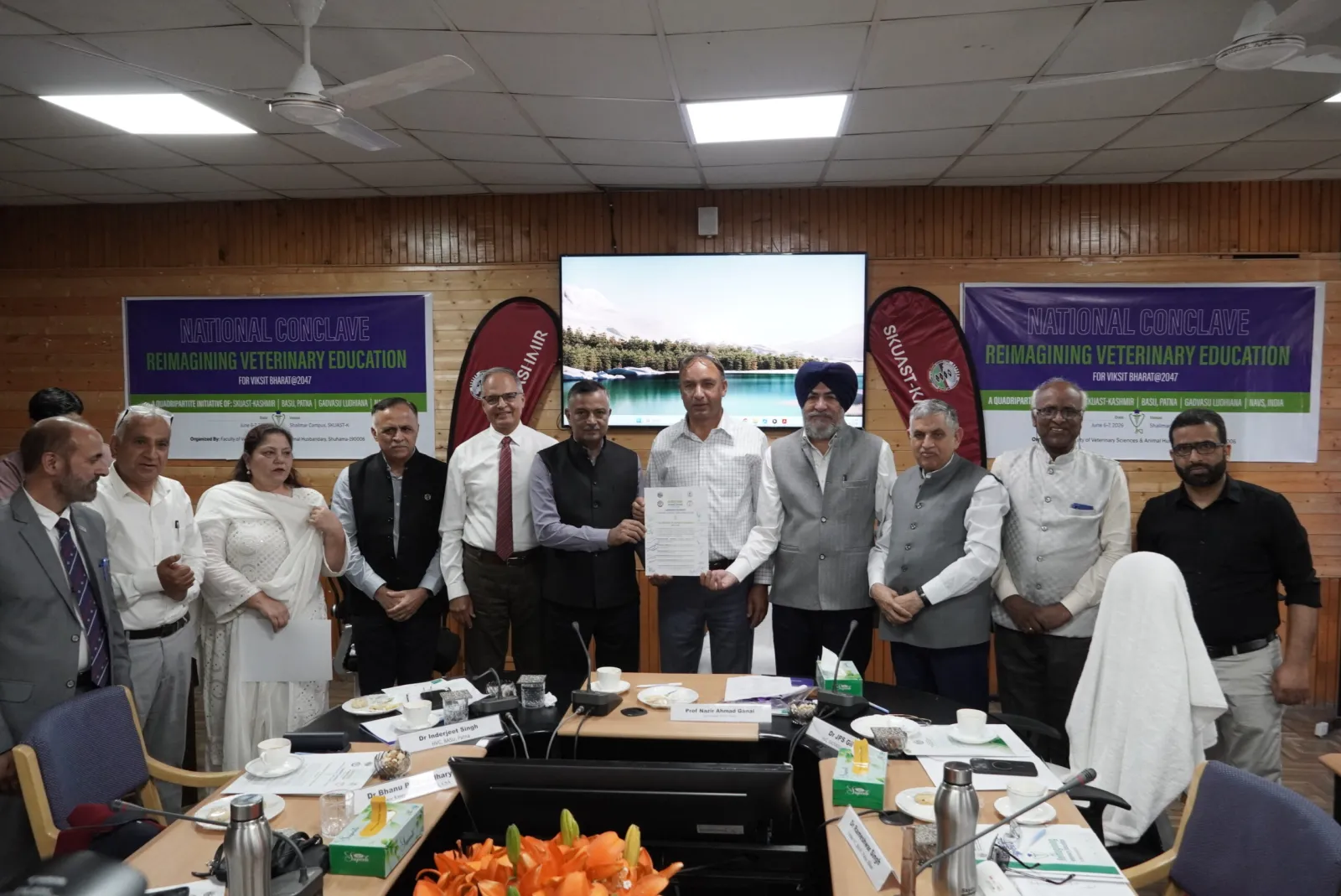
Srinagar, Jun 06: What began as a regional agricultural university is now steadily positioning itself as a nationally influential and globally ambitious institution. Sher-e-Kashmir University of Agricultural Sciences and Technology of Kashmir (SKUAST-K) is scripting a dramatic transformation through innovation, startups and research-driven education. In 2020, the University had only four patents and the numbers have risen to 123 at present, reflecting the speedy growth of the varsity in the past six years.
Speaking exclusively to Rising Kashmir on the sidelines of the two-day National Conclave on “Reimagining Veterinary Education for Viksit Bharat@2047”, Vice Chancellor Prof Nazir Ahmad Ganai said the university’s innovation-led academic model is now attracting attention across the country and beyond.
Global experts like Dr Victoria Brookes, who is the Co-Lead for One Health SIG, Sydney University, Australia, Dr Bhanu Pratp Chowhdary, Professor Emeritus, Texas A&M University, USA and Dr Punniyar Murthy, Padma Shri Awardee 2026 and expert in Ethno Veterinary Medicine, share their valuable insights during the conclave, besides VCs for various universities across the country.
Highlighting the scale of transformation witnessed in recent years, Prof Ganai said SKUAST-K has moved from having only four patents in 2020 to an impressive 123 patents today, alongside building a thriving startup ecosystem dominated by students.
“Of the 123 patents and 102 startups, nearly 90 of these startups belong to students while the remaining have been developed by faculty members,” he said.
According to the Vice Chancellor, the university’s focus is no longer limited to producing degree holders but future-ready professionals capable of generating employment and driving economic growth.
“We want our graduates to become entrepreneurs instead of merely running after government jobs. Our effort is to build an ecosystem where students create opportunities not only for themselves but also for others,” he said.
Prof Ganai said the university had earlier developed an agricultural education model that is now being followed by nearly 72 universities across the country, adding that similar reforms are now being envisioned for veterinary education as well.
“Livestock and veterinary sciences are equally important for the country’s future. Through this conclave, we are discussing how to make graduates more competent, skilled and globally competitive while also ensuring farmers become self-reliant,” he added.
The Vice Chancellor said international experts and leading academic voices joined the conclave virtually and physically to deliberate on reforms needed in veterinary education.
Foreign experts shared global perspectives on innovation, technology integration and research-oriented education, while Vice Chancellors from several agricultural universities discussed ways to modernise India’s veterinary learning ecosystem.
Prof Ganai further revealed that SKUAST-K has recommended the establishment of a National Veterinary Commission with a funding mechanism similar to the Indian Council of Medical Research (ICMR), enabling universities to build globally competitive institutions.
“We have suggested that the commission should directly support universities financially so that world-class veterinary institutions can emerge from India,” he said.
Reflecting on the university’s growing popularity among students, the SKUAST-K VC said applications and enrolment figures have witnessed a remarkable rise over the years.
“Our intake has increased from nearly 2,200 students to more than 5,000 today. Last year, we received around 18,000 applications for just 700 seats. This reflects the trust the people of Jammu & Kashmir and the rest of the country have developed in SKUAST-K,” he said.
The Vice Chancellor, however, maintained that the university’s journey was still evolving.
“This does not mean we have achieved everything. Earlier, this university was local to national. Now our mission is to transform it into the country’s first global agricultural university by adopting the best international practices,” he added.
Touching upon the growing stray dog issue in Kashmir, Prof Ganai called for a collective societal response centred around scientific waste management and sterilisation programmes.
“Animal rights cannot be ignored, but society also has responsibilities. Food waste generated during marriages, in hotels and in households should not be thrown on roads. Proper waste disposal and sterilisation are important solutions,” he said.