Srinagar, Aug 03: Jammu and Kashmir witnessed one of its most turbulent weather days of the season on Monday as four cloudbursts struck different parts of Kashmir within hours, triggering flash floods, damaging infrastructure and prompting meteorological experts to issue a fresh warning of more isolated cloudbursts, landslides and flash floods in the coming days.
The cloudbursts were reported from the Chachmarg area of Shopian district, Batkoot area of Pahalgam in Anantnag district, the Gorihajin area of Arin-Dardpora in Bandipora district and Warnow in the Lolab valley of Kupwara district, highlighting the widespread impact of the active monsoon system across the Valley.
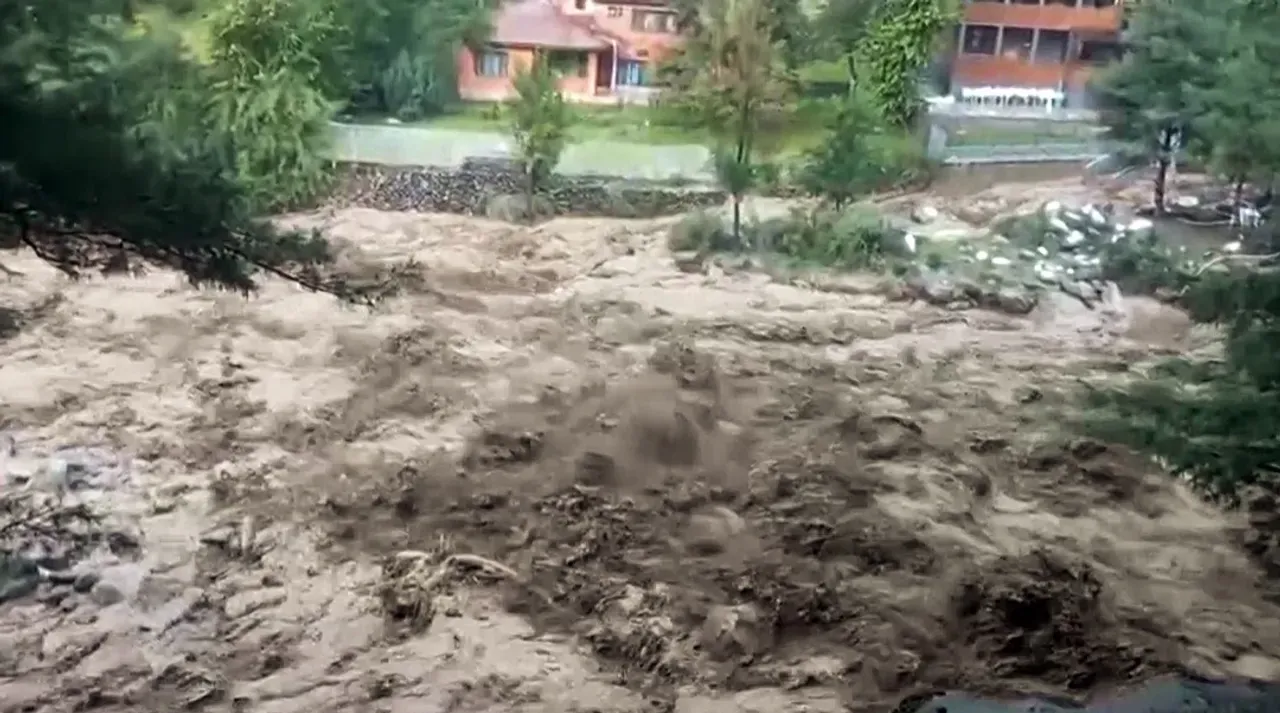
The first incident was reported from Chachmarg, an area of Shopian, when flash floods triggered by the cloudburst created panic as water entered several villages, including orchards amid intense rainfall.
The second incident was recorded from Batkoot, where an intense spell of rainfall caused Wardbal Nallah and several adjoining streams to overflow within minutes. The sudden runoff led to a sharp rise in the water level of the Lidder River, raising concerns among residents and authorities.
Soon after, the third cloudburst hit Gorihajin in north Kashmir's Bandipora district. Officials rushed revenue and disaster management teams to the area to assess losses and monitor vulnerable habitations.
The fourth cloudburst struck Warnow in Lolab, Kupwara, where local streams swelled suddenly following intense rainfall. Officials said a woman was believed to have been swept away in the flash flood and is feared dead. Search and rescue teams continued operations till late evening to trace the missing woman.
Independent weather forecaster Faizan Arif said rapid cloud development was observed over the Jammu plains during the afternoon before the weather system expanded towards several parts of J&K.
"Rain and thundershowers are expected across many parts of Jammu and Kashmir, particularly the Jammu region, over the next 12 hours. Localised high-intensity rainfall could trigger flash floods, landslides and isolated cloudburst events in vulnerable areas," Arif said.
Explaining the Batkoot cloudburst, Arif said the hydrological behaviour clearly indicated an intense, localised weather event.
"Wardbal Nallah and several nearby streams overflowed within a very short span of time following an intense spell of rainfall. As a result, the water level in the Lidder Nallah rose by several feet in just two hours. Interestingly, water levels in the Sheshnag Nallah and the Aru Valley remained largely under control. The sharp rise in the Lidder, despite its main upstream tributaries remaining near normal, confirms that an extremely intense, localised cloudburst occurred over the midway forested catchment near Batkoot, rapidly feeding runoff into the river," he said.
Even as the cloudbursts struck, high-intensity rainfall triggered flash floods across several villages in Shopian district, where overflowing streams and nallahs inundated roads, residential areas and agricultural land. Water entered several houses in low-lying areas, while local authorities launched damage assessment exercises. No casualties were reported from the district till the filing of this report.
Director Meteorological Centre Ladakh, Sonam Lotus, said the prevailing weather system over Jammu and Kashmir remains highly active due to abundant monsoon moisture interacting with the Himalayan terrain.
"The atmosphere is conducive for moderate to heavy rainfall at many places, with isolated spells of very heavy rain. Such intense spells can trigger flash floods, landslides, mudslides, shooting stones and, at isolated locations, cloudburst-like situations, particularly in vulnerable mountainous areas," Lotus told Rising Kashmir.
He urged people living near rivers, streams, nallahs and landslide-prone slopes to remain vigilant and avoid unnecessary travel during periods of heavy rainfall.
The impact of the active monsoon extended beyond Kashmir into Ladakh, where heavy rainfall triggered a major flash flood in Gund Nallah at Hardass village, causing extensive damage to private property, agricultural land, standing crops, fruit-bearing trees and local infrastructure.
Officials said preliminary reports indicated no loss of human life in Hardass. Field surveys are underway and a detailed damage assessment will be prepared after inspections are completed.
Another flash flood was also reported from Tumail village in the Sodh area of Ladakh, where officials are collecting information on the extent of damage. Residents in both villages have been advised to remain alert and avoid flood-prone areas until the weather stabilises.
Strong winds also caused damage in the Bakura area of central Kashmir's Ganderbal district on Monday evening. Officials said powerful gusts blew off the rooftop of a residential house and damaged an electric pole, disrupting power supply in the locality. No injuries were reported, while restoration work was taken up by the concerned departments.
Meanwhile, the aftermath of recent floods continued to affect the Jammu region. The Deputy Commissioner's Office in Rajouri, which sustained damage during recent flash floods, has been declared structurally unsafe. Officials have shifted the office to a new location to ensure uninterrupted public services while restoration and safety assessments are carried out.
The latest weather events come against the backdrop of an unusually active monsoon season in Jammu and Kashmir. After recording a 32 percent precipitation deficit till May 30, the Union Territory has witnessed a remarkable turnaround due to sustained monsoon activity and is now recording an overall rainfall surplus of 23 per cent.
According to official figures, 30 cloudburst incidents have been reported across Jammu and Kashmir since June 1, with the latest three reported on Monday from Pahalgam, Bandipora and Kupwara. Most incidents have occurred in the Pir Panjal belt and parts of the Jammu region, triggering flash floods, landslides and widespread damage to roads, bridges, houses, agricultural land and public infrastructure.
Srinagar-Jammu highway closed
A traffic official said that due to mudslides amid intense rainfall, the Jammu-Srinagar highway was closed for the traffic on both sides while restoration work was going on. “If weather improves, traffic may be restored on the highway on Tuesday,” he said.
SSG Road reopened within 50 minutes after landslide
A landslide at Sarbal Nallah in the Sonamarg area of central Kashmir's Ganderbal district on Monday briefly disrupted traffic on the Srinagar–Sonamarg–Gumri (SSG) Road and the Sarbal Road, prompting authorities to suspend vehicular movement as a precaution.
Officials said the landslide blocked both the SSG Road and the Sarbal Road, following which traffic was immediately halted at the Traffic Control Point (TCP) Sonamarg. The Beacon authorities were informed, and restoration work was launched without delay.
Thanks to the coordinated efforts of the Traffic Police, Jammu and Kashmir Police, Border Roads Organisation (BRO), Beacon authorities, ITBP and other concerned agencies, debris was cleared swiftly, and the SSG Road was reopened for traffic movement within just 50 minutes.
Officials confirmed that the Sarbal–Sonamarg road has also been restored and traffic is now plying smoothly on the affected stretch. Authorities have advised commuters to drive cautiously while passing through landslide-prone areas, as weather conditions may trigger fresh slides in vulnerable locations. Traffic officials continue to monitor the situation to ensure the safe movement of vehicles.
With inputs from Umar Raina