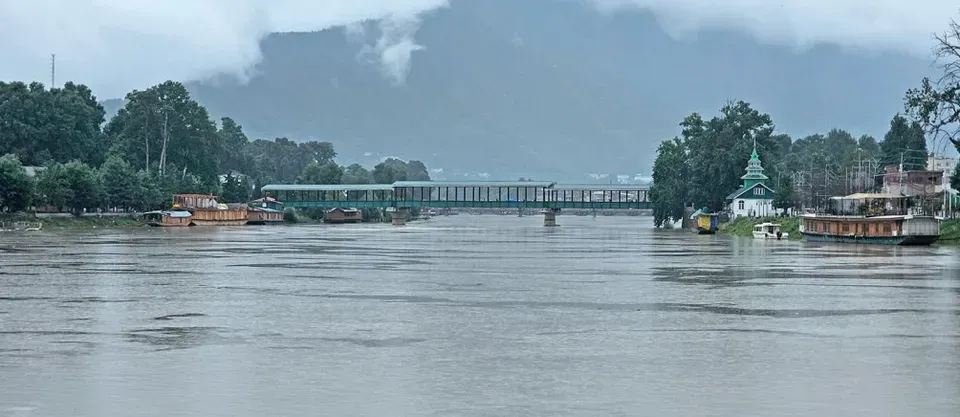
Srinagar, Jul 24: Flood fears eased across Kashmir on Friday as the Jhelum, the lifeline of Kashmir, and its tributaries receded despite moderate to heavy overnight rain, particularly in south Kashmir.
Water levels, which had touched or neared flood declaration or warning levels late Thursday night, declined steadily through Friday morning.
Fresh rain in the upper catchments and south Kashmir briefly slowed the recession around noon, but after showers ceased and the weather improved by afternoon, the rivers resumed receding as the evening progressed.
Flood control authorities ruled out any immediate flood threat, saying water levels at all major flood monitoring stations had dropped below flood declaration levels and were expected to decline further overnight.
"The water level at all flood monitoring stations on the Jhelum, its tributaries, Wular Lake and Sind Nallah is now below the flood declaration level after touching or nearing it last night," a Flood Control Department official said.
At 11 am, the Jhelum was flowing at 18.87 feet at Sangam, below the alert or warning level of 21 feet and the danger mark of 25 feet.
At Pampore, the river had touched the 5-feet danger mark overnight before beginning to recede.
The flood declaration level there is 4.5 feet.
At Ram MunshiBagh, the river stood at 19.04 feet, above the flood declaration level of 18 feet but below the 21-feet danger mark.
Further downstream, Asham recorded 12.42 feet against the flood declaration level of 14 feet and the danger mark of 16.5 feet, while Wular Lake stood at 1,575.93 metres, below its flood declaration level of 1,578 metres.
Fresh rain until around 2 pm caused a marginal rise across the basin.
By 11 pm however, the receding trend had resumed.
At 9 pm, the Jhelum was flowing at 19.77 feet at Sangam, 5.09 metres at Pampore, 18.89 feet at Ram MunshiBagh, 12.74 feet at Asham, and 1,576.10 metres at Wular.
All remained below their respective danger levels.
A similar pattern was recorded in the Vaishaw at Khudwani, Rambiara at Wachi, Lidder at Batkoot, Doodhganga at Barzulla and Sind at Doderhama.
Their levels also rose marginally following fresh rain before receding again by evening, remaining below their respective flood declaration and danger levels.
"Moderate to heavy rainfall in the southern catchment of the Jhelum basin caused a marginal rise in tributaries, slowing the recession at Sangam and Ram MunshiBagh for a few hours. However, water levels started falling again by late evening and are expected to decline further by morning," a Flood Control Department official said.
The department said the situation was being monitored round the clock and advised people not to panic or pay heed to rumours circulating on social media or other unofficial sources.
"People are advised to rely only on official updates, remain vigilant and cooperate with the administration," it said.
Weather improved across J&K on Friday afternoon. The Meteorological Department forecast generally dry weather from July 25 to 27, with brief spells of rain or thundershowers at isolated places, mainly over Jammu. A fresh wet spell is expected from July 28 to 31, with isolated heavy showers likely in parts of the Jammu division.
The five-day wet spell left widespread damage across J&K.
Rajouri and Poonch were the worst affected, where floods, cloudbursts, and landslides claimed about 28 lives.
Similar weather-related incidents damaged houses, roads, crops, and public infrastructure in Reasi, Samba, Udhampur, and the Chenab Valley districts of Ramban, Doda, and Kishtwar.
In Kashmir, floodwaters washed away a shopping complex in Beerwah after the SukhnagNallah overflowed on Tuesday.
Flash floods and landslides also damaged houses, roads, agricultural land, and apple orchards in several parts of the Valley.