Prof. R.K. Uppal. [PhD, D.Litt.]
……………………………………………………………………
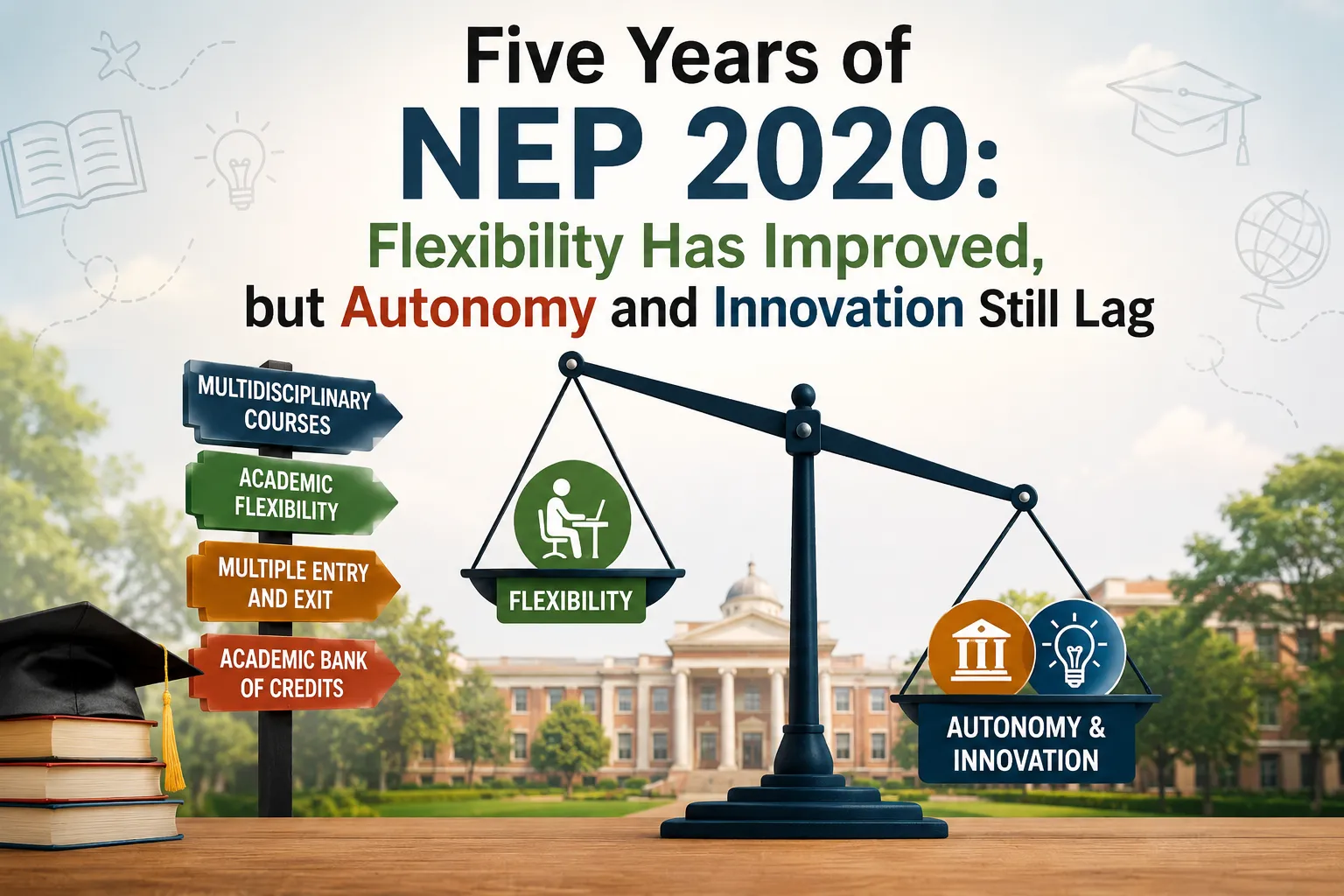
The National Education Policy (NEP) 2020 was introduced with the promise of transforming India's education system into one that is flexible, multidisciplinary, inclusive, innovative, and globally competitive. It sought to replace rote learning with critical thinking, encourage research and innovation, empower higher education institutions, and prepare students for the demands of the twenty-first century. Five years after its launch, it is evident that the policy has brought meaningful improvements in academic flexibility. However, institutional autonomy and innovation—the two pillars essential for long-term transformation—continue to lag behind.
One of the most visible achievements of NEP 2020 is the introduction of greater flexibility in learning. Students now have more opportunities to choose interdisciplinary courses, pursue multiple entry and exit options, earn academic credits through the Academic Bank of Credits, and combine subjects across traditional streams. These reforms have begun to challenge the rigid boundaries that once separated science, commerce, arts, and vocational education. The emphasis on skill development, experiential learning, internships, and digital education has also made the curriculum more relevant to contemporary needs.
The policy has encouraged universities to redesign their academic programmes, adopt outcome-based education, and integrate technology into teaching and learning. Several institutions have introduced multidisciplinary programmes, upgraded digital infrastructure, and revised syllabi to align with emerging industry requirements. These developments indicate that NEP 2020 has successfully initiated a shift from a content-driven education system to a more learner-centered approach.
Despite these positive developments, flexibility alone cannot transform higher education. Universities require genuine academic, administrative, and financial autonomy to innovate effectively. Unfortunately, many higher education institutions continue to function within highly centralized regulatory structures. Decision-making remains slow, bureaucratic, and dependent on multiple approvals. Universities often have limited freedom to design new programmes, recruit outstanding faculty, establish international collaborations, or allocate resources according to their strategic priorities.
Institutional autonomy is not merely about administrative independence; it is about creating an environment where academic leaders can make timely decisions, encourage creativity, and respond quickly to changing educational and societal needs. Without such freedom, even the most progressive educational policy cannot achieve its intended outcomes. Many universities continue to prioritize compliance over creativity, leaving little room for experimentation or academic entrepreneurship.
Innovation presents another significant challenge. Although NEP 2020 places strong emphasis on research, innovation, and entrepreneurship, progress has been uneven. India continues to produce a large number of graduates and research scholars, but relatively few globally recognized innovations, breakthrough technologies, or commercially successful research outcomes. In many institutions, research remains publication-oriented rather than problem-solving in nature. Faculty members often face heavy teaching loads and administrative responsibilities that leave limited time for meaningful research and innovation.
The ecosystem supporting innovation also requires considerable strengthening. Research funding remains inadequate in many universities, particularly in state institutions and rural colleges. Laboratories, incubation centers, and research infrastructure often fall short of international standards. Collaboration among universities, industries, government agencies, and research organizations remains limited despite repeated policy emphasis. Without stronger institutional support, innovation cannot become an integral part of higher education.
Faculty empowerment is equally important. NEP 2020 recognizes teachers as the cornerstone of educational reform, yet many educators continue to struggle with contractual employment, excessive administrative work, performance pressures, and limited opportunities for professional development. Innovation flourishes when faculty members are trusted, supported, and encouraged to pursue creative teaching and impactful research. Instead, many spend significant time on compliance-related activities rather than academic excellence.
The implementation of multidisciplinary education has also faced practical challenges. Smaller colleges, particularly those located in rural and semi-urban regions, often lack sufficient faculty, infrastructure, and financial resources to offer a wide range of interdisciplinary programmes. Digital learning initiatives have expanded, but unequal access to technology and internet connectivity continues to affect many students. Bridging these disparities is essential if the benefits of NEP 2020 are to reach every learner.
Furthermore, meaningful autonomy must be accompanied by accountability. Institutions should enjoy greater freedom while being evaluated through transparent performance indicators related to teaching quality, research output, graduate employability, innovation, and community engagement. A balanced framework that combines autonomy with accountability would encourage excellence without compromising public trust.
The success of NEP 2020 will ultimately depend not only on policy design but also on implementation. Education reforms require sustained political commitment, adequate financial investment, institutional capacity building, and continuous monitoring. Frequent policy announcements alone cannot transform classrooms, laboratories, or universities. Real change occurs when institutions receive the resources, authority, and confidence to innovate independently.
Looking ahead, India must focus on strengthening university governance, expanding research funding, simplifying regulatory processes, encouraging international partnerships, and fostering a culture that rewards creativity and academic excellence. Universities should be empowered to become centers of knowledge creation rather than merely degree-awarding institutions. Industry-academia collaboration should be expanded to ensure that research addresses real-world challenges and contributes to national development.
Five years after its introduction, NEP 2020 deserves recognition for making higher education more flexible and student-centric. These achievements represent important progress and provide a strong foundation for future reforms. However, flexibility is only one component of educational transformation. Without greater institutional autonomy, stronger research ecosystems, empowered faculty, and a genuine culture of innovation, India will struggle to achieve its ambition of becoming a global knowledge leader.
The next phase of educational reform should therefore move beyond curriculum flexibility and focus on empowering institutions to innovate, compete globally, and produce knowledge that addresses national and international challenges. Only when autonomy, innovation, and accountability advance together will the full promise of NEP 2020 be realized, enabling India's higher education system to prepare graduates who are not only employable but also creative, entrepreneurial, and capable of shaping the nation's future.