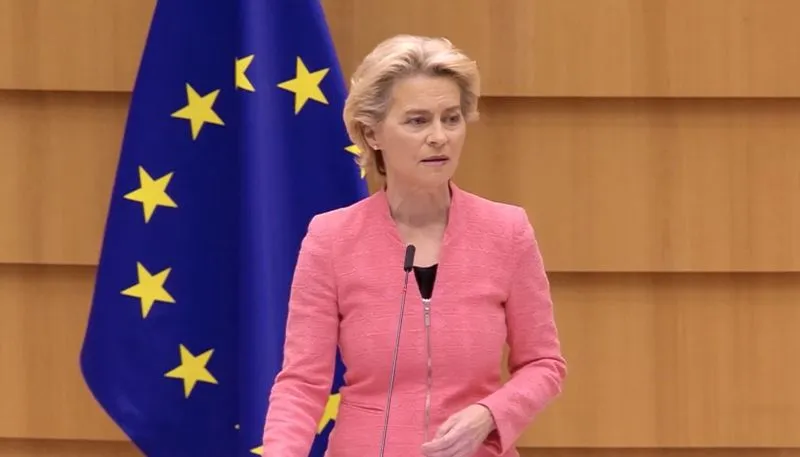
BRUSSELS, Aug 4 : European Commission President Ursula von der Leyen has called for stronger protection of the European Union's external borders following last week's mass migrant crossings into the Spanish enclave of Ceuta, saying the incident underscored the need for a coordinated European response to irregular migration.
In a letter to Spanish Prime Minister Pedro S nchez, von der Leyen praised Madrid's handling of the crisis but said the events had exposed vulnerabilities along the EU's external frontiers.
"From this incident, it is clear that we must do more to further strengthen our borders at critical points," she wrote.
She added that "the protection of all our external borders is a shared European responsibility," calling for "vigilant monitoring and the use of physical barriers where needed."
The appeal came after tens of thousands of migrants crossed from Morocco into Ceuta in one of the largest sudden migration surges at the EU's southern border.
Spanish authorities estimate that around 69,500 migrants have since returned to Morocco, surpassing earlier estimates of 50,000 returnees. Officials said 72 people died on the Spanish side of the border, while 11 fatalities were reported in Morocco.
EU interior ministers are due to hold emergency talks via video conference on Tuesday to discuss the crisis and its implications for the bloc's migration policy.
Von der Leyen said the meeting would provide an opportunity to draw "lessons" from the Ceuta crossings, warning that the challenge of irregular migration requires "a common European response, united action and solidarity."
She urged EU member states to "double down" on five priorities: preventing irregular migration through closer cooperation with partner countries, strengthening external borders, improving early warning systems, dismantling migrant smuggling networks, and accelerating the return of people with no legal right to remain in the bloc.
The migrant surge has also exposed divisions within the EU.
Italy temporarily suspended the Schengen arrangement with Spain in response to the influx, a move backed by Finland and Denmark. Czech Prime Minister Andrej Babi also called for Spain's temporary suspension from the Schengen system.
S nchez criticized the reactions from some European governments, saying he had "serious concerns" about their response and stressing that Ceuta is not part of the Schengen area.
While many governments had shown "support and solidarity," S nchez said others had chosen to attack Spain, "driven by prejudice, fake news, ignorance, or political interest."
Spain has blamed migrant trafficking networks for exploiting a recent Supreme Court ruling that limited the government's ability to immediately deport migrants arriving by sea.
Interior Minister Fernando Grande-Marlaska said the situation in Ceuta had "almost returned to normal", adding that authorities were installing a floating barrier along the maritime border with Morocco to help prevent further illegal crossings.
The crisis has reignited debate within the EU over border management and migration policy, with Brussels signaling that stronger border controls will be a central topic as member states seek a unified response to future migration surges.(UNI)