Srinagar, Jun 18: An in-depth research on the drug abuse among teenagers in Srinagar has exposed a disturbing drug supply chain operating around the schools, with classmates and friends emerging as the most powerful link connecting students to narcotics.
The research, conducted by Dr Sameena Wani, presently Principal, Government Girls Higher Secondary School Kothibagh, Srinagar, reveals that the drug ecosystem targeting school students no longer depends solely on street-level peddlers. The study has been submitted to the District Institute of Education and Trainings (DIET) Srinagar.
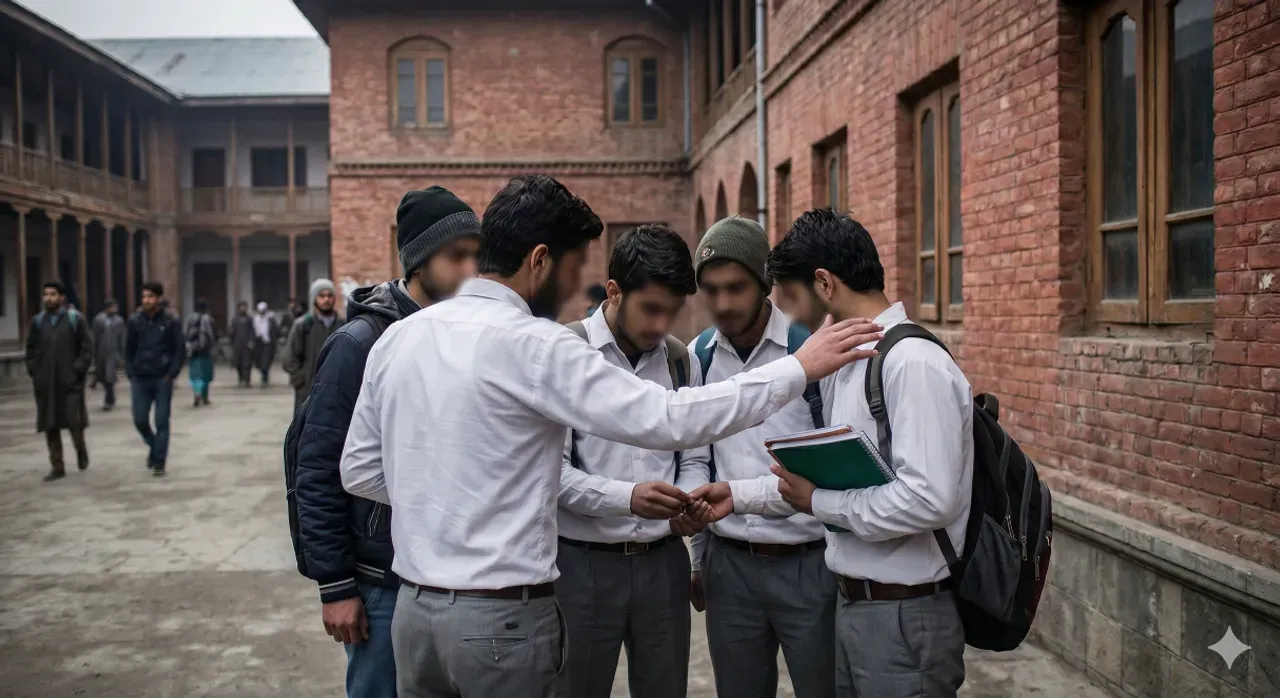
Instead, narcotics are increasingly moving through a layered chain involving drug suppliers, local shops and ultimately fellow students who introduce and circulate substances among peers inside educational institutions. The figures presented in the study point towards a deeply embedded peer-driven network.
Among High School students, 46.19 per cent of boys and 17.42 per cent of girls identified “other students” as the primary source of drugs. In Higher Secondary Schools, 25 per cent of boys and 19.75 per cent of girls gave the same response, making classmates the single largest source of narcotics access across institutions.
Overall, 495 boys — accounting for 27.46 per cent of respondents — admitted that friends and fellow students convinced others to abuse drugs. Among girls, nearly 19.01 per cent of respondents acknowledged similar peer influence.
The study concludes that fellow students are no longer merely consumers but have become active facilitators in the spread of drugs among adolescents.
Researchers describe the pattern as a “peer-to-peer supply chain,” where narcotics first enter local communities through peddlers and illegal networks before gradually reaching students through social circles, friendships and classroom contacts.
Drug peddlers emerged as the second major link in this chain. As per the study, in High Schools, 34.2 per cent of boys identified peddlers as a direct source of drugs, while 4.02 per cent of girls reported the same. In Higher Secondary Schools, 16.20 per cent of boys and 4.96 per cent of girls acknowledged drug peddlers as suppliers. The study indicates that peddlers often operate outside educational institutions and rely on teenagers already using substances to expand their reach among students.
“Small shops too surfaced as another access point. Around 14.76 per cent of boys and 4.82 per cent of girls from High Schools reported that drugs could be sourced through shops, while 10.92 per cent of boys and 5.71 per cent of girls from Higher Secondary Schools also pointed towards local commercial outlets,” the study reads. “Though smaller in proportion, some respondents also identified relatives as a source of narcotics, with 3.8 per cent High School boys and over 3 per cent Higher Secondary students acknowledging access through family connections.”
The report warns that the real danger lies in the normalisation of drugs within peer networks, where teenagers often trust friends more than outsiders, making detection difficult for parents and teachers. “The majority of respondents know that it is easy to access drugs through other students,” the study notes, highlighting how school environments are increasingly becoming vulnerable to hidden narcotics circulation.
The findings are supported by observations quoted in the study from the Police Control Room in Srinagar. Researchers have called for stricter surveillance around schools, regulation of suspicious local shops, counselling mechanisms and stronger coordination between parents, schools and law enforcement agencies to break what the report describes as an “evolving student-centred drug supply chain” in Kashmir.