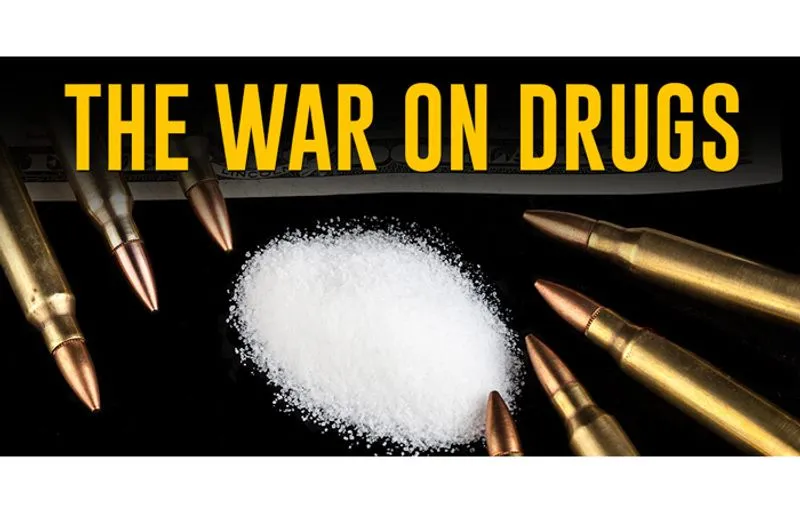
India stands at a watershed moment in its long and difficult struggle against drug trafficking and abuse. The 10th apex-level meeting of the NCORD has sent an unambiguous signal: the nation's resolve to combat the narcotics menace is not merely administrative routine but a strategic imperative of the highest order. The statistics alone are staggering - seizure of synthetic drugs has risen from 26 lakh kilograms during 2004-2014 to 1.18 crore kilograms between 2014 and 2026, a near fourfold increase. While this figure reflects the commendable vigilance of enforcement agencies, it equally confirms a disturbing truth: the scale of drug smuggling into and across India has grown enormously. The battle is far from over.
The dual threat posed by narcotics - the destruction of India's youth and the funnelling of illicit profits into terrorism - constitutes what may rightly be called narco-terrorism, one of the most insidious dangers facing contemporary India. Drug cartels do not merely peddle addiction; they bankroll insurgency, sustain naxalism, and corrode the social fabric of communities already burdened by poverty and unemployment. The revenue generated from narcotics trafficking is not spent on luxury; it is invested in weapons, propaganda, and violence. To allow the drug trade to flourish is, therefore, not merely a public health failure - it is a threat to national security of the gravest magnitude.
Home Minister Shah's three-pronged doctrine - detect, disrupt, and destroy - is clear, unambiguous, and operationally sound. It represents a shift from reactive policing to proactive network dismantlement. By targeting not just individual peddlers but entire supply chains, the approach seeks to hollow out the infrastructure of drug cartels from within. Crucially, this strategy is complemented by a compassionate distinction between the trafficker and the victim. The addict is not a criminal to be punished but a patient to be healed. Rehabilitation must be treated as seriously as enforcement, and it is encouraging that this principle now appears embedded within the national framework.
The next three years, as the Home Minister himself has acknowledged, will be decisive. Nowhere is this truer than in India's border states and Union Territories, particularly Punjab and Jammu & Kashmir, where the drug menace intersects dangerously with cross-border terrorism. In this context, the Lieutenant Governor of Jammu & Kashmir's declaration of a 100-day war on narcotics deserves special recognition. This initiative, combining public participation, police action, and political will, has already yielded encouraging results on the ground. J&K is demonstrating that when governance, law enforcement, and civil society align, tangible progress is possible. The territory is emerging not merely as a front in the war against drugs but as a model for rehabilitation and recovery efforts across the country.
Yet there remain significant structural challenges that must be urgently addressed. Traffickers are no longer operating in the shadows of back alleys; they are exploiting e-commerce platforms, drones, darknet marketplaces, and even telehealth services to move narcotics with alarming sophistication. Law enforcement must be equipped-in terms of technology, training, and inter-agency coordination-to meet this evolving threat. The centre's decision to revisit the NDPS Act to plug loopholes exploited by syndicates is long overdue and must be pursued with urgency. The Supreme Court's directive to establish special courts for expedited conviction of drug offenders is equally vital; justice delayed in narcotics cases is, quite literally, lives lost. The expansion of Narcotics Control Bureau offices across the country, the development of a three-year vision document for 2026-2029, and the real-time intelligence-sharing portals being developed under NCB are all steps in the right direction. But mechanisms alone cannot deliver results. The quality of implementation, the rigour of review, and the accountability of institutions will determine whether these measures translate into genuine, measurable outcomes.
A drug-free India is not a slogan. It is a civilisational necessity in the country's present scenario. The youth who fall prey to addiction today are the engineers, teachers, and farmers, literate as well as illiterate, whom India will need tomorrow. Every kilogramme of narcotics destroyed is not merely a statistic - it is a future reclaimed. The battle demands the collective will of Governments, communities, families, and individuals. With strategy, resolve, and unity of purpose, India can - and must - prevail.