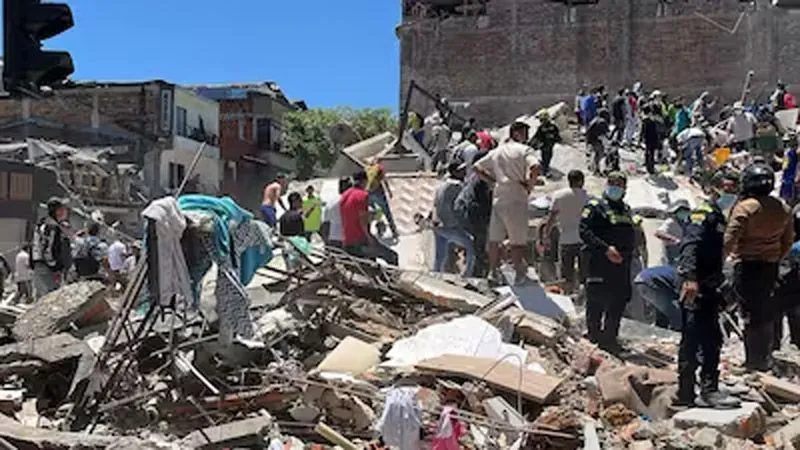
BOGOTA, Aug 11: The death toll from the devastating 7.4 magnitude earthquake that struck Colombia has risen to at least 213, according to a CNN count based on reports from agencies and authorities. According to authorities, the number is likely to be even higher as search and rescue teams continue efforts to find survivors.
Emergency personnel are working on war footing to clear the rubble and debris left in the aftermath of the earthquake, which struck San Jos del Palmar in the mountainous Choc region and sent tremors across western Colombia and into Bogot .
The highest number of deaths has been reported in Cali, where 95 people have died, followed by Pereira with 66. A further 38 deaths have been reported elsewhere in the department of Valle del Cauca, excluding Cali, while nine people were killed in Quibd and five in Manizales.
Cali and Pereira are facing the most critical conditions, with collapsed structures and people reportedly trapped, according to a report by the Colombian Association of Capital Cities. Bogot and Medell n, the country's two largest cities, have not reported serious damage, although authorities continue to carry out checks.
The earthquake struck the remote Choc region, where limited road access could complicate rescue efforts and delay assistance to more than half a million residents.
Pereira and Manizales, around 100km (62 miles) from the epicentre, were also badly affected, with about 5,000 buildings reported to have been impacted.
Colombian President Abelardo de la Espriella, who was inaugurated on Friday, declared a state of national disaster as international leaders pledged support for relief operations.
The scale of the destruction has also renewed questions over Colombia's preparedness for major earthquakes, as it is particularly vulnerable to seismic activity due to its location along the Pacific Ring of Fire and at the convergence of three tectonic plates.
Flover Rodr guez, a geologist and director of the Colombian Association of Energy Geologists and Geophysicists, told El Pa s that authorities need to update the land-use maps underpinning seismic regulations.
"Colombia needs to establish a clear land use policy to protect its people," he said.
The association had already called on the government in late July to improve geological mapping and expressed concern over the lack of a centralised database showing which municipalities had carried out basic geological studies. Such data could help reduce risks from earthquakes, landslides and floods.
John Londo o of the Colombian Geological Service told El Pa s that although earthquake-resistance regulations for new construction had improved, many existing buildings still failed to meet the required standards.
"A huge number of low-income and social housing dwellings don't meet these standards," he said. "This is a huge danger for the most vulnerable people."
Gina Villalobos, a civil engineer and professor of seismology, said construction practices could also undermine otherwise strong engineering standards.
"A lot of the time construction projects don't follow the plans in order to save time or money, and the earthquake resistance rules are broken," she told (UNI)