Army Goodwill Schools: The Real Test Is Not the Number of Schools, but the Lives They Change
Editorial | Inside Kashmir
In Jammu and Kashmir, there are places where a school means much more than four walls, a blackboard and a morning assembly.
In a remote village, a school can be the first window through which a child sees a world beyond the mountains.
This is why the story of the Army Goodwill Schools deserves to be looked at not merely as an institutional initiative, but as an experiment in changing the educational possibilities of children living in some of the most difficult and remote parts of Jammu and Kashmir.
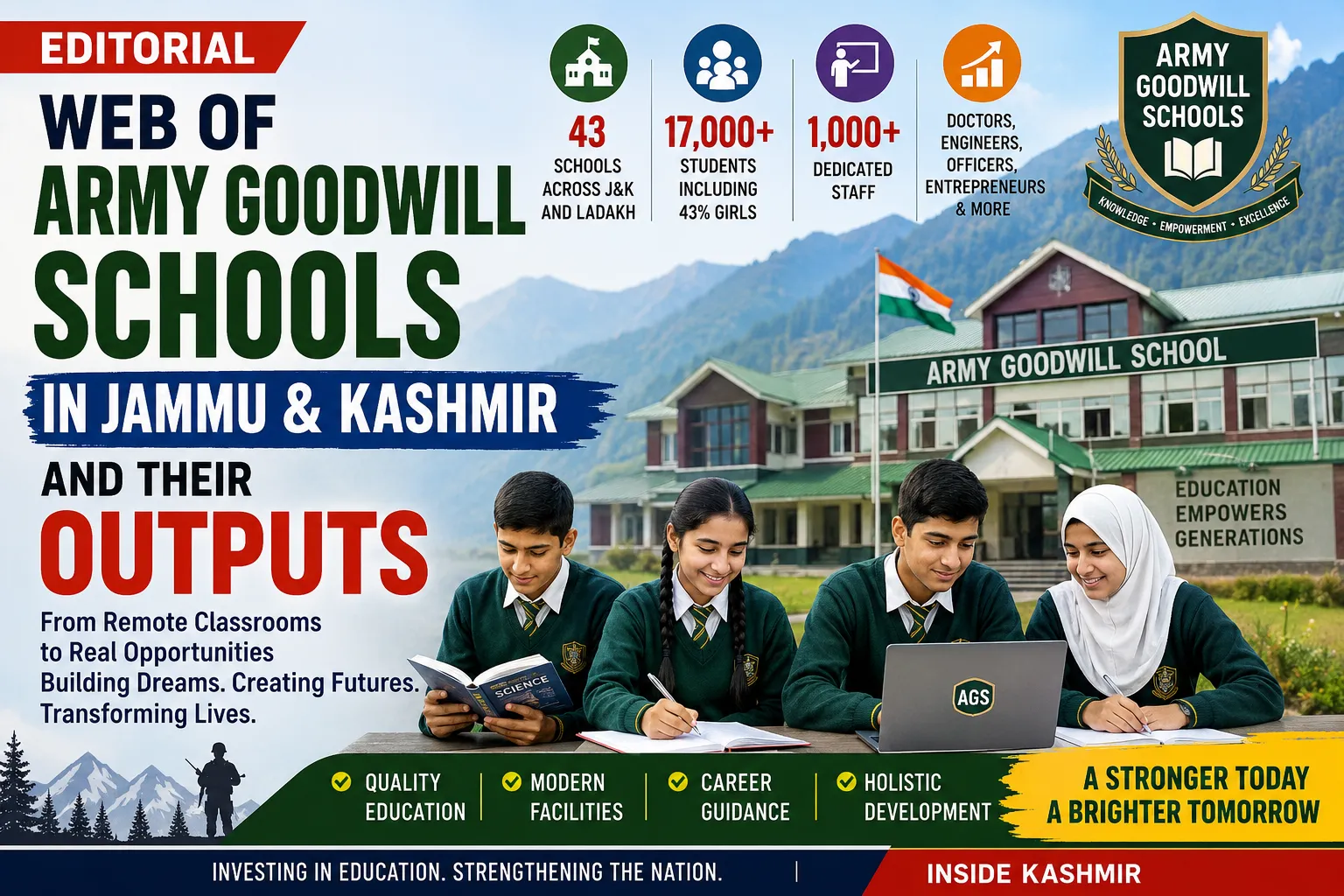
Over more than two decades, the Indian Army, under Operation Sadbhavana, has established 43 Army Goodwill Schools across Jammu, Kashmir and Ladakh. The official AGS network says around 17,000 students, including about 43 per cent girls, are currently studying in these schools, with approximately 1,000 staff members employed across the network.
But these numbers, impressive as they are, do not tell the whole story.
The real question is: what happens to the child after leaving the classroom?
That is where the story becomes more interesting.
The official AGS alumni records include students who have gone on to become doctors, engineers, government officers, advocates, entrepreneurs and professionals. Some have qualified NEET; others have entered engineering and medical institutions, while some have qualified JKAS and other competitive examinations.
Take the example of Army Goodwill School Chandigam in Lolab.
Its documented student achievements include a student selected for IIT Mumbai after qualifying JEE Advanced, students qualifying NEET and pursuing MBBS, a student achieving 100 per cent in the Class 10 board examination, and students securing national-level opportunities and recognition.
These achievements matter because Chountiwari Machil, Hajinard Karnah and Chandigam Lolab is not located in a metropolitan educational hub.
It is Kupwara district remote area of J&K UT.
And that is precisely the point.
A child growing up in a remote area should not have to surrender ambition simply because his or her village is far from a major city.
The same principle can be seen across the AGS network. The official board-result data records strong academic performance across several schools, with many students scoring above 80 per cent.
But education today cannot stop at marks.
The world into which today's children are graduating is changing rapidly.
Artificial intelligence, robotics, digital technology, communication skills, scientific thinking and entrepreneurship are becoming increasingly important. The AGS network says its schools are moving towards smart classrooms, specialised coaching, career counselling, AI and robotics, NEP-aligned learning and teacher training.
This is perhaps one of the most important developments.
A remote child should not receive a remote-quality education.
Geography should not decide the quality of a child's dreams.
Recent exposure programmes show an effort in this direction. In April 2026, 67 students and 17 principals/teachers from 20 Army Goodwill Schools in Kashmir participated in a two-day educational programme at IIT Jammu. Students also visited CSIR-IIIM, giving them exposure to scientific research and institutions that many children in remote areas may otherwise never experience.
Such exposure can change a child's imagination.
A student who has never seen an IIT may think engineering is something that happens somewhere else.
A student who enters a scientific laboratory may suddenly begin asking: Why can't I become a scientist?
That change in thinking is itself an educational outcome.
But success should not make us stop asking questions
An honest editorial must also look beyond achievements.
The purpose of an educational institution cannot be measured only by its toppers.
For every student who qualifies NEET or JEE, there are many others who may struggle academically but possess talent in sports, technology, arts, communication, skilled trades or entrepreneurship.
The next phase of the AGS journey should therefore be about identifying every kind of talent.
A child who cannot become a doctor may become a technician.
A child who does not qualify for IIT may become an excellent entrepreneur.
Another may become a teacher, sportsperson, designer, journalist, farmer, craftsman or public servant.
Education succeeds when it helps a child discover the right direction—not when every child is pushed towards the same definition of success.
The bigger challenge: What happens after school?
This is where the conversation about Goodwill Schools should become bigger.
School education is only the first step.
Students from remote areas need sustained support for higher education, scholarships, competitive examinations, vocational training, internships, career counselling and mentorship.
The AGS alumni network can become especially valuable here. The official network itself describes alumni as a bridge between former students and current learners, including mentorship and guidance.
Imagine a student from a border village being mentored by a former student of the same school who is now a doctor, engineer, civil servant or entrepreneur.
That is more powerful than a motivational lecture.
It is a living example.
It tells the child: “Someone from here has done it. You can do it too.”
The Army Goodwill School story is ultimately about children
It is easy to discuss Goodwill Schools through the language of infrastructure, budgets, enrolment figures and institutional programmes.
But behind every number is a child.
A child travelling through difficult terrain to reach school.
A girl discovering confidence through education.
A student touching a computer for the first time.
A young person from a remote village seeing an IIT campus.
A family watching its child become the first doctor or engineer in the household.
That is where the true impact of education is found.
The Army Goodwill Schools should therefore not be judged simply by how many schools have been opened.
They should be judged by how many children have been given a larger vision of their own future.
And the evidence already emerging from their alumni, examination results, exposure programmes and student achievements suggests that the impact goes considerably beyond the classroom.
But the work is not finished.
The next decade should be about taking this model deeper: better teacher development, stronger career counselling, advanced laboratories, digital and AI education, sports infrastructure, vocational skills, scholarships, university linkages and stronger alumni mentorship.
Because the ultimate measure of goodwill is not what an institution builds.
It is what the next generation becomes because that institution was there.
In the mountains of Jammu and Kashmir, there are thousands of young minds waiting for that opportunity.
The responsibility now is to make sure that distance never becomes destiny.